
Sphex pensylvanicus
Linnaeus, 1763
Great Black Wasp, Great Black Digger Wasp
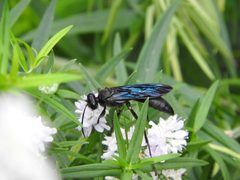
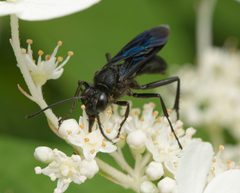
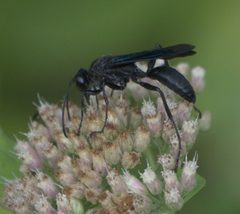
Sphex pensylvanicus is a large, solitary digger wasp native to North America. Females construct underground burrows and provision them with paralyzed orthopteran prey, primarily katydids, for their larvae. feed on nectar from diverse flowering plants and serve as . The exhibits protandry, with males emerging before females in the breeding season. Despite their formidable size and appearance, they are not aggressive toward humans and sting only when handled.
Pronunciation
How to pronounce Sphex pensylvanicus: //sfɛks pɛnˌsɪlˈvɛɪnɪkəs//
These audio files are automatically generated. While they are not always 100% accurate, they are a good starting point.
Identification
Distinguished from similar large black by combination of: entirely black body without colored markings; blue-iridescent smoky wings; large size exceeding 25 mm in females; and ground-nesting with prey. Blue Mud Dauber (Chalybion californicum) is smaller, metallic blue-black, and builds mud nests rather than digging burrows. Great Golden Digger Wasp (Sphex ichneumoneus) has golden thoracic and reddish abdominal segments. Palmodes and Prionyx wasps differ in abdominal shape and facial markings.
Images
Habitat
Open with soft, workable soil for nesting: forest edges, deciduous woodlands, sumac thickets, gardens, fields with scattered trees, and dirt floors of abandoned structures. Requires proximity to flowering plants for nectar feeding and to orthopteran for prey. Often found nesting in where soil conditions permit.
Distribution
Most of the contiguous United States and northern Mexico; range expanded northward to New York, Quebec, and Ontario during late 20th century. Absent from Pacific Northwest and most of Arizona. Western limit reaches southern California.
Seasonality
active in summer months; males emerge before females (protandry). In Iowa study, activity documented from early season through late summer. Larvae likely overwinter in pre-pupal state, pupating the following spring and emerging in summer.
Diet
feed on nectar from flowers including milkweeds (Asclepias syriaca, A. incarnata), mountain mint (Pycnanthemum virginianum), thoroughworts (Eupatorium), buttonbush (Cephalanthus occidentalis), rattlesnake master (Eryngium yuccifolium), white sweet clover (Melilotus albus), goldenrod (Solidago), and wild grape. Larvae consume paralyzed orthopteran insects, primarily katydids of Microcentrum, Amblycorypha, and Scudderia.
Host Associations
- Microcentrum rhombifolium - preyGreater Angle-wing Katydid, primary prey item
- Microcentrum retinerve - preyLesser Angle-wing
- Scudderia furcata - preyFork-tailed Bush Katydid
- Amblycorypha - prey of katydids
- Passer domesticus - kleptoparasiteHouse Sparrow steals paralyzed prey from foraging females
- Dumetella carolinensis - kleptoparasiteGray Catbird steals paralyzed prey
- Paraxenos westwoodi - Strepsipteran causing abdominal deformities
Life Cycle
Female excavates angled burrow 1 inch in diameter and over 1 foot deep in soft soil, creating multiple . Each cell receives 2–6 paralyzed katydids; single (5–6 mm × 1 mm) glued to underside of first prey item between leg pairs. Larva feeds for approximately 10 days, reaching 30–35 mm long by 7–10 mm wide before pre-. Likely overwinters as pre-pupa, pupates following spring, emerges in summer. Single per year.
Behavior
Solitary but females may nest in loose . Female hunts katydids, paralyzing each with three stings (neck once, twice); prey remains alive for weeks. Prey transported by or dragging to nest entrance, dropped while burrow is inspected, then retrieved and pulled -first into . Nest entrance left open during foraging. Males exhibit territorial and may sleep in clusters. Females vulnerable to kleptoparasitism by birds during prey transport; up to one-third of foraging trips may result in prey loss.
Ecological Role
Human Relevance
Generally beneficial: pollinates garden and native plants, controls . Not aggressive; stings rare and occur only when is handled or trapped against skin. Sting reported as painful but not swelling. Historical significance as subject of first insect article by native-born North American naturalist (John Bartram, 1749). May cause concern due to large size and nesting near human structures, but poses minimal actual threat.
Similar Taxa
- Sphex ichneumoneusSimilar size and habits, but distinguished by golden thoracic , red-and-black banded , and yellow wings
- Chalybion californicumBlue Mud Dauber is smaller, metallic blue-black, builds mud nests rather than digging burrows, preys on spiders not katydids
- Palmodes speciesSimilar western digger wasps but differ in abdominal shape and lack blue wing iridescence
- Prionyx speciesSimilar size and black-and-red coloration in some, but have silvery patches on and and different abdominal shape
Misconceptions
Often mistaken for aggressive social due to size and black coloration; actually solitary and non-aggressive. Confused with tarantula hawks (Pepsis) by lay observers. Nesting sometimes interpreted as 'colonies' suggesting social ; females are merely exploiting suitable localized nesting substrate. Large size leads to exaggerated fear disproportionate to actual sting risk.
More Details
Historical significance
First insect subject of scientific writing by native-born North American naturalist; John Bartram's observations presented to Royal Society in 1749, described by Linnaeus in 1763.
Foraging efficiency
Remarkably efficient hunters; one study documented 252 katydids collected by an in five days, averaging nearly 17 katydids per female per day.
Nesting substrate
Shows flexibility in nest site selection, using natural soil, dirt floors of abandoned buildings, and even loose gravel or millings.
Sources and further reading
- BugGuide
- Wikipedia
- GBIF taxonomy match
- iNaturalist taxon
- Catalogue of Life
- Bug Eric: Grape is Blooming
- Bug Eric: Wasp Wednesday: Great Black Wasp
- Bug Eric: Wasp Wednesday: Sphex lucae
- Bug Eric: Wasp Wednesday: Great Golden Digger
- Pixelated Entomology: Analyzing Beetles' Flower Use Through Digital Samples
- Beneficial Beetle Diversity Blooms on Strip-Tilled Farms
- The Life Span of the Great Black Wasp Sphex pensylvanicus Linnaeus, 1763 (Hymenoptera: Sphecidae) and Other Observations from a Nesting Aggregation in Sioux City, Iowa, USA. 2003-2017