
Sphecinae
Latreille, 1802
digger wasps, thread-waisted wasps, grass-carrying wasps
Tribe Guides
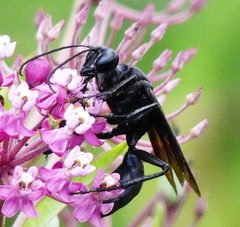
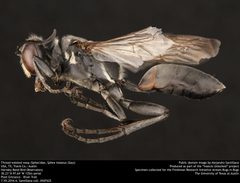
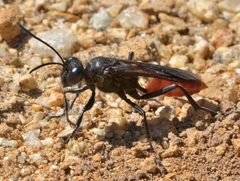
2Sphecinae is a of digger wasps ( Sphecidae) characterized by thread-waisted bodies and solitary nesting . Members construct nests in soil, plant stems, or pre-existing cavities, provisioning with paralyzed prey for their larvae. The subfamily includes notable such as Sphex, Isodontia, and Podalonia, with diverse nesting strategies ranging from burrowing to grass-carrying.
Pronunciation
How to pronounce Sphecinae: /ˈsfɛkɪniː/
These audio files are automatically generated. While they are not always 100% accurate, they are a good starting point.
Images
Habitat
Diverse environments including sandy beaches, grasslands, and areas with reed canes or suitable nesting substrates. Some utilize trap nests or pre-existing cavities in plant stems.
Distribution
distribution with representation across Eastern Palaearctic, Oriental region, Australia, Europe (including in Crimea), and North America (60% of eastern North American sphecine fauna occurs in Michigan).
Host Associations
Life Cycle
Two per year observed in Isodontia nigella; of second generation overwinter with in June-July.
Behavior
Solitary nesting with diverse construction strategies: burrowing in sand, excavating soil, or utilizing pre-existing cavities. Some (Isodontia) exhibit grass-carrying , constructing nests with partitions and closing plugs made of packed grass stalks and blades. Nests typically contain 1-8 with 3-15 prey victims stored per cell. Cell partitions may be absent between subsequent cells in some cases.
Ecological Role
of orthopterans and other insects; serve as for including Melittobia acasta and bombyliid flies.
Human Relevance
Some have established outside native ranges (e.g., Isodontia nigella in Crimea, Isodontia mexicana in Europe).
Sources and further reading
- BugGuide
- Wikipedia
- iNaturalist taxon
- NCBI Taxonomy
- Catalogue of Life
- Distribution and Biology of the Sphecine Wasps of Michigan (Hymenoptera: Sphecidae: Sphecinae)
- The first record of the Far Eastern grass-carrying wasp Isodontia nigella (F. Smith, 1856) (Hymenoptera: Sphecidae: Sphecinae) from the Crimea
- Nesting behaviour ofPodalonia tydei suspiciosa(Smith) (Hymenoptera: Apoidea: Sphecidae; Sphecinae) at Castlecliff Beach, Wanganui, with a description of the mature larva