
Sphex
Linnaeus, 1758
digger wasps
Species Guides
11- Sphex ashmeadi(thread-waisted wasp)
- Sphex dorsalis
- Sphex flavovestitus
- Sphex habenus(Golden-reined Digger Wasp)
- Sphex ichneumoneus(Great Golden Digger Wasp)
- Sphex jamaicensis(Jamaican Digger Wasp)
- Sphex lucae(katydid hunter)
- Sphex nudus(Katydid Wasp)
- Sphex pensylvanicus(Great Black Wasp)
Sphex is a of solitary containing over 130 . Females construct subterranean nests provisioned with paralyzed insects, primarily katydids and other orthopterans, as food for their larvae. The genus is notable for its stereotyped nesting that have been extensively studied in cognitive science and philosophy of mind, particularly the so-called 'Sphex Wasp Experiment' demonstrating rigid behavioral sequences.
Pronunciation
How to pronounce Sphex: /sfɛks/
These audio files are automatically generated. While they are not always 100% accurate, they are a good starting point.
Identification
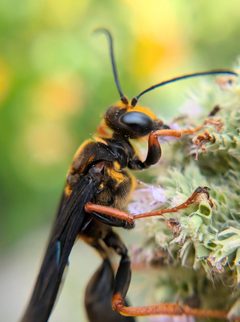
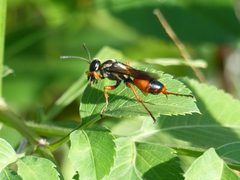
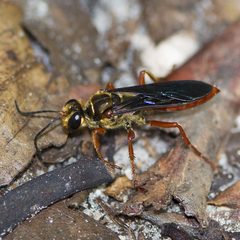
identification requires examination of minute morphological characters including wing venation, facial markings, and body proportions. Females typically have robust bodies adapted for digging, while males are often more slender. Coloration varies widely: Sphex ichneumoneus has golden and a bi-colored ; Sphex lucae females are black with red abdomens and yellowish-violaceous wings, while males are entirely black with violaceous wings. Sphex pensylvanicus is predominantly black with brilliant blue wing reflections. The is distinguished from similar digger wasps by the oval abdomen shape and lack of silvery patches on the and seen in related genera such as Prionyx.
Images
Habitat
Found in diverse terrestrial across most continents. occupy open sandy or loose soil areas suitable for nest excavation, including grasslands, meadows, forest edges, and urban gardens. Nesting sites are typically in well-drained soils with sufficient depth for burrow construction.
Distribution
distribution with on every continent except Antarctica. Sphex ichneumoneus ranges transcontinentally across North America from Canada to Peru and Brazil. Sphex lucae occurs in western North America from southern British Columbia to California, east to Arizona, Colorado, Oklahoma, and Mexico. Australian fauna includes 34 recognized species following recent revision. The is notably absent from some oceanic islands.
Seasonality
are active primarily during warm months. In temperate regions, activity peaks in summer when females construct multiple nests. Sphex ichneumoneus overwinters as developing larvae in nests, with new adults emerging the following season. Multiple per year may occur in warmer climates.
Diet
feed on nectar from flowers. Larvae are exclusively , consuming paralyzed insects provisioned by the female parent. Prey consists primarily of Orthoptera, especially katydids (Tettigoniidae) including Neoconocephalus, Orchelimum, Conocephalus, Scudderia, Amblycorypha, Neduba, Atlanticus, and Insara elegans. Tree crickets (Oecanthus) and leafroller crickets (Gryllacrididae) are also recorded as prey. Some hunt grasshoppers or other insects depending on regional availability.
Life Cycle
Complete with solitary nesting. Each female constructs an individual nest: a vertical or near-vertical burrow in soil terminating in two to seven . The female hunts and paralyzes prey with her sting, transports it to the nest, and deposits it in a cell. A single is laid on the prey. The larva feeds on the paralyzed , pupates within the cell, and overwinters in the nest. emerge the following season. Females may construct up to six nests per season in favorable conditions.
Behavior
Solitary and non-aggressive toward humans. Females exhibit stereotyped nesting sequences: excavate burrow, hunt and paralyze prey, drag prey to nest entrance, inspect nest interior, then retrieve prey and drag it -first into the burrow. This sequence is highly inflexible; experimental displacement of prey triggers repeated inspection without modification. Males perch on flowers and vegetation to watch for females. Some exhibit sleeping : males cluster in sheltered locations at night, and females may aggregate under bark for . Prey is transported by when possible; if antennae are removed, the does not shift to alternative grasping points.
Ecological Role
of orthopteran insects, potentially regulating of katydids and related . Nesting activities contribute to soil aeration. serve as while foraging for nectar. The are for various cleptoparasitic insects.
Human Relevance
Generally beneficial insects that avoid human contact and do not defend colonies aggressively. Occasionally encountered in gardens and urban green spaces where they may be observed at flowers. The is famous in cognitive science and philosophy as the type example of 'sphexishness'—rigid, apparently mindless behavioral routines contrasted with flexible cognition. Daniel Dennett and Douglas Hofstadter used Sphex to argue against attributing complex mental states to simple organisms, though this interpretation has been challenged by researchers noting behavioral plasticity after repeated iterations.
Similar Taxa
- PrionyxSimilar size and coloration, but distinguished by silvery patches on and and more cylindrical
- AmmophilaThread-waisted digger wasps with similar nesting habits, but construct burrows before rather than after procuring prey, and typically provision with caterpillars rather than orthopterans
- PodaloniaFemales resemble small Sphex , but hunt cutworms (soil-dwelling caterpillars) and dig burrows after obtaining prey, the reverse sequence of most Sphecidae
- IsodontiaGrass-carrying wasps that provision nests with orthopterans, but use pre-existing cavities rather than excavated burrows and carry grass fragments to line nests
Misconceptions
The 'Sphex Experiment' has been widely cited as demonstrating purely mechanistic, mindless , but this interpretation oversimplifies findings. Some researchers observed behavioral adaptations after many iterations, and repeated nest inspection following disturbance may represent adaptive caution rather than cognitive rigidity. The term 'sphexishness' implies more behavioral inflexibility than is strictly warranted by experimental evidence.
More Details
Taxonomic history
Historically placed in Sphecidae sensu lato; most former sphecid now classified in Crabronidae, but Sphex remains in Sphecidae sensu stricto ( Sphecinae). Recent revision of Australian fauna increased count from 23 to 34. The genus contains 132 extant species plus three fossil species.
Nesting mechanics
Unlike sand wasps that kick soil backward during excavation, Sphex females gather soil in their front legs under the , back out of the hole, and deposit loads at a short distance. This distinctive aids field identification.
Research significance
Niko Tinbergen studied navigation abilities in Sphex. Richard Dawkins and Jane Brockmann investigated female rivalry over nesting holes in S. ichneumoneus. The continues to serve as a model system for studying behavioral and the evolution of instinctive .