
Prionyx
Vander Linden, 1827
Species Guides
6- Prionyx atratus
- Prionyx canadensis
- Prionyx fervens
- Prionyx foxi
- Prionyx parkeri(Parker's Thread-waisted Wasp)
- Prionyx thomae
Prionyx is a of solitary thread-waisted wasps in the Sphecidae, distributed across the Americas from southern Canada to Argentina. All are of grasshoppers (Acrididae), which they paralyze with venom and provision as food for their larvae in underground burrows. The genus is characterized by a globose , spiny legs with saw-like tarsal claws, and distinctive nesting . Females dig burrows after securing prey, transport paralyzed grasshoppers to single-celled nests, and seal the entrance upon completion. Some species exhibit facultative kleptoparasitism when nesting overlap with other species.
Pronunciation
How to pronounce Prionyx: /ˈpriːət.nɪks/
These audio files are automatically generated. While they are not always 100% accurate, they are a good starting point.
Identification
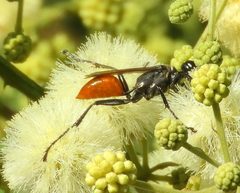
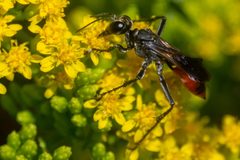
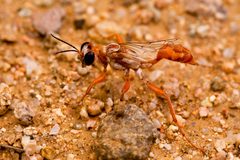
Prionyx are distinguished from similar thread-waisted sphecid by their stocky, globose (nearly spherical) that does not extend beyond the wingtips when at rest, relatively short and heavily spiny legs, and saw-like tarsal claws (the source of the name, from Greek 'prion' = saw and 'onyx' = claw). Two North American species (P. atratus and P. subatratus) are entirely black; remaining species are black with red markings and silvery highlights. Females average 15 mm in body length, males approximately 12 mm. The compact body form and spiny legs separate Prionyx from more elongate genera like Ammophila and Sphex.
Images
Habitat
Open sandy or loose soil areas including shortgrass prairie, coastal margins, dirt roads, arroyos, and degraded grasslands. Nesting sites require sun-exposed ground without dense litter, often in areas with social trails or disturbed soil. Some occupy dry in at least part of their range.
Distribution
Widespread across the Americas: from southern Canada (British Columbia, Saskatchewan) through the United States (entire continental range), Mexico, Central America, and South America to Argentina. Specific records include: southeastern and western U.S. to Argentina (P. thomae); northeastern Brazil (P. pumilio in Paraíba); coastal southeastern Brazil (P. fervens in Rio de Janeiro State).
Seasonality
active primarily during warmer months; in temperate North America, activity spans late spring through summer (May–August). Peak activity coincides with abundance and flowering plants for nectar.
Diet
of grasshoppers (Orthoptera: Acrididae). Recorded prey include Schistocerca, Orphulella, Rhammatocerus, Abracris, Ronderosia, Conozoa, Amphitornus, Aulocara, Arphia, Dissosteira, Encoptolopus, Paraidemona, and Xyphocera. Prey are paralyzed by venomous sting and remain alive but immobile, serving as fresh food for developing larvae.
Life Cycle
Solitary nesting with single-celled underground burrows. Female excavates burrow (curved, linear, or L-shaped, ~13 cm long, 2 cm diameter) after securing prey. Single victim placed in terminal chamber; laid on prey, typically at junction of foreleg with . Nest sealed with excavated soil, surface evidence obliterated. Larval development rapid: egg hatches in ~3 days, larval feeding and development to cocoon spinning in ~4 days (6 days total egg to cocoon under laboratory conditions). Cocoon formed with internal coating of brownish excreted substance. described for P. kirbii matches mature larvae of .
Behavior
Females exhibit distinctive prey handling: grasshoppers temporarily stored on vegetation or ground while nest is constructed, then transported by grasping with and dragging while vibrating wings. Nest excavation involves cutting soil with mandibles, carrying lumps backward, and throwing earth beneath body; closure involves throwing soil backward and compacting with mandibles while vibrating and emitting buzzing sound. Defensive stereotyped movements (alternating body support on legs) and vigilant pauses with rapid movement and visual scanning observed when threatened. Males of some exhibit territoriality. Facultative kleptoparasitism documented: P. kirbii steals grasshoppers from Stizus continuus nests and re-uses holes at multi-specific nesting .
Ecological Role
of grasshoppers (Acrididae); may influence in prairie and coastal . Subject to kleptoparasitism by satellite flies (Miltogramminae: Sarcophagidae) that larviposit on provisioned prey. Serves as for specialized kleptoparasitic including Stizoides renicinctus, which locates sealed burrows, destroys host , and replaces them with its own.
Human Relevance
Non-aggressive; solitary females defend neither nests nor mates, and stings are rare without direct handling. Ecologically beneficial through . No economic importance documented; not a pest .
Similar Taxa
- AmmophilaThread-waisted sphecid with caterpillar prey; distinguished by more slender body, longer legs, and different prey type.
- SphexThread-waisted sphecid with more oval and different prey (katydids in S. lucae); lack saw-like tarsal claws and globose abdomen of Prionyx.
- PalmodesSimilar thread-waisted form but hunts katydids (Tettigoniidae) rather than grasshoppers; distinguished by prey type and subtle morphological differences.
- StizoidesKleptoparasitic that exploit Prionyx nests; similar coloration (black with orange/red bands) but slenderer body and different ecological role.
- SceliphronMud-nesting sphecid wass with spider prey; distinguished by nest material (mud vs. soil), prey type, and body proportions.
Sources and further reading
- BugGuide
- Wikipedia
- GBIF taxonomy match
- iNaturalist taxon
- NCBI Taxonomy
- Catalogue of Life
- Bug Eric: Caught on Video: Prionyx atratus
- Bug Eric: Wasp Wednesday: Prionyx thomae
- Bug Eric: Wasp Wednesday: Sphex lucae
- Bug Eric: White Prairie Clover: An Awesome Blossom
- Bug Eric: Ammophila in Action
- Bug Eric: Wasp Wednesday: Stizoides renicinctus
- Insecta, Hymenoptera, Sphecidae, Prionyx pumilio (Taschenberg, 1869): distribution extension
- Reproductive behaviour and larval development of Prionyx thomae (Fabricius) from Brazil (Hymenoptera: Sphecidae).
- Nesting behaviour and larval biology of Prionyx fervens (Linnaeus) (Hymenoptera, Sphecidae) from Brazil
- A note on facultative kleptoparasitism in <i>Prionyx kirbii</i> (Hymenoptera: Sphecidae) as a consequence of multi-specific shared nesting site, with description of its prepupa