
Stizoides
Guérin-Méneville, 1844
Species Guides
2- Stizoides foxi(Fox's stizoide)
- Stizoides renicinctus
Stizoides is a of kleptoparasitic sand wasps in the Crabronidae, containing approximately 30 described globally. The genus is notable for its unique parasitic strategy: females exploit the food caches of other solitary rather than hunting their own prey. Two species occur in North America—S. renicinctus (widespread in western North America) and S. foxi (restricted to Arizona and Mexico). Most species are found in Africa, Mediterranean Europe, the Middle East, and India.
Pronunciation
How to pronounce Stizoides: //stɪˈzoʊ.aɪ.diːz//
These audio files are automatically generated. While they are not always 100% accurate, they are a good starting point.
Identification
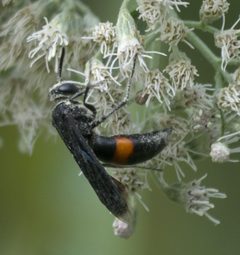
Members of Stizoides can be recognized by their elongate, slender body form and distinctive coloration. S. renicinctus, the best-studied North American , has an all-black body with a red or orange band on the second abdominal segment (tergite), dark wings with translucent wingtips, and a body length of 16–18 mm. Both sexes are nearly identical in appearance. The can be confused with spider wasps (Pompilidae), scoliid wasps (Scoliidae), and even large flies such as Mydas clavatus, which share similar black-and-orange color patterns. Reliable identification requires careful examination of wing venation and other structural features.
Images
Habitat
occur in diverse open including deserts, prairies, and glades. S. renicinctus has been documented in dry arroyos, along rivers, and in suburban areas with blooming trees such as saltcedar (Tamarix). The presence of Stizoides indicates healthy of and their prey.
Distribution
The has a primarily Old World distribution, with most in Africa, Mediterranean Europe, the Middle East, and India. In North America, S. renicinctus ranges from Michigan and Wisconsin south to North Carolina and west to Alberta, British Columbia, California, Arizona, and Mexico. S. foxi is restricted to Arizona and southward into Mexico. Records from eastern North America require careful verification due to confusion with similar-looking .
Seasonality
are active during the warmer months. S. renicinctus has been observed from late spring through summer, with males frequently visiting flowers for nectar. Females are most active when are provisioning nests.
Diet
feed on nectar from flowers. The parasitic larvae feed on the paralyzed prey (grasshoppers or katydids) stored by in their burrows.
Host Associations
- Prionyx - kleptoparasite that hunt grasshoppers (Acrididae)
- Palmodes - kleptoparasite that hunt katydids (Tettigoniidae)
Life Cycle
Behavior
Males frequently visit flowers for nectar and may establish territories around blooming shrubs. Females are primarily engaged in searching for nests. Individuals of S. renicinctus have been observed forming loose "sleeping" on vegetation at night and during approaching storms, sometimes mixed with other solitary .
Ecological Role
As kleptoparasites, Stizoides act as regulators of their wasp . A documented rate of approximately 7.5% on Palmodes laeviventris in Nevada suggests significant impact on host populations. The presence of Stizoides indicates functional connectivity between prey (grasshoppers/katydids), host wasps, and .
Similar Taxa
- Scolia dubiaBlue-winged Wasp shares black body with orange/red markings and similar size; distinguished by blue wing bases and different wing venation
- Anoplius spp.Spider wasps have similar coloration but are more slender with longer legs; they hunt spiders rather than being kleptoparasites
- Mydas clavatusLarge fly mimics appearance with black body and orange markings; distinguished by single pair of wings and fly-like structure
Misconceptions
Many reported sightings of Stizoides in eastern North America are misidentifications of more common such as Scolia dubia or spider wasps. The is genuinely rare in the eastern United States and has been verified primarily from states west of the Mississippi River. Comments from Florida, New York, New England, and the Mid-Atlantic often refer to other species.