
Scolia dubia
Say, 1837
Blue-winged Scoliid Wasp, Two-spotted Scoliid Wasp, Blue-winged Digger Wasp
Species Guides
2- Scolia dubia dubia(Blue-winged Wasp)
- Scolia dubia haematodes(Blood-tailed Scoliid Wasp)
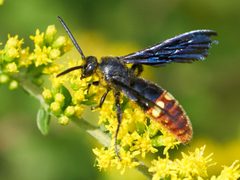
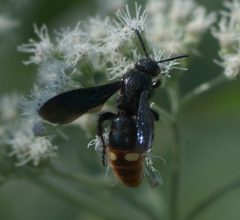
Scolia dubia is a medium-sized scoliid , 20–25 mm in length, with striking iridescent blue-black wings and a black-and-red body marked by two yellow spots on the . The ranges across eastern and central North America, from New England to Florida and west to California. It is a of scarab beetle , particularly the green June beetle (Cotinis nitida), and has been observed attacking Japanese beetle (Popillia japonica) larvae. are nectar feeders, frequently visiting flowers of the mint and aster .

Pronunciation
How to pronounce Scolia dubia: /ˈskoː.li.a ˈduː.bi.a/
These audio files are automatically generated. While they are not always 100% accurate, they are a good starting point.
Identification
Distinguished from and similar scoliids by the combination of two yellow abdominal spots (nominate ), blue-iridescent wings, and two submarginal in the forewing. The subspecies S. dubia haematodes lacks yellow spots and resembles Triscolia ardens, but differs in having two rather than three forewing submarginal cells. Scolia nobilitata, a sympatric congener, has four yellow spots on the and smoky brown rather than blue wings.
Images
Habitat
Open including lawns, gardens, meadows, and other areas with exposed soil suitable for burrowing. Presence strongly associated with turfgrass and landscape beds supporting of scarab beetle . frequently observed nectaring at flowering plants in late summer.
Distribution
Eastern and central United States, ranging from New England south to Florida and west to California. Southern limit extends to Coahuila, Mexico.
Seasonality
active from July through September or October. Mating observed from mid-August to early September in Virginia.
Diet
feed on nectar from flowers, particularly members of Lamiaceae (mints including mountain mint, spotted horse mint) and Asteraceae (goldenrods). Larvae are , feeding on scarab beetle .
Host Associations
- Cotinis nitida - green June beetle; primary
- Popillia japonica - Japanese beetle; secondary , suggested by some research
- Exomala orientalis - Oriental beetle
- Maladera castanea - Asiatic garden beetle
Life Cycle
Females locate scarab beneath the soil surface, burrow down, sting the grub to paralyze it, and deposit an on the 's body. The larva hatches and consumes the living grub, completing development during summer and autumn. The mature larva spins a silken cocoon, pupates, and overwinters within the host's burrow. emerge the following August.
Behavior
Females exhibit solitary hunting , excavating soil to locate and parasitize subterranean . of both sexes engage in nectar-foraging at flowers. Males participate in large aerial mating , flying in tight patterns approximately one foot above ground. When hunting, adults may fly in figure-eight patterns over turf to locate grub-infested areas. Non-aggressive toward humans; does not defend nests.
Ecological Role
Important agent of pestiferous scarab beetles, including that damage turfgrass roots and ornamental plant foliage. Functions as a in larval stage and as .
Human Relevance
Beneficial insect for garden and turf management, providing natural suppression of white without chemical intervention. Can be encouraged by planting nectar sources such as mountain mint, spotted horse mint, and goldenrod. Non-aggressive; poses minimal sting risk.
Similar Taxa
- Scolia nobilitataFour yellow spots on versus two in S. dubia; smoky brown wings versus blue-iridescent.
- Triscolia ardensSimilar coloration to S. d. haematodes, but possesses three forewing submarginal versus two in S. dubia.
More Details
Subspecies
Two recognized : S. dubia dubia (nominate, with yellow spots) and S. dubia haematodes (lacks yellow spots, described by Burmeister, 1854).