
Anomala orientalis
(Waterhouse, 1875)
Oriental beetle, OB
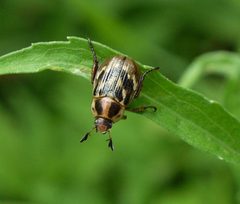
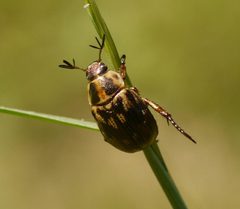
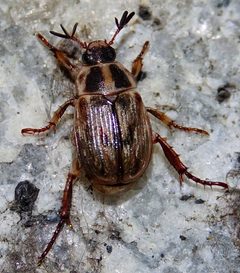
A small scarab beetle native to eastern Asia, now established as an pest in the northeastern United States. are 7–11 mm long with mottled metallic brown and black , often confused with the larger Japanese beetle. The is notable for its subterranean lifestyle—larvae feed on plant roots while adults emerge briefly to feed on flowers and foliage. Sexual communication relies on a specific blend that has been chemically characterized and exploited for monitoring and control. Heavy can damage turfgrass, ornamental plantings, and agricultural crops including sugarcane, maize, and pineapple.
Pronunciation
How to pronounce Anomala orientalis: /əˈnoʊ.mə.lə ˌɔː.riˈɛn.tə.lɪs/
These audio files are automatically generated. While they are not always 100% accurate, they are a good starting point.
Identification
Distinguished from the Japanese beetle (Popillia japonica) by smaller size, duller metallic coloration without green or coppery iridescence, and less robust body form. Larvae are distinguished from other white by the parallel-line raster pattern. are active nocturnally, unlike which are primarily , and are attracted to light.
Images
Habitat
occur on flowers and low vegetation. Larvae inhabit soil in turfgrass, agricultural fields, and garden beds, burrowing 8–17 inches deep depending on temperature. Soil-dwelling habit restricts natural ; spread occurs primarily through human-mediated transport of infested nursery stock and plant material.
Distribution
Native to Japan, Korea, Taiwan, Philippines, and eastern China (Heilongjiang, Jilin, Liaoning, Russian Far East). Introduced to Hawaii by 1908, then to the continental United States (first detected in Connecticut before 1920). Currently established in 12+ eastern states from Maine to North Carolina and west to Ohio, with scattered records in the Midwest.
Seasonality
emerge in the first half of June and remain active through mid-August, with peak mating activity from mid-June to mid-August—a relatively short 2-month window. Larvae are present in soil year-round, moving deeper in winter.
Diet
Larvae feed on roots of grasses, and plants, and agricultural crops including sugarcane, maize, pineapple, and various vegetable crops. feed on petals and leaves of flowers including Shasta daisies, coneflowers, sunflowers, bushes, and roses.
Life Cycle
Complete . are deposited 1–11 inches below the soil surface. Larvae develop through three instars, feeding on roots and moving horizontally up to 4 feet. occurs in spring; emerge from turf in early June. densities can reach 60 per square foot in heavy .
Behavior
feeding on above-ground plant parts. Females emit a (primarily 7-(Z)-tetradecen-2-one in 7:1 ratio with the E-isomer) while in a characteristic '-stand' position—head in soil, elevated. Males detect from a distance, exhibiting -waving, leg-waving, and activation before locating the source. Males exhibit post-copulatory mate guarding, holding the female's abdomen for up to 2 hours to prevent rival mating. Females feed on flowers to increase , with nutrient intake correlating to additional production (~5.5 more fertile eggs).
Ecological Role
Larval root-feeding can significantly alter soil structure and plant composition in infested areas. serve as minor while feeding on flowers, though their damage to floral structures often outweighs this benefit. Serves as prey for various and , though natural enemy communities in introduced range are less developed than in native range.
Human Relevance
Major pest of turfgrass, ornamentals, and agricultural crops. Management focuses on control in soil using neonicotinoids (with documented risks to ), chlorantraniliprole (lower ), (Heterorhabditis spp. most effective), and -based or attract-and-kill strategies. Hand removal of is effective for small . Spread facilitated by nursery trade; and inspection of plant material recommended.
Similar Taxa
- Popillia japonica (Japanese beetle)Larger (10–15 mm), more robust, with distinctive metallic green and coloration; activity pattern contrasts with .
- Maladera castanea (Asiatic garden beetle)Similar size and habit, but uniformly chestnut-brown without mottled pattern; often found together but distinguished by coloration and slightly different seasonal .
- Cotinis nitida (Green June beetle)Much larger (25–30 mm), bright metallic green, with distinctive -like pattern; larvae are also larger and move on their backs using bristles.
Sources and further reading
- BugGuide
- Wikipedia
- GBIF taxonomy match
- NCBI Taxonomy
- Archive — Bug of the Week
- Blossom busters: Oriental beetle, Anomala orientalis — Bug of the Week
- Blossom buster: Oriental beetle, Anomala orientalis — Bug of the Week
- Chafer madness: Oriental beetle, Anomala orientalis, and Asiatic garden beetle, Maladera castanea — Bug of the Week
- Alternative host-searching strategy in Ghilaromma orientalis
- Lawn zoomers: Green June Beetle, Cotinus nitida — Bug of the Week
- Anomala orientalis . [Distribution map].
- The oriental beetle, Anomala orientalis (Waterhouse) (Insecta: Coleoptera: Scarabaeidae)
- Effects of delayed mating on reproductive output of female oriental beetle Anomala orientalis (Coleoptera: Scarabaeidae)
- Evaluating the behavior of oriental beetle (Anomala orientalis) in proximity to pheromone point sources used in mating disruption and attract-&-kill
- Known Distribution and Abundance of Anomala Orientalis Waterhouse, Aserica Castanea Arrow, and Serica Similis Lewis in New York1
- Recent Observations on Distribution And Abundance of Anomala Orientalis Waterhouse and Aserica Castanea Arrow in New York
- Present Distribution of the Japanese Beetle (Popillia Japonica Newm.) and the Asiatic Beetles (Aserica Castanea Arrow, Anomala Orientalis) in the United States