
Anomala
Samouelle, 1819
Pale and Green Leaf Chafers, Shining Leaf Chafers
Species Guides
29- Anomala antennata
- Anomala arida
- Anomala binotata (Gyllenhal, 1817)(Shining leaf chafer)
- Anomala carlsoni
- Anomala castaniceps
- Anomala cavifrons
- Anomala delicata(shining leaf chafer)
- Anomala diabla
- Anomala digressa(shining leaf chafer)
Anomala is a large of scarab beetles containing at least 1,200 described , commonly known as shining leaf chafers or pale and green leaf . Members are recognized by their metallic or iridescent coloration and compact, oval body shape. The genus includes significant agricultural pests, most notably the (Anomala orientalis), which was introduced to North America before 1920 and has become established from Maine to the Carolinas and westward. Larvae of many species are root-feeding white that damage turfgrass and ornamental plants.
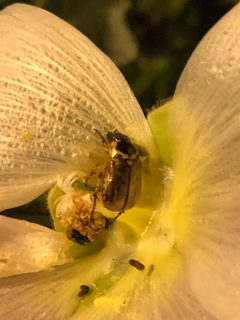

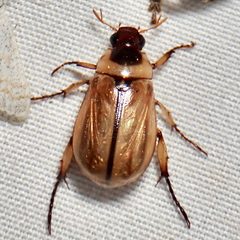
Pronunciation
How to pronounce Anomala: /əˈnoʊ.mə.lə/
These audio files are automatically generated. While they are not always 100% accurate, they are a good starting point.
Identification
Anomala beetles typically exhibit metallic green, bronze, or coppery coloration with a smooth, shiny . The body is compact and oval, with (plate-like) characteristic of scarab beetles. within the are distinguished by subtle differences in color pattern, body proportions, and male genitalia. The (A. orientalis) can be recognized by its variable pattern of black markings on a tan to brown background, often with two distinct dark spots on the pronotum.
Images
Habitat
vary by but commonly include grasslands, agricultural fields, lawns, gardens, and open woodlands. Many species are associated with sandy or well-drained soils suitable for larval development. The thrives in irrigated turf and ornamental landscapes across its introduced range.
Distribution
The has a broad distribution with native in Asia, Europe, Africa, and the Americas. The (A. orientalis), native to Asia, is established in the eastern United States from Maine south to the Carolinas and west to the Mississippi River region. Other species have more restricted native ranges.
Seasonality
activity varies by and latitude. In temperate regions, adults typically emerge in late spring to early summer (June-July in the northeastern United States) and remain active through summer. Larvae overwinter in soil and complete development the following spring.
Diet
feed on leaves, flowers, and petals of a wide variety of herbaceous and woody plants, including coneflowers, daisies, sunflowers, and bushes. Larvae (white ) feed on roots of grasses and other plants, including turfgrass, corn, and ornamental perennials.
Life Cycle
Complete with four stages: , larva (white ), pupa, and . Females deposit eggs in soil during summer. Larvae feed on roots through late summer and autumn, then overwinter in soil. Development completes in spring, with occurring in soil . Adults emerge and feed on above-ground plant parts before mating and egg-laying.
Behavior
are primarily and often go unnoticed during daytime inspections, becoming active at night to feed on plants. They are attracted to light. Larvae remain in soil, feeding on roots. When disturbed, adults may drop from plants and feign death.
Ecological Role
Larvae function as soil-dwelling herbivores that process plant root material, contributing to nutrient cycling but also damaging vegetation. serve as foliar herbivores. Both life stages provide food for vertebrate and including birds, moles, skunks, and parasitic .
Human Relevance
Several are significant agricultural and horticultural pests. The and related species damage turfgrass through root-feeding larvae and defoliate ornamental plants as . Management relies on , using , and manual removal. Neonicotinoid insecticides used for control have been shown to pose risks to when applied to flowering turf.
Similar Taxa
- Maladera (Asiatic garden beetles)Similar size, shape, and feeding habits on ornamental plants; distinguished by more uniform brown coloration and different pattern of setae on the
- Popillia (Japanese beetles)Overlapping pest status and white larvae; distinguished by more robust body, distinct green and coloration, and presence of white tufts of setae along the sides
- Cotinis (Green June beetles)Similar metallic green coloration and scarab ; distinguished by larger size, more elongated body, and different larval (crawls on back rather than C-shaped posture)
More Details
Taxonomic Scale
With over 1,200 described , Anomala represents one of the most species-rich within Scarabaeidae. The genus has undergone extensive taxonomic revision, and species identification often requires examination of male genitalia.
Invasion History
Anomala orientalis was first detected in Connecticut before 1920 and has since expanded its range across the eastern United States. Its successful establishment reflects to temperate climates and availability of suitable plants in managed landscapes.
Grub Management
White fluctuate with soil moisture; abundant rainfall during -laying periods favors survival, while summer drought reduces larval success. This environmental sensitivity makes population prediction difficult from year to year.
Sources and further reading
- BugGuide
- Wikipedia
- iNaturalist taxon
- NCBI Taxonomy
- Catalogue of Life
- Blossom busters: Oriental beetle, Anomala orientalis — Bug of the Week
- Blossom buster: Oriental beetle, Anomala orientalis — Bug of the Week
- Chafer madness: Oriental beetle, Anomala orientalis, and Asiatic garden beetle, Maladera castanea — Bug of the Week
- Archive — Bug of the Week
- Ascalaphidae | Beetles In The Bush
- August | 2022 | Beetles In The Bush