
Maladera
Mulsant, 1871
Species Guides
2- Maladera formosae(Asiatic garden beetle)
- Maladera japonica(Birodo Beetle)
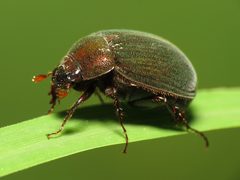
Maladera is a large of scarab beetles in the Scarabaeidae, Melolonthinae, tribe Sericini. The genus contains over 200 , with exceptional diversity in China where 224 valid species have been recorded. Several species are significant agricultural pests, including (Asiatic garden beetle) and Maladera formosae, which have been introduced to North America where they damage ornamental plants, vegetables, and turfgrass. The genus has a primarily Palaearctic distribution with extensions into eastern Asia.

Pronunciation
How to pronounce Maladera: //mæləˈdɛrə//
These audio files are automatically generated. While they are not always 100% accurate, they are a good starting point.
Images
Distribution
Primarily Palaearctic; exceptionally diverse in China with 224 recorded . Several species introduced to North America: established from Canada to Florida and west to the Mississippi River; Maladera formosae present in commercial agricultural systems. Maladera holosericea recorded from Europe through Siberia (to Lake Baikal), Kazakhstan, Kyrgyzstan, Uzbekistan, Korea, and China, with recent detection in Belarus.
Human Relevance
Several are economically important pests. (Asiatic garden beetle), introduced to North America before 1921, damages over 100 species of ornamental plants and vegetables including corn; larvae (white ) feed on roots of turfgrass and herbaceous plants, with densities reaching 100 per square foot in heavy . Maladera formosae infests commercial mint and corn-soybean systems. Maladera holosericea is an emerging pest of sugar beet in Belarus, requiring intervention.
Similar Taxa
- AnomalaBoth contain small to medium-sized scarab beetles with similar body plans and include known as 'Oriental beetle' or 'garden '; feed on leaves and flowers while larvae are root-feeding white . Anomala orientalis and are frequently discussed together as turf and ornamental pests in North America.
- PopilliaShares scarab beetle and white larval ; Popillia japonica (Japanese beetle) and (Asiatic garden beetle) are co-occurring pests with similar damage patterns on ornamental plants and turf, though cause characteristic skeletonization while remove larger tissue sections.
More Details
Taxonomic complexity
The Maladera has undergone extensive taxonomic revision. A 2021 monograph of Chinese established 152 new species, 9 new combinations, and 17 new synonyms, with subgenera including Omaladera. Previous generic assignments (Autoserica, Serica, Cephaloserica, Coronoserica) have been synonymized or transferred.
Invasive history
was first detected in New Jersey in 1921, following the earlier arrival of in 1916. The is strongly attracted to light, a that facilitates detection but also leads to nuisance encounters with humans. Spread has been facilitated by favorable soil moisture conditions that improve and larval survival.
Sources and further reading
- BugGuide
- GBIF taxonomy match
- iNaturalist taxon
- NCBI Taxonomy
- Catalogue of Life
- Beetles that go bump in the night: Asiatic Garden Beetles, Maladera Castanea — Bug of the Week
- Chafer madness: Oriental beetle, Anomala orientalis, and Asiatic garden beetle, Maladera castanea — Bug of the Week
- Midnight marauders: Asiatic garden beetles, Maladera castanea — Bug of the Week
- Maladera castanea Archives - Entomology Today
- Blossom busters: Oriental beetle, Anomala orientalis — Bug of the Week
- Blossom buster: Oriental beetle, Anomala orientalis — Bug of the Week
- Maladera castanea . [Distribution map].
- Хрущик шелковистый (Maladera holosericae Scop.) в посевах сахарной свеклы
- A monograph of the genus Maladera Mulsant & Rey, 1871 of China (Coleoptera: Scarabaeidae: Melolonthinae: Sericini)
- Ecology, Behavior, and Biocontrol Studies on the Scarab Beetle, Maladera castanea (Coleoptera: Scarabaeidae) Infesting Strawberry Plants in Egypt
- Biocontrol potential of naturally occurring entomopathogens against Maladera formosae in corn-soybean rotated systems.
- Evaluating sampling techniques for quantifying Asiatic garden beetle (Maladera formosae) (Coleoptera: Scarabaeidae) infestations in commercial mint.