
Maladera formosae
(Brenske, 1898)
Asiatic garden beetle
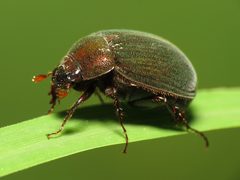
Maladera formosae, the , is an scarab beetle native to East Asia that was introduced to North America in 1921. It has become a significant agricultural pest, particularly in the Great Lakes region where it damages field corn, soybeans, and commercial mint. The exhibits a with soil-dwelling larvae that feed on plant roots and that consume foliage and flowers. Both life stages cause economically important damage, with larvae responsible for early-season crop losses and adults defoliating ornamental and crop plants.

Pronunciation
How to pronounce Maladera formosae: /mæləˈdɛɹə fɔɹˈmoʊsi/
These audio files are automatically generated. While they are not always 100% accurate, they are a good starting point.
Identification
can be distinguished from similar scarab beetles by the combination of: concealed ; 10-segmented ; flat rear tibia with spurs separated by tarsal ; and elongated male genitalia with large movable apical hooks. The reddish-brown iridescent coloration and sturdy body form are supportive but not diagnostic alone. Larvae are distinguished from other white by prominent maxillary stipes, aggressive defensive , and the chevron-shaped raster pattern under Y-shaped anal slits. The is frequently mistaken for (Popillia japonica), (Anomala orientalis), and other sericine .
Images
Habitat
Native range include various terrestrial environments in East Asia. In the range, larvae inhabit agricultural soils, particularly moist, sandy, irrigated substrates in corn-soybean , commercial mint fields, turfgrass, and ornamental plantings. occur on plants above ground. Females preferentially oviposit in moist, cool, shaded soils with loose texture, often beneath plant or in weedy turf patches. Sandy soils derived from glacial deposits in the Great Lakes region support particularly high .
Distribution
Native to East Asia: Taiwan (type locality), China, Japan, North Korea, South Korea, and eastern Russia. Introduced to North America: first detected in New Jersey in 1921. Established throughout the eastern United States from Maine to Florida and west to the Mississippi River, with records in at least 24 states. Documented in Canada in Quebec (1996) and Nova Scotia (2003). Significant agricultural pest in the Great Lakes region (Ohio, Michigan, Indiana) since the mid-2000s.
Seasonality
are active from late June through October, with peak activity in July and August. are laid in July and August, hatching within 10 days with most larvae emerging by mid-July. Larvae actively feed from late July through October, overwinter in soil below the frost line (15-30 cm), resume feeding in April through mid-June, and pupate in June or July. Adult lifespan ranges from several weeks to approximately 100 days under favorable conditions.
Diet
feed nocturnally on foliage and flowers of over 100 plant , with documented preference for aster, chrysanthemum, dahlia, goldenrod, rose, strawflower, sunflower, and zinnia. Field studies indicate preference for basil over multiple vegetable and tree species. Adults feed sparingly on grass blades. Larvae feed on plant roots and decaying plant material, causing significant damage to roots of corn, soybean, sweet potato, mint, turfgrass, and ornamental plants. Larval feeding progresses from young roots to tertiary, secondary, and primary roots.
Host Associations
- Zea mays - larval field corn; significant early-season pest in Great Lakes region
- Glycine max - larval soybean; crop sustains
- Mentha × spicata - larval spearmint; major pest in Indiana commercial production
- Mentha × piperita - larval peppermint; major pest in Indiana commercial production
- Ipomoea batatas - larval sweet potato
- Ocimum basilicum - preferred preferred over multiple other in field trials
- Various ornamental Asteraceae - including sunflower, aster, chrysanthemum, dahlia, zinnia
- Rosa spp. - roses
- Turfgrasses - larval cool-season grasses particularly damaged
- Heterorhabditis bacteriophora - natural enemy ; causes mortality in larvae
- Steinernema carpocapsae - natural enemy ; causes mortality in larvae
- Steinernema scarabaei - natural enemyhigh for this
- Pristionchus sp. - natural enemyfree-living associated with infected
Life Cycle
with one per year, though multiple generations may occur in sufficiently warm, moist environments. Complete proceeds through , three larval instars, pupa, and . Females lay 3-15 egg clusters of up to 20 eggs each, averaging approximately 60 eggs total (maximum observed: 178 eggs), 1-10 cm below the soil surface in July-August. Eggs hatch within 10 days. First-instar larvae feed in shallow soil (up to 13 cm) on young roots and decaying material. Second and third instars achieved through molting as feeding continues. Third instar reached by September-October. Larvae overwinter below frost line (15-30 cm). Approximately 25% of larvae are slow to mature and may overwinter as second instars; first-instar larvae typically do not survive winter. Spring feeding resumes at shallower depths (≤13 cm). occurs in June-July after approximately 10 months of larval development; prepupal stage lasts 4 days, pupal stage 10 days. Adults emerge in July, remaining in pupal skin several days for hardening. Adult lifespan up to 100 days but typically shorter.
Behavior
are strictly , feeding at night and hiding in soil or vegetation during daylight. Strongly attracted to artificial light sources, frequently colliding with illuminated windows. Adults are poor swimmers and can be drowned in soapy water. Larvae exhibit rapid burrowing , entering soil within 15 minutes when exposed on the surface. Larvae display aggressive defensive behavior when handled. Both adults and larvae exhibit aggregated spatial distributions in field conditions. Adults disperse between feeding sites and oviposition locations, with activity determining subsequent larval distribution.
Ecological Role
As an , M. formosae functions primarily as an herbivorous pest in agricultural and horticultural . Larval root feeding reduces plant vigor, causes stunting and wilting, and can kill plants at high densities. foliar feeding defoliates plants and reduces reproductive output of flowering . The species serves as a for and fungi, contributing to soil dynamics. In its native range, ecological relationships are poorly documented but likely include similar herbivory and patterns.
Human Relevance
Major agricultural pest causing significant economic losses. Estimated $325 per acre damage to corn growers in Ohio, Michigan, and Indiana. Larval feeding in corn causes seedling stunting, wilting, discoloration, and plant death leading to stand loss. feeding damages ornamental plantings and reduces aesthetic value of gardens and landscapes. Management is complicated by adult activity, subterranean larval , and ineffectiveness of standard white . Limited chemical control options available due to regulatory restrictions and resistance concerns. using is under development. Sampling challenges necessitate specialized techniques (golf hole cup cutters) for assessment. -based monitoring is used for detection and management timing.
Similar Taxa
- Popillia japonicaJapanese beetle; similar size, scarab pest, overlapping range and plants. Distinguished by metallic green- coloration, distinct white tufts along sides, and skeletonizing feeding damage (M. formosae consumes entire leaf sections).
- Anomala orientalisOriental beetle; similar size, scarab pest, overlapping range and habits. Distinguished by variable coloration including black and mottled patterns, and different raster pattern on larvae.
- Phyllophaga spp.May/June beetles; similar white larvae and scarab form. Distinguished by larger adult size, different seasonal (earlier spring ), and different raster patterns on larvae.
- Cyclocephala spp.Masked chafers; similar white larvae and turfgrass damage. Distinguished by different coloration (often tan or brown with distinctive markings) and different larval raster patterns.
Misconceptions
Damage caused by M. formosae is frequently misattributed to other pests due to feeding and subterranean larval activity. The was formerly known as , and older literature may use this synonym. Some sources incorrectly state the species is more damaging than other white in all contexts; current evidence supports this assessment specifically for field corn in the Great Lakes region, not universally.
More Details
Invasion History
First detected in New Jersey in 1921, approximately five years after Japanese beetle introduction. Initial spread was rapid along the East Coast, reaching 10 states and Washington D.C. by 1933. remained relatively stable for decades before emerging as a significant field crop pest in the Great Lakes region in the mid-2000s, with first reports of corn damage in 2007.
Management Challenges
Standard white management practices are often ineffective. Seed-applied and soil-applied neonicotinoids commonly used for other scarabs fail to control M. formosae in field crops. Carbaryl and trichlorfon remain viable chemical options for turfgrass but are restricted in many agricultural settings. show promise but and strain selection is critical; Heterorhabditis bacteriophora and Steinernema scarabaei demonstrate higher efficacy than Steinernema carpocapsae.
Sex Determination Methods
Reliable sexing requires microscopic examination. Male pinch the edges of abdominal sternites; female pygidia do not. Front tibia size is unreliable for individual specimens due to size variation and lack of reference databases.
Sampling Recommendations
Golf hole cup cutters (10.8 cm diameter) are more sensitive than standard turf cup cutters or excavation for quantifying larval . Wire-mesh stations are less effective. Aggregated spatial distribution necessitates higher numbers for reliable population estimates.
Sources and further reading
- BugGuide
- Wikipedia
- GBIF taxonomy match
- iNaturalist taxon
- NCBI Taxonomy
- How One Entomologist is Exploring Insect Pests in Midwestern Agroecosystems
- Maladera formosae Archives - Entomology Today
- Beetles that go bump in the night: Asiatic Garden Beetles, Maladera Castanea — Bug of the Week
- Chafer madness: Oriental beetle, Anomala orientalis, and Asiatic garden beetle, Maladera castanea — Bug of the Week
- Midnight marauders: Asiatic garden beetles, Maladera castanea — Bug of the Week
- Blossom busters: Oriental beetle, Anomala orientalis — Bug of the Week
- Biocontrol potential of naturally occurring entomopathogens against Maladera formosae in corn-soybean rotated systems.
- Evaluating sampling techniques for quantifying Asiatic garden beetle (Maladera formosae) (Coleoptera: Scarabaeidae) infestations in commercial mint.