
Sericini
Kirby, 1837
Genus Guides
3- Maladera
- Nipponoserica(May beetles)
- Serica
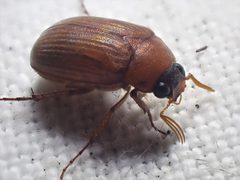
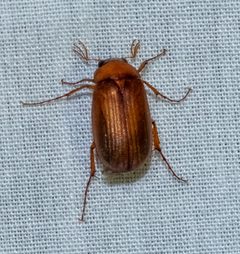
Sericini is a megadiverse tribe of scarab beetles (Scarabaeidae: Sericinae) containing over 3,000 described . Members are distinguished by specialized mouthpart , specifically a three-jointed and asymmetric . The tribe exhibits extensive diversification across tropical and subtropical regions of Asia, with particularly high in the Himalayan region, Indochina, and the Indian subcontinent. Many species show strong geographic and seasonal activity patterns tied to monsoon cycles.

Pronunciation
How to pronounce Sericini: /sɛ.rɪˈkiː.niː/
These audio files are automatically generated. While they are not always 100% accurate, they are a good starting point.
Identification
Members of Sericini can be identified by their distinctive mouthpart structure: a three-jointed and asymmetric . These characters serve as key diagnostic features distinguishing the tribe from other scarabaeid groups. -level identification typically requires examination of male genitalia; female genitalia also show high taxonomic utility, particularly sclerotized structures in the ductus bursae. Asymmetric genitalia are widespread in the tribe, with asymmetry affecting the bursa copulatrix and/or ductus bursae in most examined species.
Images
Distribution
Sericini has a predominantly Palearctic and Oriental distribution, with major centers of diversity in the Himalayan region (including Nepal), Indochina (Thailand, Laos, Vietnam, Cambodia, Myanmar), mainland China, the Indian subcontinent (including Sri Lanka), and Taiwan. Some lineages extend into the Afrotropical region. The tribe includes fossil from the Cretaceous (Cretoserica, Lithanomala, Mioserica) indicating ancient evolutionary history.
Seasonality
activity in many Sericini is strongly tied to monsoon seasonality. In the Himalayan Calloserica, adult and mating occur specifically during the monsoon season, a trait considered a major factor driving diversification and geographic restriction in this group.
Human Relevance
Some Sericini are associated with agricultural . Surveys in groundnut (Arachis hypogaea) cultivations in South India have documented Sericini diversity in these agroecosystems, though specific pest status is not clearly established in the available sources.
Similar Taxa
- MelolonthiniAnother tribe in Melolonthinae; distinguished from Sericini by mouthpart —Sericini possess the diagnostic three-jointed and asymmetric not found in Melolonthini
- RhinotraginiTribe within Scarabaeidae; Sericini separated by the characteristic asymmetric and three-jointed structure
More Details
Taxonomic significance of genital asymmetry
Female genitalia in Sericini show widespread asymmetry affecting both sclerotized and membranous structures, with asymmetry of the bursa copulatrix and ductus bursae being most common. This asymmetry is phylogenetically conserved and linked to corresponding asymmetry in male copulation organs, with hypothesized as the primary evolutionary driver.
Endemic radiations
The tribe contains notable groups, such as the Maladera fistulosa group in Sri Lanka, characterized by entirely reduced or parameres. The Himalayan Calloserica represents another endemic radiation with highly restricted distribution and strong geographic isolation between species.
Sources and further reading
- BugGuide
- Wikipedia
- GBIF taxonomy match
- iNaturalist taxon
- Catalogue of Life
- How an International Education Program Fosters a Young Student's Interest in Entomology
- New species of Sericini from Sri Lanka (Coleoptera, Scarabaeidae)
- The Sericini (Coleoptera: Scarabaeidae: Sericinae) from the Nanling Mountains, China
- New species of Sericini from Sri Lanka (Coleoptera, Scarabaeidae). Part II
- A monograph on the genus Tetraserica from the Indochinese region (Coleoptera, Scarabaeidae, Sericini)
- Diversification of the endemic Himalayan monsoon-season beetle genus Calloserica inferred from a cladistic analysis (Coleoptera : Scarabaeidae : Sericini)
- New species and distributional records of Sericini from groundnut ecosystem in South India (Coleoptera: Scarabaeidae: Sericinae)
- New species of the Microserica lineata group from Laos and Thailand (Coleoptera: Scarabaeidae: Melolonthinae: Sericini)
- Taxonomic review on the Trioserica Moser, 1922 species of China (Coleoptera: Scarabaeidae: Melolonthinae: Sericini)
- New species and records of Sericini of India (Coleoptera: Scarabaeidae: Melolonthinae) III
- New species and records of Sericini of India (Coleoptera: Scarabaeidae: Melolonthinae) II.
- An overview on the genus Amiserica Nomura, 1974 (Coleoptera: Scarabaeidae: Melolonthinae: Sericini)
- Zur Identität der aus Madagaskar beschriebenen Autoserica stupida Brenske, 1900 (Coleoptera: Scarabaeidae: Sericini).
- Taxonomic utility of female copulation organs in Sericini chafers (Coleoptera, Scarabaeidae), with special reference to asymmetry
- A taxonomic review of Microserica Brenske, 1894 from continental Asia (Coleoptera: Scarabaeidae: Melolonthinae: Sericini)