
Rhinotragini
Genus Guides
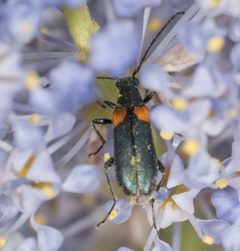
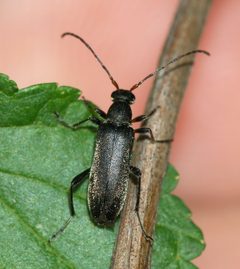
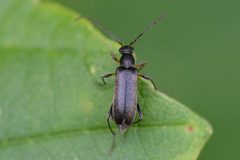
2Rhinotragini is a tribe of longhorn beetles within the Cerambycinae, characterized by diverse distributed primarily in the Neotropical region. The tribe includes numerous genera with showing striking -like mimicry and associations with flowers. Taxonomic revisions have described multiple new genera and species, particularly from Bolivia, with ongoing work clarifying generic boundaries and species limits. Members range from small to medium-sized beetles, often with vivid coloration and elongated bodies.
Pronunciation
How to pronounce Rhinotragini: //ˌraɪnoʊˈtrædʒɪnaɪ//
These audio files are automatically generated. While they are not always 100% accurate, they are a good starting point.
Identification
Members of Rhinotragini can be distinguished from other Cerambycinae tribes by a combination of characters including antennal structure, pronotal shape, and elytral . The tribe contains with pronounced and exhibiting mimicry, particularly in genera such as Isthmiade. Identification to genus and species level requires examination of male genitalia, antennal segment proportions, and detailed elytral punctation patterns. Keys to regional faunas exist for Bolivia and other Neotropical areas.
Images
Habitat
Rhinotragini occur in diverse Neotropical including disturbed transition forests, semi-deciduous Chiquitano forest, tropical humid forest, and subhumid Chaco forests of Andean foothills. Elevational range extends from lowland subtropical localities to montane sites at approximately 1940 meters. Specific microhabitat associations include dead branches and trunks of trees, with frequently encountered on flowers.
Distribution
The tribe is distributed throughout the Neotropical region, with documented records from Mexico through Central America ( Rica, Panama) and across South America including Bolivia, Brazil, Peru, Ecuador, and Argentina. The Isthmiade ranges from Surinam to Argentina in the east and Peru to Bolivia in the west. Bolivian records are particularly well-documented from the Department of Santa Cruz and Department of Tarija.
Host Associations
- flowers - feeding/ flower records documented for multiple ; specific plant vary by species
- Carya - larval Documented for Stenosphenus notatus, associated almost exclusively with hickories and pecan
Life Cycle
Developmental period spans two seasons in at least some . occurs in the stage in some species, contrasting with the more common larval overwintering pattern in eastern North American Cerambycidae. occurs in the latter part of the second season, with adults emerging in early spring.
Behavior
of many exhibit phoretic associations with pseudoscorpions, which attach to legs or body surfaces for to new patches. This phoretic relationship has been documented on multiple longhorn beetle species and represents a notable behavioral interaction. Adults are frequently observed on flowers, suggesting nectar-feeding or pollen consumption.
Ecological Role
As wood-boring beetles, larvae contribute to decomposition of dead wood and nutrient cycling in forest . flower visitation may contribute to pollination, though this has not been quantified. The phoretic relationship with pseudoscorpions facilitates of these predatory arachnids between dead wood patches.
Human Relevance
Some serve as research subjects for studying phoretic relationships and mimicry evolution. Wood-boring larvae occasionally occur in economically important tree species such as hickories, though significant pest status is not documented. The tribe contributes to biodiversity assessments in Neotropical conservation areas.
Similar Taxa
- other Cerambycinae tribesDistinguished by combination of antennal, pronotal, and genitalic characters; Rhinotragini typically shows more pronounced mimicry and flower associations than many related tribes
- ElaphidioniniHistorical taxonomic confusion; separated by antennal segment proportions and male genitalia structure
More Details
Taxonomic activity
The tribe has been subject to intensive recent revision, with multiple papers describing new (Anomalotragus, Antennommata, Stultutragus, Paraeclipta, Clepitoides) and numerous new from Bolivia. Generic boundaries remain active areas of research, with several species transferred between genera. Mitochondrial sequence data have been employed to investigate cryptic species and color .
Phoretic pseudoscorpion associations
Documentation of pseudoscorpions attached to Rhinotragini and other cerambycid beetles has generated discussion regarding the nature of this relationship. While (-mediated attachment) is the most probable explanation, alternative hypotheses including accidental boarding and phagophily have been proposed. Pseudoscorpions position themselves on legs or under , ceasing feeding and development during transport.
Sources and further reading
- BugGuide
- Wikipedia
- iNaturalist taxon
- NCBI Taxonomy
- Catalogue of Life
- Hitchin’ A Ride | Beetles In The Bush
- Nomenclatural changes in Phymatodes | Beetles In The Bush
- Bolivian Rhinotragini III: new genera and species (Coleoptera, Cerambycidae)
- New species and new distribution records in Rhinotragini (Coleoptera: Cerambycidae: Cerambycinae)
- Bolivian Rhinotragini II: Isthmiade Thomson, 1864 (Coleoptera, Cerambycidae), with two new species
- Bolivian Rhinotragini IV: Paraeclipta gen. nov. (Coleoptera, Cerambycidae), new species and new combinations
- Bolivian Rhinotragini I: new species of Ecliptoides Tavakilian & Peñaherrera-Leiva, 2005 new status, and Clepitoides new genus (Coleoptera, Cerambycidae)
- Bolivian Rhinotragini V: new species of Erythroplatys White, 1855, Rhinotragus Germar, 1824, Ornistomus Thomson, 1864, and Aechmutes Bates, 1867 (Coleoptera, Cerambycidae)
- LARRY G. BEZARK, UBIRAJARA R. MARTINS, ANTONIO SANTOS-SILVA & AMY BERKOV (2013) New species and new distribution records in Rhinotragini (Coleoptera: Cerambycidae: Cerambycinae) <i>Zootaxa</i>, 3647(1), 181–193.