
Cyclocephala
Dejean, 1821
Masked Chafers
Species Guides
10- Cyclocephala aravaipensis
- Cyclocephala borealis(Northern Masked Chafer)
- Cyclocephala hirta(Western Masked Chafer)
- Cyclocephala longula
- Cyclocephala lunulata(masked chafer)
- Cyclocephala lurida(Southern Masked Chafer)
- Cyclocephala melanocephala(masked chafer)
- Cyclocephala parallela
- Cyclocephala pasadenae(Southwestern Masked Chafer)
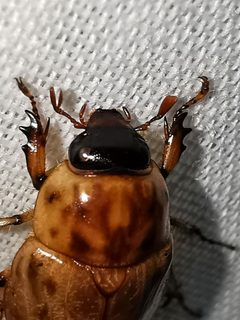
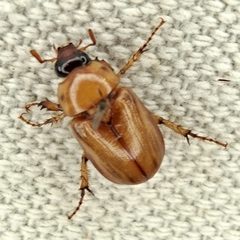
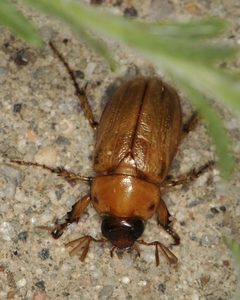
is a large of scarab beetles in the Dynastinae, commonly known as masked . are small brown beetles (10–15 mm) with a distinctive black facial mask across the . The genus is to the Americas, ranging from southeastern Canada to Argentina, India, and the West Indies. Adults are or and attracted to lights. Larvae develop in soil, feeding on organic matter and plant roots, and are significant pests of turfgrass.
Pronunciation
How to pronounce Cyclocephala: /ˌsɪkloʊˈsɛfələ/
These audio files are automatically generated. While they are not always 100% accurate, they are a good starting point.
Identification
are recognized by the characteristic black stripe or mask across the and , from which the derives. They are small brown scarab beetles, 10–15 mm in length depending on . occurs in tarsal claw size, with males possessing larger claws. Larvae are cream-colored, brown-headed up to 25 mm long, typically found curled in a C-shape in soil.
Images
Habitat
Larvae develop in soil substrates with organic matter, including preserved, disturbed, and agroecosystem . are active in darkness between grass and ground surfaces. occupy diverse environments: temperate subhumid climates with tropical deciduous vegetation at 1,800–2,600 m altitude (C. barrerai), as well as grasslands, turfs, and lawns across North and South America.
Distribution
to the Americas. Occurs from southeastern Canada to Argentina, including the West Indies. Specific distributions: C. borealis in the northeastern quarter of the United States; C. lurida in the southeastern quarter; C. pasadenae and C. hirta through much of the southwestern United States; C. parallela in parts of Florida; C. barrerai in central Mexican states (Mexico City, Durango, Morelos, Puebla, Michoacán, Tlaxcala, Aguascalientes).
Seasonality
emerge at the start of the rainy season in tropical regions, or during specific seasonal windows in temperate zones. In temperate areas, adults are active in late spring and summer (May–July for some ). activity peaks in darkness. spans 108–269 days -to-adult across congeneric species; most species are , though C. lunulata is .
Diet
Larvae are facultative feeders consuming soil organic matter and plant roots, primarily of wild grasses (Poaceae). They may feed on plant tissue when organic matter is scarce. do not feed; their activity is limited to mating.
Life Cycle
Complete : , three larval instars, , pupa, and . The third larval instar is the longest duration stage. Adults emerge from pupae with mature . Gonads mature 18 days after pupal in C. barrerai, using larval fat reserves. Mass-rearing has achieved 66.6% average egg-to-adult survival over three .
Behavior
are or and attracted to lights. Mating occurs in darkness with three phases: premating (male search and courtship, female resistance), mating (mounting, antennal movements, insertion), and postmating (male guards female to prevent remating). Males locate females using , possibly produced by symbiotic bacteria in the female genital chamber or cuticular hydrocarbons. Females 'call' by exposing the genital chamber. Adults exhibit discrete activity periods: digging up from substrate, mating, and reburial.
Ecological Role
Larvae contribute to nutrient cycling through consumption of soil organic matter and promote soil aeration via burrowing tunnel creation. They are significant rhizophagous pests of turfgrass, forming part of the 'white complex.' High grub concentrations attract vertebrate (skunks, raccoons) that damage turfgrass while excavating for larvae. serve as for flowers of Nymphaea subg. Hydrocallis and Victoria. Several serve as for parasitic larvae of the South American robber fly Mallophora ruficauda.
Human Relevance
Larvae are major pests of turfgrass, causing damage by feeding on roots; affected grass browns and dies during drought conditions, and can be pulled up like carpet. High attract skunks and raccoons that tear up lawns. Managed through chemical , though biological approaches using fungi are being investigated.
Similar Taxa
- PhyllophagaBoth contain 'May beetles' with similar-looking white larvae and attracted to lights; adults of are distinguished by the black facial mask and smaller size (10–15 mm vs. typically larger Phyllophaga).
- PeltonotusHistorically confused with due to enlarged male front ; molecular evidence places Peltonotus outside the tribe Cyclocephalini, and are associated with aroid flowers rather than being light-attracted.
Sources and further reading
- BugGuide
- Wikipedia
- GBIF taxonomy match
- iNaturalist taxon
- NCBI Taxonomy
- Catalogue of Life
- Bug Spotlight | Entomology Research Museum
- JIPM Article on Masked Chafer Grubs in Turfgrass Explains Management Techniques
- Scarabaeidae | Beetles In The Bush | Page 3
- How an International Education Program Fosters a Young Student's Interest in Entomology
- Quiz Yourself: 2020 Entomology Games Questions
- Bug Eric: Wasp Wednesday: Blue-winged Wasp
- Mating Behavior of Cyclocephala barrerai Martínez (Coleoptera: Melolonthidae).
- Mass-rearing and life history of Cyclocephala barrerai (Coleoptera: Melolonthidae) and congeneric species.