
Cyclocephala lunulata
Burmeister, 1847
masked chafer
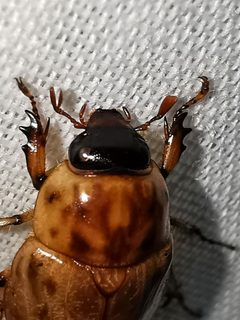
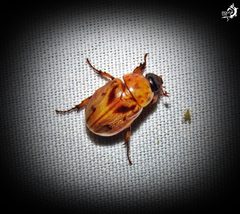
lunulata is a rhinoceros beetle in the Scarabaeidae, widely distributed across the Americas from the southwestern United States through Mexico and Central America to South America. are attracted to volatile organic compounds produced by bacteria (VOCsB) isolated from their genital chambers, with both sexes responding to bacterial volatiles from Morganella morganii. The is a documented agricultural pest of strawberry, guava, and ornamental pastures.
Pronunciation
How to pronounce Cyclocephala lunulata: /sɪˌkloʊˈsɛfələ ˌluːnjəˈleɪtə/
These audio files are automatically generated. While they are not always 100% accurate, they are a good starting point.
Images
Distribution
Widely distributed across the Americas: Nearctic region (Arizona, Texas, USA); Neotropical region including Mexico (Aguascalientes, Baja California Sur, Campeche, Chiapas, Coahuila, Colima, Distrito Federal, Guanajuato, Guerrero, Hidalgo, Jalisco, México, Michoacán, Morelos, Nayarit, Oaxaca, Puebla, Querétaro, Quintana Roo, San Luis Potosí, Sinaloa, Sonora, Tabasco, Tamaulipas, Veracruz, Yucatán, Zacatecas), Belize, Bolivia, Brazil (Acre, Amazonas, Bahia, Espírito Santo, Goiás, Minas Gerais, Paraná, Rio de Janeiro, Rio Grande do Sul, Santa Catarina, São Paulo), Colombia, Rica, Ecuador, El Salvador, French Guiana, Guatemala, Guyana, Honduras, Nicaragua, Panama, Paraguay, Peru, Suriname, Trinidad & Tobago, Venezuela, and Argentina.
Diet
Phytophagous; feed on plants. Documented as a pest of strawberry, guava, and ornamental pastures.
Host Associations
- Morganella morganii - bacteria isolated from female genital chamber; produces attractive volatile organic compounds (VOCsB)VOCsB from this bacterium attracted 90% of males and 73.6% of females in
- Klebsiella sp. - bacteria isolated from female genital chamberisolated alongside M. morganii but specific behavioral effects not detailed in available sources
Behavior
exhibit attraction to volatile organic compounds from bacteria (VOCsB) isolated from genital chambers. Both males and females are attracted to VOCsB from Morganella morganii, with antennal responses confirmed via electroantennography (EAG). participate in precopulatory .
Ecological Role
Agricultural pest of strawberry, guava, and ornamental pastures. Potential for management programs using bacterial volatiles as attractants.
Human Relevance
Documented agricultural pest causing damage to strawberry, guava, and ornamental pasture crops. Research interest in using bacterial volatiles from associated genital chamber bacteria as attractants for potential programs.
Sources and further reading
- BugGuide
- Wikipedia
- GBIF taxonomy match
- iNaturalist taxon
- NCBI Taxonomy
- Catalogue of Life
- Hemiptera | Beetles In The Bush | Page 9
- JIPM Article on Masked Chafer Grubs in Turfgrass Explains Management Techniques
- Attraction of Adults of Cyclocephala lunulata and Cyclocephala barrerai (Coleoptera: Scarabaeoidea: Melolonthidae) towards Bacteria Volatiles Isolated from Their Genital Chambers
- Behavioral and Histological Evidence of Participation by Pheromones in Precopulatory Behavior of Cyclocephala lunulata 1