
Colocasia
Schott, 1832
elephant ears, taro, cocoyam, dasheen, eddoe
Species Guides
2- Colocasia flavicornis(yellowhorn)
- Colocasia propinquilinea(Close-banded Yellowhorn)
Colocasia is a of herbaceous plants in the Araceae, native to Southeast Asia and the Indian subcontinent. The genus includes the economically important C. esculenta (taro), widely cultivated for its edible corms and leaves across tropical and subtropical regions. Plants are characterized by large sagittate leaves and reproduce primarily through underground corms and rhizomes. Several species have become naturalized beyond their native range, with C. esculenta recognized as in wetland along the Gulf Coast of the United States.
Identification
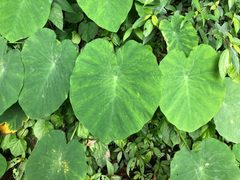
Colocasia are distinguished from similar large-leaved Araceae by their sagittate (arrowhead-shaped) leaves with the basal lobes pointing downward, and by their herbaceous growth from a prominent corm positioned at or just below the soil surface. The genus differs from Xanthosoma, which has leaves with basal lobes pointing outward or upward and often produces an upright trunk, and from Caladium, which typically has smaller, more colorful and variably patterned leaves. Colocasia leaves are generally larger (20–150 cm long) and less variegated than those of Caladium.
Images
Habitat
Native to tropical and subtropical regions of Southeast Asia and the Indian subcontinent. Cultivated plants thrive in moist, compost-rich soils with partial shade; they require consistent soil moisture and warm temperatures between 20–30°C for optimal growth. In temperate regions, plants are grown as annuals or overwintered in protected conditions. C. esculenta has established in wetlands along the Gulf Coast of the United States, where it displaces native vegetation.
Distribution
Native range includes southern China, the Indian subcontinent, Indochina, and Sumatra. Widely naturalized and cultivated across tropical Africa, southern Europe, South and Central America, the West Indies, the southeastern United States, Hawaii, and numerous Pacific and Indian Ocean islands. Individual show more restricted distributions: C. affinis occurs from Yunnan through the eastern Himalayas to Bangladesh and Myanmar; C. fallax is found in Tibet, Yunnan, and northern Indochina; C. hassanii is to Bangladesh.
Host Associations
- Colocasia esculenta - serves as food plant for larvae of some Lepidoptera
Life Cycle
Herbaceous . occurs primarily vegetatively through underground corms and rhizomes. produces clusters of two to five fragrant inflorescences in leaf axils. In , corms are typically planted close to the soil surface with growth within 1–3 weeks; mature plants require approximately 1 m² of space for full development.
Ecological Role
Leaves serve as food source for larvae of certain Lepidoptera , including Palpifer murinus and P. sexnotatus. The supports associated microbial including endophytic fungi with documented interactions with (Atta sexdens). of C. esculenta in North American wetlands threaten to displace native wetland plant communities.
Human Relevance
C. esculenta is a major tropical starch staple, with corms and leaves consumed across Asia, Africa, the Pacific, and the Caribbean. Requires processing (cooking, soaking, or fermenting, often with acid) to neutralize calcium oxalate raphides that cause oral irritation. Specific culinary traditions include poi in Hawaii, kolokasi in Cyprus, kolkas in Egypt, arbi in northern India, and numerous preparations across Southeast Asia. Plants are also cultivated as ornamentals for their dramatic foliage. Contains phytochemicals including anthraquinones, apigenin, catechins, cinnamic acid derivatives, vitexin, and isovitexin.
Similar Taxa
- XanthosomaAlso called elephant ear and cocoyam; distinguished by outward or upward-pointing leaf basal lobes and often trunk-forming habit
- CaladiumAlso called elephant ear; distinguished by smaller size, more variable and colorful leaf patterns, and lack of prominent corm
- Leucocasia giganteaFormerly classified as Colocasia gigantea; separated into distinct based on phylogenetic analysis
More Details
Chemical defense
All parts contain microscopic needle-like raphides of calcium oxalate monohydrate that cause intense irritation to lips, mouth, and throat. This acridity necessitates proper processing before consumption.
Etymology
Generic name derived from ancient Greek kolokasion, used by 1st-century CE botanist Pedanius Dioscorides, possibly referring to edible roots of both taro and Nelumbo nucifera.
Cultural significance
Featured in Meitei mythology of Manipur in the folktale Hanuba Hanubi Paan Thaaba, involving trickery by monkeys related to practices. Depicted in Byzantine-era Levantine mosaics as serving platforms for fruit.
Sources and further reading
- BugGuide
- Wikipedia
- iNaturalist taxon
- NCBI Taxonomy
- Catalogue of Life
- Ants and Science Are Her Passions | Bug Squad
- Genome-wide association study of resistance to taro leaf blight and yield traits in taro (Colocasia esculenta (L.) Schott).
- Identification of a novel mitovirus in Colocasia esculenta through high‑throughput sequencing and in-silico miRNA prediction for sequence-specific gene silencing.