
Mallophora
Macquart, 1834
Bee-killers
Species Guides
5- Mallophora atra(Black Bee-Killer)
- Mallophora bomboides(Florida Bee-Killer)
- Mallophora fautrix
- Mallophora leschenaultii(Belzebul bee-eater)
- Mallophora orcina(Southern Bee-Killer)
Mallophora is a of large, robust robber flies ( Asilidae) commonly known as -killers. The genus contains approximately 60 described distributed primarily in the Americas. are powerful aerial that capture bees and other insects in , while larvae of at least some species are solitary ectoparasitoids of scarab beetle larvae (white ) in soil. Mallophora ruficauda, the best-studied species, is a significant pest of apiculture in the Pampas region of Argentina, where adults prey on honey bees, yet the same species functions as a beneficial agent of agricultural pests through its larval of scarab grubs.
Pronunciation
How to pronounce Mallophora: /ˌmælɵˈfɔːrə/
These audio files are automatically generated. While they are not always 100% accurate, they are a good starting point.
Identification
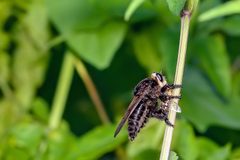
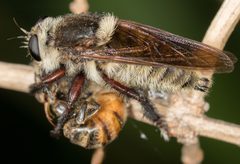
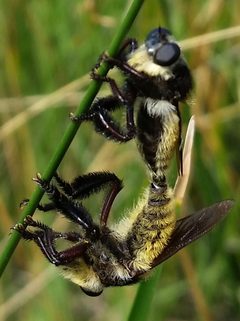
are large, heavy-bodied robber flies with dense pile (hairs) giving a -like appearance in many . have a thin terminal segment (), distinguishing Mallophora from the similar bumble bee-mimic Laphria, which has thick antennae. The body is typically covered with yellow, black, or reddish-brown setae forming banded or patterned coloration. are large and often meet dorsally in males. The legs are stout and spiny, adapted for seizing prey. Larvae are elongate, cylindrical, and undergo heteromorphosis with distinct morphological changes between instars, particularly in cephalic structures.
Images
Habitat
frequent open grasslands, prairies, and glades where they perch on vegetation to hunt flying insects. Larvae occur in soil, where they locate and parasitize scarab beetle larvae. Specific associations include tall grasslands for oviposition sites and soil habitats suitable for scarab larvae.
Distribution
distributed in the Americas, with recorded from North America (including the United States), Central America, South America (particularly Argentina and Brazil), and the Caribbean (Trinidad). Mallophora ruficauda is common in the Pampas region of Argentina.
Diet
are predatory, capturing flying insects including bees, , and other hymenopterans. Adults of M. ruficauda are documented of honey bees (Apis mellifera). Larvae are ectoparasitoids, feeding on scarab beetle larvae (Coleoptera: Scarabaeidae).
Host Associations
- Cyclocephala signaticollis - larval (ectoparasitoid)Preferred of M. ruficauda; 87% of field observed on this
- Cyclocephala modesta - larval (ectoparasitoid)Accepted , primarily by older M. ruficauda larvae
- Cyclocephala putrida - larval (ectoparasitoid)Accepted in laboratory studies
- Apis mellifera - prey preyed upon by M. ruficauda in Argentina
- Scarabaeidae (various) - larval General association for larval
Life Cycle
Females oviposit on tall grasses. hatch and first instar larvae drop to the ground. Second instar larvae actively search for and locate scarab beetle larvae buried in soil. Larvae undergo five instars (I-V), with pronounced heteromorphosis—cephalic structures (cephalic capsule width, maxillary palps, ) change morphologically at each moult to match functional requirements of host orientation, attachment, and consumption. occurs in soil.
Behavior
are sit-and-wait that perch on vegetation and capture flying prey in aerial attacks. They are wary and difficult to approach closely. Larvae exhibit active -seeking , orienting toward chemical cues from host gut microorganisms in the fermentation chamber. Host specificity varies with larval age: young larvae orient only to preferred host chemical stimuli, while older larvae show broader response. Adults may engage in kleptoparasitism avoidance behaviors when feeding.
Ecological Role
function as of flying insects, including . Larvae act as ectoparasitoids of scarab beetle larvae, providing of white that are agricultural pests. This dual ecological role creates tension between apiculture interests (where adults are pests) and agricultural interests (where larvae are beneficial).
Human Relevance
Mallophora ruficauda is a significant pest of apiculture in Argentina, where on honey bees can impact colony productivity. Conversely, the same is valued for of scarab beetle larvae (white ) that damage crop roots. The includes effective mimics that may be mistaken for bees by observers.
Similar Taxa
- LaphriaSimilar large, hairy, -mimicking robber flies; distinguished by thick (vs. thin terminal segment in Mallophora) and generally different body proportions
- MicrostylumLarge robber flies with reduced body hair; distinguished by nearly glabrous, streamlined body and different antennal structure
- PromachusGiant robber flies of similar size; distinguished by different body shape, less dense pile, and different wing venation patterns
Sources and further reading
- BugGuide
- Wikipedia
- iNaturalist taxon
- NCBI Taxonomy
- Catalogue of Life
- North America’s largest robber fly | Beetles In The Bush
- Where have all the honeybees gone? Honeybees, Apis mellifera — Bug of the Week
- freeloader flies | Beetles In The Bush
- Heteromorphosis associated to host-exploitation in an atypical parasitoid, Mallophora ruficauda (Diptera: Asilidae)
- Host-seeking behavior in larvae of the robber fly Mallophora ruficauda (Diptera: Asilidae)
- Spatial density‐dependent parasitism and specificity in the robber flyMallophora ruficauda(Diptera: Asilidae)
- Dual identity: the ecology and behaviour of the robber fly Mallophora ruficauda, a pest of honeybees and parasitoid of Scarab beetles
- Notes on the behaviour of the robber fly,Mallophora ruficauda, preying on honey bees in Argentina
- Incidence of Non-Immunological Defenses of Soil White Grubs on Parasitism Success of Mallophora ruficauda Larva (Diptera: Asilidae)
- The structure and biology of a new species of Mallophora Macq. (Diptera, Asilidae) from Trinidad, W.I.
- The sexual behavior of the robber-fly Mallophora ruficauda Wied. (Asilidae, Asilinae) in normal and experimental conditions
- Host gut microorganisms’ cues mediate orientation behaviour in the larva of the parasitoidMallophora ruficauda
- Host specificity in the host-seeking larva of the dipteran parasitoidMallophora ruficaudaand the influence of age on parasitism decisions
- Description of antennal structures of the parasitoid Mallophora ruficauda (Diptera: Asilidae) and its relationship with resources searching behaviour