
Cyclocephala pasadenae
(Casey, 1915)
Southwestern Masked Chafer, Pasadena Masked Chafer
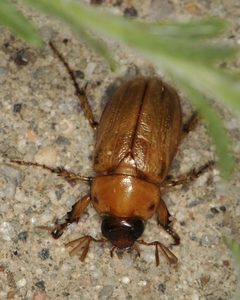
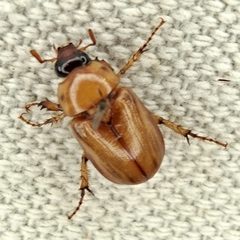
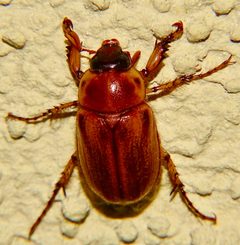
Cyclocephala pasadenae, commonly known as the southwestern masked chafer or Pasadena masked chafer, is a of rhinoceros beetle in the Scarabaeidae. Native to southwestern North America, it is one of several masked chafer species whose larvae are significant pests of turfgrass. The species is tan or auburn in color, approximately 13 mm in length, with some patterning on the . Along with its Cyclocephala hirta, it is locally abundant in the Los Angeles basin.
Pronunciation
How to pronounce Cyclocephala pasadenae: /sɪkloʊˈsɛfələ pæsəˈdiːni/
These audio files are automatically generated. While they are not always 100% accurate, they are a good starting point.
Identification
Distinguished from other masked chafers by its southwestern distribution and association with arid and semi-arid regions. The is most reliably separated from the sympatric C. hirta and other by examination of male genitalia. can be distinguished from the northern masked chafer (C. borealis) and southern masked chafer (C. lurida) by geographic range, as those species occur in the northeastern and southeastern United States respectively. The elytral patterning and overall coloration differ subtly from related species, but definitive identification requires dissection and comparison of aedeagal structures.
Images
Appearance
are tan or auburn colored beetles approximately 13 mm long with some patterning on their wing covers (). They possess the characteristic black stripe or mask across the and that gives masked chafers their . The body is typical of scarab beetles, with clubbed and a robust, oval form. Larvae are cream-colored, brown-headed up to 25 mm long, typically found curled in a C-shape in soil.
Habitat
Associated with turfgrass in arid and semi-arid regions of the southwestern United States. Larvae develop in soil, feeding on grass roots. are attracted to lights at night. The occurs in urban and suburban environments including lawns, golf courses, and parks, as well as natural grassland areas.
Distribution
Southwestern North America, from Texas, western Kansas, and Oklahoma westward to southern California. Also recorded from Arkansas, Colorado, Iowa, Missouri, Nebraska, Nevada, New Mexico, South Dakota, Utah, and Arizona. In Mexico, known from Baja California, Baja California Sur, Chihuahua, Coahuila, Durango, Hidalgo, Jalisco, Nuevo León, San Luis Potosí, Sonora, and Zacatecas. Introduced to Hawaii.
Seasonality
are active from late spring through summer, with peak activity typically occurring in June and July. Larval development occurs through summer and fall, with in soil and resuming feeding in spring.
Diet
Larvae feed exclusively on roots of turfgrass and other grasses. do not feed; they rely on fat reserves accumulated during the larval stage.
Host Associations
- Turfgrass - larval food sourceLarvae consume roots, causing significant damage to lawns, golf courses, and pastures
- Poaceae - larval food sourceVarious grass serve as for larval development
Life Cycle
Complete with four stages: , larva, pupa, and . Eggs are laid in soil. Larvae pass through three instars, feeding on grass roots and growing to approximately 25 mm. Larvae typically curl into a C-shape when disturbed. occurs in soil . Adults emerge in late spring to summer, mate, and lay eggs. One per year in most of its range.
Behavior
are and strongly attracted to lights. Larvae feed on grass roots in soil, typically remaining below the surface. When soil is saturated, larvae may move closer to the surface. High can attract vertebrate such as skunks and raccoons, which excavate turf in search of larvae.
Ecological Role
Larvae function as root-feeding herbivores in grassland . In natural settings, densities are typically low enough that damage is minimal. In managed turfgrass systems, they become pests. The serves as prey for various vertebrate and . , while non-feeding, may contribute to nutrient cycling through their decomposition.
Human Relevance
Significant pest of turfgrass in the southwestern United States. Larval feeding on grass roots causes lawns to brown and die, particularly during drought conditions when damaged root systems cannot supply adequate water. Infested turf can be pulled up like carpet due to severed roots. High densities attract skunks, raccoons, and birds that tear up lawns while foraging. Management relies primarily on chemical , though using fungi is being investigated.
Similar Taxa
- Cyclocephala hirtaSympatric in the southwestern United States including the Los Angeles basin; similarly tan/auburn in coloration and approximately the same size; distinguished by subtle differences in elytral patterning and male genitalia
- Cyclocephala luridaSouthern masked chafer with overlapping range in some areas; distinguished by geographic distribution primarily in the southeastern quarter of the United States and different male genitalia
- Cyclocephala borealisNorthern masked chafer with similar appearance and ; distinguished by northeastern distribution and different male genitalia
More Details
Biology Knowledge Gaps
Compared to the northern and southern masked chafers (C. borealis and C. lurida), the of C. pasadenae is poorly documented. Basic information on its precise , larval development rates, and optimal management timing remain understudied, likely because its range overlaps with the more extensively studied C. hirta in key areas like the Los Angeles basin.
Insecticide Resistance
Masked chafers are among the most difficult white to control with chemical . This challenge has motivated research into integrated approaches combining reduced-risk insecticides with agents such as fungi.
Sources and further reading
- BugGuide
- Wikipedia
- GBIF taxonomy match
- iNaturalist taxon
- Catalogue of Life
- Bug Spotlight | Entomology Research Museum
- JIPM Article on Masked Chafer Grubs in Turfgrass Explains Management Techniques
- Scarabaeidae | Beetles In The Bush | Page 3
- How an International Education Program Fosters a Young Student's Interest in Entomology
- Quiz Yourself: 2020 Entomology Games Questions