
Cyclocephala hirta
LeConte, 1861
Western Masked Chafer
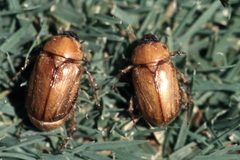
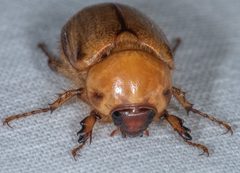
Cyclocephala hirta, commonly known as the Western Masked , is a scarab beetle native to the southwestern United States. It is one of the most common 'June beetles' in the Los Angeles Basin, often encountered alongside the related Cyclocephala pasadenae. The species is a turfgrass pest whose larval stage causes significant damage to lawns and golf courses by feeding on grass roots.

Pronunciation
How to pronounce Cyclocephala hirta: /saɪkloʊˈsɛfələ ˈhɜːrtə/
These audio files are automatically generated. While they are not always 100% accurate, they are a good starting point.
Identification
Distinguished from other Cyclocephala by geographic range and subtle morphological differences; C. hirta occurs in the southwestern United States while C. borealis (northern masked ) ranges through the northeastern quarter and C. lurida (southern masked chafer) through the southeastern quarter. of C. hirta and C. pasadenae overlap in the Los Angeles Basin and are among the most common June beetles there. Specific diagnostic features separating C. hirta from C. pasadenae are not well documented in available sources.
Images
Habitat
Associated with turfgrass environments including lawns, golf courses, and other maintained grasslands. Larvae develop in soil beneath turfgrass. have been observed flying to lights at night.
Distribution
Southwestern United States, including southern California, Arizona, New Mexico, and adjacent regions of Texas, western Kansas, and Oklahoma. Particularly abundant in the Los Angeles Basin.
Seasonality
are active primarily in June and July, typical for 'June beetles' in this . Larval development occurs underground with timing dependent on soil temperature and moisture.
Diet
do not feed on plants. Larvae feed exclusively on the roots of turfgrass .
Host Associations
- turfgrass - larval food plantLarvae consume roots, causing damage to lawns and golf courses
Life Cycle
Complete with , larval, pupal, and stages. Larvae live in soil and feed on grass roots. occurs in soil. Adults emerge in early summer, mate, and females lay eggs in soil. The of this is less well studied than that of C. borealis and C. lurida.
Behavior
are and attracted to lights. Larvae remain in soil, feeding on roots and assuming a characteristic C-shaped posture when disturbed. Adults do not feed.
Ecological Role
Larvae function as root herbivores in grassland . High larval can attract vertebrate such as skunks and raccoons, which excavate turfgrass in search of , causing secondary damage.
Human Relevance
Significant pest of turfgrass, particularly lawns and golf courses. Larval feeding on roots causes grass to brown and die, especially under drought stress. Damage can be severe enough that turf pulls up 'like a carpet.' Management typically involves chemical , though research is ongoing into using fungi combined with reduced insecticide rates.
Similar Taxa
- Cyclocephala pasadenaeOverlaps in range in the Los Angeles Basin and is similarly common there; both are among the most abundant June beetles in this region
- Cyclocephala luridaSimilar larval form and appearance, but ranges through the southeastern rather than southwestern United States
- Cyclocephala borealisSimilar appearance and , but occurs in the northeastern quarter of the United States
- Cyclocephala parallelaAnother poorly known southwestern with similar and pest status in parts of Florida
More Details
Research gaps
The of C. hirta is poorly understood compared to C. borealis and C. lurida. It is often overlooked in management literature due to this knowledge gap, despite being a significant turfgrass pest in its range.
Sources and further reading
- BugGuide
- Wikipedia
- GBIF taxonomy match
- iNaturalist taxon
- Catalogue of Life
- JIPM Article on Masked Chafer Grubs in Turfgrass Explains Management Techniques
- Sunday scarab: Phileurus valgus | Beetles In The Bush
- Stories about small insects and making a big difference - Buglife Blog - Buglife
- Botanizing at Castlewood State Park | Beetles In The Bush
- How an International Education Program Fosters a Young Student's Interest in Entomology