
Cyclocephala borealis
Arrow, 1911
Northern Masked Chafer
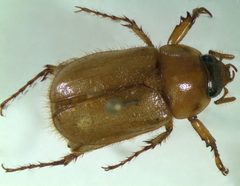
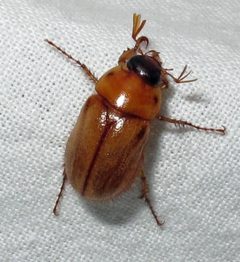
is a scarab beetle native to North America and a significant pest of turfgrass and cereal crops. are small, dull yellow-brown beetles with darker facial markings and hairy wing covers. The has a one-year with adults emerging in mid-June. Unlike many scarab beetles, adults do not feed; all damage is caused by root-feeding larvae (white ). The species is recognized as edible to humans.
Pronunciation
How to pronounce Cyclocephala borealis: //ˌsaɪkloʊˈsɛfələ bɔːriˈælɪs//
These audio files are automatically generated. While they are not always 100% accurate, they are a good starting point.
Identification
distinguished from similar Cyclocephala by the combination of dull yellow-brown coloration, hairy and , and the dark facial mask. Males possess enlarged fifth tarsal segments on forelegs for grasping females during mating. Larvae are morphologically indistinguishable from those of Cyclocephala immaculata; laboratory crosses between species produce that appear to develop normally but fail to yield viable larvae. The species overlaps in range with C. lurida in the southern Midwest, where precise identification requires examination of adult specimens.
Images
Habitat
Turfgrass environments including lawns, golf courses, and cereal crop fields. Larvae occur in soil where they feed on roots. are attracted to lights and may be found near illuminated areas at night.
Distribution
Native to North America. Ranges from Maine to California and south to Alabama. Common in the northeastern quarter of the United States, with range overlapping C. lurida in southern portions of the Midwest.
Seasonality
emerge from mid-June through summer. Males emerge from soil after sunset, before females. Mating activity occurs from sunset until a few hours before sunrise. Larvae feed through summer, reach third instar by September, then burrow 30 cm deep to hibernate. Larvae return to surface in late April to May to resume feeding, then move down in late May to early June to pupate.
Diet
Larvae feed on plant roots and organic matter near the soil surface. do not feed.
Host Associations
- turfgrass - larval food plant / pest damageprimary ; root feeding causes browning and death, especially under drought conditions
- cereal crops - larval food plant / pest damagerecognized pest from New England to Illinois
Life Cycle
One-year . hatch in 14-18 days at 70-75°F. Larvae pass through three instars, growing rapidly under ideal conditions. Third instars common by September. occurs as third instar larvae buried 30 cm deep. in late May to early June, with emerging mid-June. Pre-pupal larvae void gut contents and becomes translucent.
Behavior
Males emerge before females and await mates. Unmated females climb vegetation and release to attract males. Multiple males may crowd a female; successful copulation involves male grasping female with forelegs. Mated individuals fly at night: males within 60 cm of ground, females higher. Both sexes strongly attracted to light. Parasitized honey bees have been reported to exhibit aberrant near lights when infested by Apocephalus borealis, though this appears to be a misattribution in source material (the phorid fly Apocephalus borealis parasitizes bees, not the C. borealis).
Ecological Role
Larvae are significant root herbivores in grassland . High larval densities attract vertebrate including skunks and raccoons, which excavate turfgrass seeking , causing secondary damage. serve as potential food source for .
Human Relevance
Major pest of turfgrass and cereal crops. Damage most severe in September-October and spring when larval feeding peaks. Control typically relies on chemical , though biological approaches using fungi are under investigation. Recognized as edible to humans. Historical case of accidental human ear invasion reported from Pennsylvania (1958), classified as aural myiasis incident.
Similar Taxa
- Cyclocephala luridaSouthern masked with overlapping range in southern Midwest; distinguished by distribution and subtle morphological differences in
- Cyclocephala immaculataMorphologically indistinguishable larvae; distinguishable but can hybridize in laboratory with non-viable offspring
- Cyclocephala pasadenae, C. hirta, C. parallelaOther North American masked chafers with similar larval and pest status; less well known
Misconceptions
Source material contains a significant taxonomic error conflating (the ) with Apocephalus borealis (a phorid fly of honey bees). The 'zombie ' phenomenon involving and disorientation is caused by the fly Apocephalus borealis, not the beetle. These are unrelated sharing only a specific epithet.
More Details
Taxonomic History
Originally described as Cyclocephala villosa by Hermann Burmeister, but renamed borealis by Gilbert John Arrow in 1911 because the name villosa was preoccupied by a Bolivian .
Mating System
-mediated mate attraction with female calling . Male foreleg tarsal modification represents morphological for grasping females during copulation.
Management Challenges
Among the most difficult white to control chemically. research focuses on fungi combined with reduced applications.
Sources and further reading
- BugGuide
- Wikipedia
- GBIF taxonomy match
- iNaturalist taxon
- NCBI Taxonomy
- Catalogue of Life
- Bugs for All, All for Bugs | Bug Squad
- Grasshoppers of Wyoming and the West
- Grasshoppers of Colorado
- JIPM Article on Masked Chafer Grubs in Turfgrass Explains Management Techniques
- Quiz Yourself: 2020 Entomology Games Questions
- Zombie bees, Apis mellifera, and their tormentor the humpbacked fly, Apocephalus borealis — Bug of the Week