
Cyclocephala lurida
Bland, 1863
Southern Masked Chafer
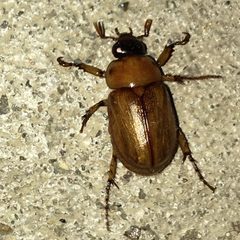
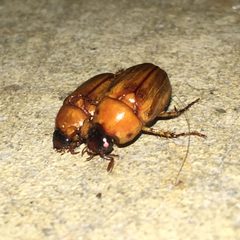
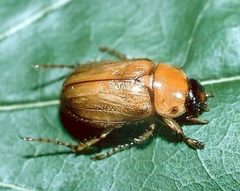
, commonly known as the southern masked , is a scarab beetle native to the southeastern United States. are small brown beetles with distinctive black facial markings, measuring 10–14 mm in length. The is , with adults active primarily in June and July. While adults do not feed on plants and cause no damage, the subterranean larvae—known as white —are significant turfgrass pests that feed on grass roots and can cause extensive lawn damage under dry conditions.
Pronunciation
How to pronounce Cyclocephala lurida: /sɪˌkloʊˈsɛfələ ˈlʊrɪdə/
These audio files are automatically generated. While they are not always 100% accurate, they are a good starting point.
Identification
can be distinguished from other masked chafers by their southeastern U.S. distribution and the specific pattern of the black facial mask. They are most reliably separated from the closely related northern masked (C. borealis) by geographic range, with C. lurida occurring primarily in the Southeast and C. borealis in the Northeast; the two overlap in the southern Midwest. Adults emerge earlier in the evening than C. borealis, with peak activity around sunset rather than after midnight. Larvae cannot be reliably distinguished from other Cyclocephala species without molecular techniques or rearing to adulthood.
Images
Appearance
beetles are brown with a black and distinctive black facial mask extending across the . Body length ranges from 10 to 14 mm (0.4–0.6 in). The overall coloration is relatively uniform brown, with the contrasting dark head providing the 'masked' appearance that gives the group its . Larvae are cream-colored, C-shaped with brown heads, growing to approximately 2.5 cm (1 in) in length.
Habitat
are found in open grassy areas including lawns, golf courses, pastures, and meadows. They are active on the ground surface or climbing grasses during the mating period. Larvae develop entirely underground in the root zone of turfgrass and other grasses. The prefers well-drained soils in open sunny areas.
Distribution
Native to the southeastern United States, ranging from the Atlantic coast westward through the southern Midwest. The distribution overlaps with C. borealis in the southern portions of the Midwest, where both can occur sympatrically.
Seasonality
with a single per year. emerge from the soil soon after sunset, primarily in June and July, with peak activity lasting several weeks. Males make zig-zag low over the ground to locate females. By 11 p.m., unmated females and all males return underground. Larvae feed through late summer, autumn, and spring, pupating in late spring with adults emerging approximately two weeks later.
Diet
do not feed; they rely on energy reserves accumulated during the larval stage. Larvae feed exclusively on the roots of grasses, including turfgrass and occasionally other plants.
Life Cycle
Females emerge at sunset and remain on the surface or climb grasses, emitting a to attract males. Males engage in zig-zag patterns low over the ground to locate females. After mating, females burrow into the soil to lay . Eggs hatch into larvae that feed on grass roots through late summer, autumn, and spring. Larvae pupate in late spring, with emerging approximately two weeks later. There is one per year. Larvae infected with the bacterium popilliae (milky spore) may experience developmental delays and occasionally appear on the soil surface.
Behavior
males exhibit distinctive zig-zag patterns while searching for females. Females release -specific that attract males; unmated females retained above ground after 11 p.m. have been observed to attract males of the related species C. borealis, suggesting partial pheromone similarity between the two species. Adults are primarily and , with surface activity ceasing by late evening.
Ecological Role
Larvae function as root herbivores in grassland . In high densities, they can significantly alter plant structure by killing turfgrass and opening space for weed . The serves as prey for vertebrate including raccoons and skunks, which excavate turf to access larvae. Thief ants (Solenopsis molesta) prey on and larvae, providing natural that is disrupted by applications.
Human Relevance
The larvae are among the most destructive turfgrass pests in the southeastern United States and southern Midwest, causing significant economic damage to lawns, golf courses, and athletic fields. Damage is most severe during drought conditions when grass cannot regenerate roots. Management historically relied on chemical , though using fungi has shown laboratory promise with variable field efficacy. Milky spore ( popilliae) can suppress larval . Vertebrate seeking can cause additional turf damage through excavation. The has been kept as a short-term pet by entomology enthusiasts due to its colorful appearance and ease of temporary maintenance.
Similar Taxa
- Cyclocephala borealis (Northern Masked Chafer)Overlaps in distribution in the southern Midwest; emerges later at night (after midnight vs. sunset); are similar enough that males of each may be attracted to females of the other when timing overlaps.
- Other Cyclocephala species (C. pasadenae, C. hirta, C. parallela)Share similar larval and white habit; require geographic separation or timing for reliable identification; C. pasadenae and C. hirta occur in the southwestern U.S., C. parallela in Florida.
- Popillia japonica (Japanese Beetle)Larvae are also destructive white in turfgrass; are readily distinguished by metallic green and coloration and active plant-feeding , unlike the dull brown, non-feeding adults of C. lurida.
Sources and further reading
- BugGuide
- Wikipedia
- GBIF taxonomy match
- iNaturalist taxon
- NCBI Taxonomy
- Catalogue of Life
- JIPM Article on Masked Chafer Grubs in Turfgrass Explains Management Techniques
- How an International Education Program Fosters a Young Student's Interest in Entomology
- The Marvelously Cryptic Dicerca lurida | Beetles In The Bush
- Sunday scarab: Phileurus valgus | Beetles In The Bush
- ID Challenge #19 | Beetles In The Bush
- Old, But Not That Old: Debunking the Myth of Ancient Cockroaches