
Cyclocephala melanocephala
(Fabricius, 1775)
masked chafer
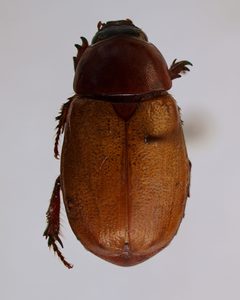
Cyclocephala melanocephala is a of scarab beetle in the Dynastinae, commonly known as masked chafers. The species occurs across North and Central America and has been documented in association with flowers of yellow passionfruit (Passiflora edulis). have been observed feeding on sunflower inflorescences (Helianthus annuus).
Pronunciation
How to pronounce Cyclocephala melanocephala: //saɪˌkloʊsɪˈfɑːlə mɪˌlænoʊˈsɛfəla//
These audio files are automatically generated. While they are not always 100% accurate, they are a good starting point.
Identification
can be distinguished from other Cyclocephala by the combination of the black facial mask and geographic distribution. Similar species include other masked chafers in the , which may require examination of male genitalia or other subtle morphological features for definitive identification. The black mask across the and is a key diagnostic feature.
Images
Appearance
are small brown beetles, 10-15 mm in length, with a distinctive black stripe or mask across the and . The body is compact and typical of the Cyclocephala, with enlarged front in males characteristic of the tribe Cyclocephalini.
Habitat
Associated with flowering plants including yellow passionflower (Passiflora edulis) and sunflower (Helianthus annuus). Occurs in diverse environments across its broad geographic range from the southwestern United States through Central America and into South America.
Distribution
Nearctic region: southwestern United States (Arizona, Arkansas, California, Kansas, Louisiana, Mississippi, Nevada, New Mexico, Oklahoma, Texas, Utah). Neotropical region: Mexico, Central America (Belize, Rica, El Salvador, Guatemala, Honduras, Nicaragua, Panama), Caribbean (Dominica, Dominican Republic, Grenada, Guadeloupe, Martinique, Montserrat, Puerto Rico, Saint Kitts and Nevis, Saint Lucia, Trinidad and Tobago), and South America (Bolivia, Brazil, Colombia, Ecuador, French Guiana, Guyana, Peru, Suriname, Venezuela).
Diet
feed on Helianthus annuus (sunflower) inflorescences. Floral association with Passiflora edulis (yellow passionflower) documented, though specific feeding role not confirmed.
Host Associations
- Helianthus annuus - food source feed on sunflower inflorescences
- Passiflora edulis - floral visitation sampled in yellow passionflower flowers; specific ecological role (pollination, feeding) not confirmed
Life Cycle
Complete typical of scarab beetles. Larval stage not specifically described for this , but related Cyclocephala species have cream-colored, brown-headed larvae (white ) that feed on plant roots.
Behavior
are attracted to flowers and have been documented visiting passionflower and sunflower. activity patterns typical of the , with adults often attracted to lights.
Ecological Role
Potential or floral visitor; specific services not quantified. As a member of the Cyclocephalini tribe, may contribute to pollination of associated flowering plants.
Human Relevance
Member of a containing significant turfgrass pests, though specific pest status of C. melanocephala not documented. Related (C. borealis, C. lurida) are major pests of lawns and golf courses due to root-feeding larvae.
Similar Taxa
- Cyclocephala luridaSouthern masked ; similar with facial mask, but restricted to southeastern United States and differs in male genitalia
- Cyclocephala borealisNorthern masked ; similar appearance but occurs in northeastern United States, separated by geographic range and subtle morphological differences
- Cyclocephala pasadenaeSouthwestern masked chafer; similar range and but differs in specific morphological features
More Details
Taxonomic History
First described by Fabricius in 1775. Placed in tribe Cyclocephalini within Dynastinae. Molecular studies suggest this tribe may not be monophyletic as traditionally defined.
Research Gaps
Larval , specific feeding habits, and complete remain poorly documented for this compared to better-studied like C. borealis and C. lurida.
Sources and further reading
- BugGuide
- Wikipedia
- GBIF taxonomy match
- iNaturalist taxon
- NCBI Taxonomy
- Catalogue of Life
- Bug Spotlight | Entomology Research Museum
- JIPM Article on Masked Chafer Grubs in Turfgrass Explains Management Techniques
- Scarabaeidae | Beetles In The Bush | Page 3
- How an International Education Program Fosters a Young Student's Interest in Entomology
- Quiz Yourself: 2020 Entomology Games Questions
- Floral association of adult Cyclocephala tucumana Brethes and Cyclocephala melanocephala (Fabricius) with passion flowers (Passiflora edulis Sims)