
Scolia
Fabricius, 1775
digger wasps, blue-winged digger wasps
Species Guides
5- Scolia bicincta(Double-banded Scoliid Wasp)
- Scolia dubia(Blue-winged Scoliid Wasp)
- Scolia guttata
- Scolia mexicana
- Scolia nobilitata(Noble Scoliid Wasp)
Scolia is a of digger wasps in the Scoliidae. females hunt scarab beetle in soil, paralyze them with a sting, and deposit on the living . The larvae consume the grub from the outside, eventually pupating in the burrow and before emerging the following summer. Several are common in North American lawns and gardens, where they serve as important agents of turf pests.
Pronunciation
How to pronounce Scolia: /ˈsko.li.a/
These audio files are automatically generated. While they are not always 100% accurate, they are a good starting point.
Identification
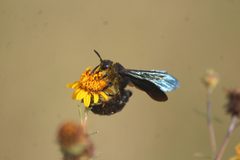
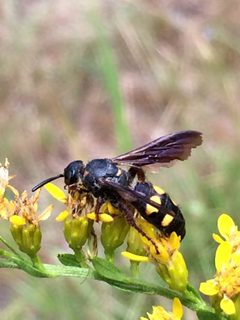
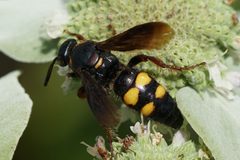
Scolia are robust, hairy with dark bodies and contrasting abdominal markings. Scolia dubia has iridescent blue-black wings, a black body with a reddish-brown terminal , and one pair of bright yellow spots on the abdomen. Scolia nobilitata has smoky brown wings and two pairs of yellow or off-white spots on the abdomen. These spot patterns distinguish the two common species.
Images
Habitat
Open areas with well-drained soil where scarab beetle occur, including lawns, pastures, and landscape beds. require nearby nectar sources, particularly plants in the mint (Lamiaceae) and aster family (Asteraceae).
Distribution
Records from North America (Vermont, United States), Sweden, and Norway. The has broad distribution with occurring across multiple continents.
Seasonality
active in late summer and autumn. In temperate regions, typically occurs in August. Females hunt during this period, and larvae complete development during summer and autumn before as pupae.
Diet
feed on nectar from flowers, particularly mountain mint, spotted horse mint, and goldenrod. Larvae are ectoparasitoids of scarab beetle , feeding on living but paralyzed underground.
Host Associations
- Scarabaeidae (scarab beetles) - Larvae parasitize white including green June beetles, , , and
Life Cycle
Females locate scarab underground, dig through soil to reach them, deliver a paralyzing sting, and deposit an on the grub's exterior. The larva hatches and consumes the living . After completing development in summer and autumn, the larva spins a silken cocoon, pupates, and overwinters in the burrow. emerge the following year.
Behavior
Females fly low over turf in searching patterns, sometimes in tight figure-eight , to locate . They are capable diggers, tunneling through soil to reach prey. are not aggressive toward humans and do not defend nests. Males and females both visit flowers for nectar, particularly on sunny days.
Ecological Role
Important agents of scarab beetle pests in turf and ornamental systems. increases often follow of white , functioning as a -dependent check on pest populations.
Human Relevance
Highly beneficial in managed landscapes and agriculture due to suppression of root-feeding scarab . Can be encouraged by planting nectar sources such as mints and goldenrods. Not a stinging hazard to humans; non-aggressive.
Similar Taxa
- Sphecidae (thread-waisted wasps)Also hunt soil-dwelling prey, but have distinctly thread-like petiole and different wing venation
- Pompilidae (spider wasps)Similar size and coloration, but hunt spiders rather than and have different body proportions
- Vespa/hornetsLarger social that may occur in similar , but Scolia are solitary, more robust, and have different abdominal color patterns
More Details
Nectar foraging
require substantial energy for -searching and digging activities. They are frequent visitors to late-summer blooming plants, particularly mountain mint (Pycnanthemum) and goldenrod (Solidago).
Population dynamics
Local abundance often correlates with white . High spring and summer rainfall that favors grub survival typically results in increased the following year.