
Scolia bicincta
Fabricius, 1775
Double-banded Scoliid Wasp, double-banded scoliid
Scolia bicincta is a large, conspicuous scoliid native to eastern and central North America. are active from late summer through autumn, where they visit flowers for nectar. Females are of scarab beetle , digging underground to locate , paralyzing them, and laying single on the immobilized prey. The is considered beneficial for of lawn and garden pests known as "white grubs."
Pronunciation
How to pronounce Scolia bicincta: /ˈskoʊ.li.ə baɪˈsɪŋk.tə/
These audio files are automatically generated. While they are not always 100% accurate, they are a good starting point.
Identification
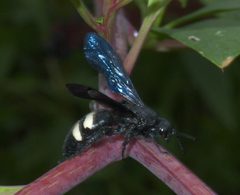
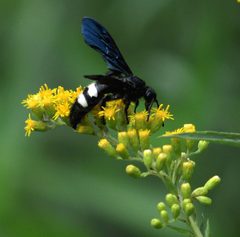
The two broad white bands on the black distinguish this from other North American scoliids. Scolia dubia (blue-winged wasp) has yellow spots rather than white bands. Scolia nobilitata has four yellow spots. The blue or violet wing reflections with dense horizontal ridges near the tips are characteristic of the Scoliidae. Males fly in lazy figure-eight patterns close to the ground; females are more often seen at flowers.
Images
Appearance
Large, robust with dense hair covering the body. Black overall coloration with two broad, white bands across the front half of the —this banding pattern is the source of both the (bicincta = "twice-banded") and . Wings show bluish or violet reflections with dense horizontal ridges near the tips. Body length ranges 15–25 mm (sources vary: 15–25 mm per Eric; 21–25 mm per Wikipedia). Females have short and a retractable true stinger. Males have longer antennae and a three-pronged "pseudostinger" at the abdominal tip.
Habitat
Open areas with flowers, including meadows, fields, gardens, and woodland edges. frequent autumn-blooming wildflowers. Larval is subterranean, within the burrows of scarab beetle in soil.
Distribution
Eastern and central North America, from southern New England west to Nebraska and Kansas, south to Florida and Louisiana. Records from Vermont confirm northern range limits.
Seasonality
active July through September or October, with period varying by latitude. Peak activity in late summer and autumn.
Diet
feed on nectar from flowers including goldenrod (Solidago spp.), thoroughworts (Eupatorium spp.), milkweed (Asclepias spp.), and other late-season blooms. Larvae are ectoparasitoids, feeding externally on scarab beetle .
Host Associations
- Scarabaeidae - Subterranean scarab beetle ("white grubs"); specific records lacking for S. bicincta but assumed based on
Life Cycle
Female locate scarab beetle underground, dig to them using spiny legs, sting into paralysis, and lay a single on the grub. The wasp larva hatches and feeds externally on the paralyzed for approximately two weeks, then spins a cocoon and overwinters. occurs in spring, with emerging in summer. Males emerge before females.
Behavior
Males patrol close to the ground in lazy figure-eight patterns searching for females. They roost at night by curling around stems or twigs, singly or in loose groups. Females dig actively through soil to locate , using spiny legs to excavate. are flower visitors, effectively pollinating while foraging for nectar.
Ecological Role
agent of scarab beetle , which are significant pests of lawns, gardens, and crops. flower visitation contributes to pollination of late-season wildflowers.
Human Relevance
Beneficial insect for natural pest management in turf and ornamental plantings. Non-aggressive toward humans; stinger used only for prey capture. Can be attracted to gardens by planting nectar sources such as goldenrod, mountain mint, and milkweed.
Similar Taxa
- Scolia dubiaBlue-winged wasp with yellow spots on rather than white bands; more abundant in many areas
- Scolia nobilitataHas four yellow spots on rather than two white bands
- Campsomeris spp.Related scoliid wasps, often with different color patterns and more southern distribution
More Details
Taxonomic note
No records exist specifically for S. bicincta; inferred from -level studies and congeneric .
Conservation status
Not formally assessed; appears secure throughout range based on observation records.
Sources and further reading
- BugGuide
- Wikipedia
- GBIF taxonomy match
- iNaturalist taxon
- NCBI Taxonomy
- Ziad Khouri: Zeroing in on Mammoth Wasps, the Scoliid Wasps | Bug Squad
- Bug Eric: Double-banded Scoliid wasp
- Bug Eric: February 2014
- Befriend wasps and they will befriend you: Digger wasps, Scolia dubia and Scolia nobilitata — Bug of the Week
- Bug Eric: Wasp Wednesday: Triscolia ardens