
Scolia nobilitata
Fabricius, 1805
Noble Scoliid Wasp
Species Guides
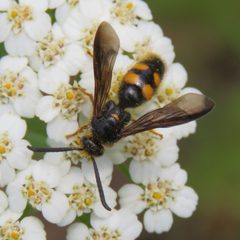
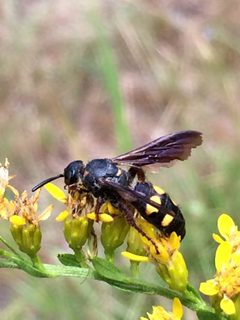
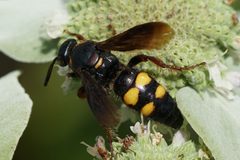
3Scolia nobilitata is a of scoliid native to North America. are active in late summer and autumn, when they visit flowers for nectar. Females are of scarab beetle , locating underground, paralyzing them with a sting, and laying on the immobilized larvae. The species is considered beneficial for of turf-damaging white grubs.
Pronunciation
How to pronounce Scolia nobilitata: /ˈskoʊ.li.ə noʊˌbɪl.ɪˈtɑː.tə/
These audio files are automatically generated. While they are not always 100% accurate, they are a good starting point.
Identification
Distinguished from the similar Scolia dubia by having four yellow or off-white spots on the (two pairs) rather than two yellow spots; Scolia dubia has a reddish-brown terminal abdominal segment with two yellow spots, while S. nobilitata lacks the reddish coloration. Wings are smoky brown rather than the iridescent blue-black of S. dubia. Body is black and moderately hairy. Females have short ; males have long antennae and a three-pronged pseudostinger.
Images
Habitat
Open areas with exposed soil suitable for digging, including lawns, gardens, pastures, and meadows. Requires presence of scarab beetle in soil. Often associated with flowering plants in the mint (Lamiaceae) and aster family (Asteraceae) where forage.
Distribution
Eastern North America; specific range boundaries not well documented in sources but occurs in the Mid-Atlantic and eastern United States based on observation records.
Seasonality
active from late summer through autumn, typically August to October depending on latitude. of adults follows after winter .
Diet
feed on nectar from flowers, particularly mountain mint, spotted horse mint, goldenrod, and other late-season blooming plants. Larvae are ectoparasitoids that consume scarab beetle .
Life Cycle
Females locate scarab beetle underground, dig to expose them using spiny legs, sting to paralyze, and lay a single on the grub. The larva hatches and feeds externally on the paralyzed for one to two weeks, then spins a silken cocoon and overwinters as a pre-pupa. occurs the following summer, with emerging in late summer.
Behavior
Females fly low over soil in searching patterns to detect subterranean . Males fly in figure-eight patterns near the ground to locate emerging virgin females. are solitary and non-aggressive toward humans; females sting only if physically molested. Males cannot sting. Adults roost on vegetation overnight, sometimes in loose .
Ecological Role
agent of scarab beetle pests including white that damage lawns and ornamental plants. Contributes to pollination through nectar foraging.
Human Relevance
Beneficial insect for management of turfgrass and garden pests without chemical intervention. Presence may indicate substantial scarab in soil. pose minimal sting risk and should be conserved rather than controlled.
Similar Taxa
- Scolia dubiaSimilar size and habit; distinguished by two yellow spots on reddish-brown abdominal tip and iridescent blue-black wings versus four yellow spots on black and smoky brown wings in S. nobilitata
- Scolia bicinctaSimilar eastern North American range and autumn activity; distinguished by two broad white bands across rather than four spots
Sources and further reading
- BugGuide
- Wikipedia
- GBIF taxonomy match
- iNaturalist taxon
- NCBI Taxonomy
- Ziad Khouri: Zeroing in on Mammoth Wasps, the Scoliid Wasps | Bug Squad
- Befriend wasps and they will befriend you: Digger wasps, Scolia dubia and Scolia nobilitata — Bug of the Week
- Bug Eric: Wasp Wednesday: Triscolia ardens
- Bug Eric: Double-banded Scoliid wasp
- Bug Eric: Wasp Wednesday: Blue-winged Wasp