
Scolia nobilitata tricincta
Say, 1823
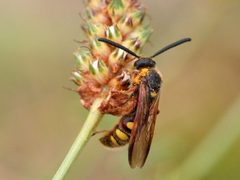
Scolia nobilitata tricincta is a of digger wasp in the Scoliidae. As a of scarab beetle , it locates white grubs beneath the soil surface, tunnels through dirt to reach them, delivers a paralyzing sting, and deposits an on the grub's skin. The larva consumes the living grub before spinning a silken cocoon to overwinter, emerging as an the following August. Adults are distinguished from the related Scolia dubia by having four yellow or off-white spots on the rather than two.
Pronunciation
How to pronounce Scolia nobilitata tricincta: //ˈskoʊ.liːə noʊˌbɪlɪˈtɑː.tə traɪˈkɪŋk.tə//
These audio files are automatically generated. While they are not always 100% accurate, they are a good starting point.
Identification
Distinguished from Scolia dubia by having four yellow or off-white spots on the (two pairs) rather than one pair of bright yellow spots. Wings are smoky brown rather than iridescent blue-black. From other Scolia , the specific spot pattern and wing coloration are diagnostic, though precise distinguishing features from all are not documented in available sources.
Images
Habitat
Lawns, landscape beds, and other areas with soil-dwelling scarab beetle . Requires access to flowering plants for nectar feeding and suitable soil conditions for grub hunting.
Distribution
Documented in the DMV region (Washington D.C., Maryland, Virginia); broader distribution of the extends through eastern North America.
Seasonality
active in August; larvae develop through summer and autumn; overwinters as pupa in cocoon within burrow.
Diet
feed on nectar from flowers in Lamiaceae (mint , including mountain mint) and Asteraceae (aster family, including goldenrod and spotted horse mint). Larvae are that consume living scarab beetle .
Host Associations
- Scarabaeidae - Larval stages (white ) of green June beetles, , , , and other scarabs that dwell in soil
Life Cycle
emerge in August. Female locates beneath soil surface, tunnels through dirt, delivers paralyzing sting, and deposits on grub's skin. Egg hatches; larva slowly consumes living grub. After completing development during summer and autumn, larva spins silken cocoon, pupates, and overwinters in the burrow. Fresh adults emerge the following August.
Behavior
fly in tight figure-eight patterns approximately one foot above turf, presumably searching for prey. Not aggressive toward humans. Females dig through soil to locate and parasitize . Adults nectar on flowers before hunting.
Ecological Role
agent of scarab beetle pests; functions as a that suppresses of root-feeding in lawns and gardens.
Human Relevance
Beneficial insect that reduces of destructive lawn and garden pests including and other scarab . Can be encouraged by planting nectar sources such as mints and goldenrods. Not aggressive toward humans.
Similar Taxa
- Scolia dubiaSimilar size, shape, and ; distinguished by having two yellow spots (one pair) on versus four in S. nobilitata, and iridescent blue-black wings versus smoky brown wings
More Details
Conservation status
Not assessed; appears to benefit from abundant prey and nectar-rich flowering plants in human-modified landscapes.