
Scolia mexicana
Saussure, 1858
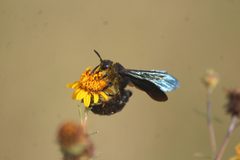
Scolia mexicana is a digger wasp in the Scoliidae, distributed across Mexico and the southern United States. As a , females locate scarab beetle underground, sting them to induce paralysis, and deposit on the living . The larvae develop by consuming the immobilized grubs, eventually pupating within the host burrow and before emerging as . Adults have been observed visiting flowers for nectar, particularly members of the mint and aster families.
Pronunciation
How to pronounce Scolia mexicana: /ˈskɔ.li.a ˌmɛk.siˈka.na/
These audio files are automatically generated. While they are not always 100% accurate, they are a good starting point.
Images
Habitat
Lawns, landscape beds, and other areas with soil-dwelling scarab beetle . frequent flowering plants for nectar.
Distribution
Mexico (Estado de México, Chiapas, Coahuila, Guanajuato, Guerrero, Michoacán, Morelos, Querétaro) and the United States.
Seasonality
emerge in August; active in late summer and autumn.
Diet
feed on nectar from flowers, particularly Lamiaceae (mints) and Asteraceae (goldenrods). Larvae are that consume scarab beetle , including such as green June beetles, , , and .
Host Associations
- Scarabaeidae - Larvae parasitize soil-dwelling scarab including green June beetles, , , and
Life Cycle
Females dig through soil to locate scarab , sting them to induce paralysis, and deposit on the surface. Larvae hatch and consume the living grub, completing development during summer and autumn. The mature larva spins a silken cocoon, pupates, and overwinters within the host burrow. emerge the following August.
Behavior
Females exhibit low patterns over turf, searching for . They are capable of excavating soil to access subterranean prey. have been observed nectaring on flowers and are not aggressive toward humans.
Ecological Role
agent of pestiferous scarab beetle in lawns and gardens.
Human Relevance
Beneficial for natural suppression of lawn and garden pests including white . Can be encouraged by planting nectar sources such as mountain mint, spotted horse mint, and goldenrod.
Similar Taxa
- Scolia dubiaSimilar size and ; distinguished by iridescent blue-black wings, black body with reddish-brown terminal , and one pair of yellow abdominal spots versus two pairs in S. nobilitata (not S. mexicana)
- Scolia nobilitataSimilar size and ; distinguished by smoky brown wings and two pairs of yellow or off-white abdominal spots
More Details
Conservation status
Not evaluated