
Triscolia ardens
Smith, 1855
Fire-tailed Scoliid Wasp
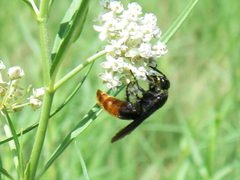
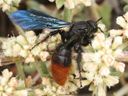
Triscolia ardens is a large scoliid and the sole member of its occurring in North America north of Mexico. Females are robust with short and hunt subterranean scarab beetle as for their larvae. Males possess long antennae and a distinctive three-pronged pseudosting at the tip. The is recognized by its black and setae on the and first two segments, with the remainder of the gaster bright red.
Pronunciation
How to pronounce Triscolia ardens: /trɪˈskoʊliə ˈɑːrdɛns/
These audio files are automatically generated. While they are not always 100% accurate, they are a good starting point.
Identification
Distinguished from other North American scoliids by the combination of single recurrent and three submarginal . Resembles Scolia dubia in general coloration but lacks the yellow spots characteristic of that ' nominate . The red distinguishes it from all-black scoliid species. Males are easily recognized by their long and three-pronged pseudosting. As the only Triscolia species in the United States and Canada, -level identification confirms species identity in this range.
Images
Appearance
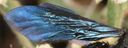
Large, robust scoliid with striking coloration. and setae black from through second segment; remainder of gaster red. Females have short and are powerfully built for digging. Males have conspicuously long antennae and a three-pronged pseudosting at the tip. Wing venation includes a single recurrent and three submarginal . Body length typically up to 30 mm, though size varies based on nutrition during larval development.
Habitat
Open fields, meadows, and open areas in general. frequently observed flying low over ground while searching for prey. Associated with milkweed patches and other flowering plants in desert and semi-arid environments.
Distribution
Seasonality
active during warmer months; observed at flowers and in during day. Specific seasonal limits not documented in sources.
Diet
visit flowers for nectar, particularly milkweed (Asclepias), seep willow (Baccharis), saltcedar (Tamarix), desert willow (Chilopsis), mesquite (Prosopis), scalebroom (Lepidospartum), and buckwheat (Eriogonum). Larvae are obligate external of scarab beetle (Scarabaeidae).
Host Associations
- Scarabaeidae - Scarab beetle are the known ; specific scarab not documented for T. ardens
Life Cycle
Female excavates subterranean scarab , stings it into paralysis, and deposits a single on the . The grub is reburied, sometimes in a constructed earthen . larva feeds externally on the paralyzed grub for one to two weeks, then spins a silken cocoon and pupates. Overwinters as pupa. timing presumably coordinated with host availability and warm season conditions.
Behavior
Females fly low over ground to detect subterranean scarab , then dig rapidly using spiny legs to unearth . of both sexes visit flowers during day. At day's end, individuals bed down singly on vegetation, remaining alert but relatively immobile as temperatures decline. Males do not participate in host provisioning.
Ecological Role
agent of scarab beetle through of soil-dwelling . pollination services at flowers. Serves as prey or for other organisms in .
Human Relevance
Potential agent for pest scarabs; no documented negative impacts. Attracts attention due to large size and conspicuous coloration. Non-aggressive toward humans; sting used only for paralysis.
Similar Taxa
- Scolia dubiaSimilar black-and-red coloration, but distinguished by yellow spots on in nominate and different wing venation (two recurrent in Scolia versus one in Triscolia)
- Campsomeris speciesOther large scoliid wasps in same range, but differ in wing venation and typically have different color patterns
More Details
Research opportunities
associations for T. ardens specifically are undocumented; most biological details inferred from general scoliid . Video documentation of host-finding and oviposition likely to constitute novel scientific records.
Taxonomic note
The three-pronged pseudosting of males is a -level characteristic of Triscolia, distinguishing it from related scoliid genera.