
Scolia dubia haematodes
Burmeister, 1854
Blood-tailed Scoliid Wasp, Blue-winged Digger Wasp
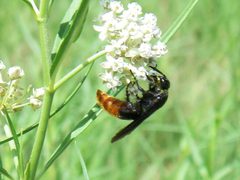
Scolia dubia haematodes is a of digger wasp in the Scoliidae. are recognized by iridescent blue-black wings, black body, and reddish-brown terminal abdominal segments. Females hunt scarab beetle in soil, paralyze them with a sting, and deposit on the living . The developing larvae consume the grubs, making this a significant agent of turfgrass and garden pests.
Pronunciation
How to pronounce Scolia dubia haematodes: /ˈskoː.li.a ˈdu.bi.a hɛˈmaː.to.des/
These audio files are automatically generated. While they are not always 100% accurate, they are a good starting point.
Identification
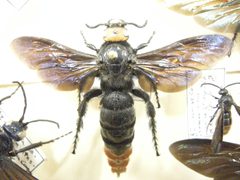
Distinguished from Scolia nobilitata by having only one pair of yellow spots on the (S. nobilitata has two pairs) and by iridescent blue-black rather than smoky brown wings. The reddish-brown terminal abdominal segments separate S. d. haematodes from other S. dubia . pattern of low figure-eight loops over turf is diagnostic when are present.
Images
Appearance
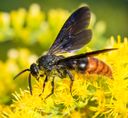
Medium-sized with striking iridescent blue-black wings. Body predominantly black with dense hair. Terminal abdominal segments reddish-brown to reddish-orange, giving the 'blood-tailed' appearance. with one pair of bright yellow spots on either side. Wings held flat or slightly folded at rest. in size, with females larger than males.
Habitat
Open areas with well-drained soil supporting scarab beetle , including residential lawns, gardens, pastures, and meadows. Requires access to nectar sources for feeding. Soil must be sufficiently soft to allow excavation for location.
Distribution
Eastern North America; documented from Vermont southward through the Mid-Atlantic region of the United States. Records concentrated in the northeastern and mid-Atlantic United States.
Seasonality
active from August through autumn. timed to coincide with peak availability of scarab beetle . Adults observed nectaring on late-summer and autumn-blooming plants.
Diet
feed on nectar from flowers in Lamiaceae (mints, mountain mint) and Asteraceae (goldenrod, spotted horse mint). Larvae are obligate , feeding exclusively on living scarab beetle including green June beetle, Japanese beetle, Oriental beetle, Asiatic garden beetle, and other soil-dwelling scarab larvae.
Host Associations
- Cotinis nitida - PARASITOID_OFGreen June beetle
- Popillia japonica - PARASITOID_OFJapanese beetle
- Anomala orientalis - PARASITOID_OFOriental beetle
- Maladera castanea - PARASITOID_OFAsiatic garden beetle
Life Cycle
. emerge in August, mate, and females hunt for scarab in soil. Female excavates soil to reach grub, delivers paralyzing sting, and deposits single on exterior. Larva hatches and consumes living grub over summer and autumn. Mature larva spins silken cocoon and pupates within host burrow. Overwinters as pupa. Adults emerge following August.
Behavior
Females exhibit low pattern approximately one foot above ground, tracing figure-eight loops while searching for vibrations or chemical cues. Non-aggressive toward humans; sting used only for prey immobilization. frequently observed nectaring in groups on preferred flowers. Males patrol territories and may engage in aerial combat.
Ecological Role
Important agent of scarab beetle pests. track abundance, functioning as -dependent mortality factor in turfgrass and agricultural . pollination activity on late-season flowers provides secondary ecosystem service.
Human Relevance
Beneficial insect for natural pest management in lawns and gardens. Reduces of destructive scarab without chemical intervention. Can be encouraged through planting nectar sources (mints, goldenrods). Sting poses minimal risk to humans; not defensive. Misidentification as dangerous sometimes leads to unnecessary control attempts.
Similar Taxa
- Scolia nobilitataOverlapping range and similar ; distinguished by two pairs of yellow/off-white abdominal spots and smoky brown rather than iridescent blue-black wings
More Details
Conservation status
Not evaluated; appear stable where and nectar sources are available. Vulnerable to broad-spectrum applications targeting scarab beetles.
Taxonomic note
haematodes distinguished from nominate S. dubia dubia by reddish rather than black terminal abdominal segments. Some authorities consider subspecies validity questionable.