
Mydas clavatus
(Drury, 1773)
Clubbed Mydas Fly
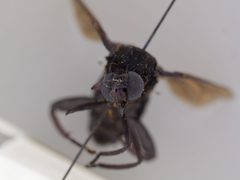
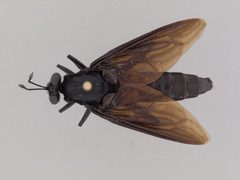
Mydas clavatus is a large, striking mydas fly native to temperate eastern North America. are notable Batesian mimics of spider wasps, displaying bold enabled by their -like appearance. The is distinguished by a prominent orange to red abdominal marking and clubbed —a trait shared across the . Adults are active in mid-summer and have been documented visiting diverse flowering plants for nectar.
Pronunciation
How to pronounce Mydas clavatus: /ˈmaɪdəs kləˈveɪtəs/
These audio files are automatically generated. While they are not always 100% accurate, they are a good starting point.
Identification
Large black fly, 25–30 mm in length with wingspan exceeding 50 mm. Most distinctive feature is the prominent orange to red mark on the side of the second abdominal segment. Body is black and somewhat glabrate (smooth, not densely hairy). are clubbed, though this is a -level trait. Overall appearance closely resembles spider wasps ( Pompilidae), particularly in the genus Anoplius, which serves as its model.
Images
Habitat
Occurs in diverse including deciduous woodlands, fields, meadows, and gardens. are associated with flowering vegetation. Larval habitat consists of standing and downed trees with extensive rot, where they develop as of woodboring larvae.
Distribution
Native to temperate eastern North America. Range extends from eastern United States westward through the Mississippi River basin, reaching north into southern Canada and south to the Gulf Coast states.
Seasonality
fly in mid-summer, typically June through August in most of the range.
Diet
are pollen and nectar feeders, documented visiting flowers of Asclepias (milkweeds), Saponaria, Spiraea, Monarda ( balm), Pycnanthemum (mountain mint), Teucrium (germander), and Verbena. Larvae are predatory on larvae of deadwood-feeding scarab beetles, specifically Osmoderma .
Host Associations
- Osmoderma - preylarvae of deadwood-feeding scarab beetles, primary larval food source
- Platanus occidentalis - dead sycamore stumps provide larval development sites
- Asclepias - food nectar source
- Monarda - food nectar source
- Verbena - food nectar source
- Spiraea - food nectar source
- Saponaria - food nectar source
- Pycnanthemum - food nectar source
- Teucrium - food nectar source
- Eryngium yuccifolium - food nectar source, observed in Missouri
Life Cycle
are deposited singly in soil or rotting wood. Larvae develop through multiple instars as within decaying wood, feeding on scarab beetle larvae. occurs within the wood substrate. emerge in mid-summer. The complete from egg to adult likely spans one to two years, though precise duration is not well documented.
Behavior
are notably bold in their movements, a consequence of effective of spider wasps. When not nectaring, adults may rest on vegetation or actively run on the ground. Adults have been observed curling and jabbing the in a mock stinging routine, reinforcing the mimicry. Males may defend areas near larval food sources, though mating remains poorly known.
Ecological Role
Larvae function as of woodboring scarab beetles, potentially regulating of these decomposers in forest . serve as through their nectar-feeding activities at diverse flowering plants. The relationship with spider wasps represents a classic example of defensive in Diptera.
Human Relevance
are harmless to humans and do not sting despite their -like appearance. The is of interest to entomologists as a conspicuous example of . No significant economic impact, positive or negative, has been documented.
Similar Taxa
- Stizoides renicinctussimilar size, black body with orange/red abdominal band, and dark wings; both are mimics but S. renicinctus is a kleptoparasitic wasp (Hymenoptera), not a fly
- Scolia dubiasimilar color pattern with black body and orange/red markings; blue-winged wasp is a scoliid that is more common and widespread
- Anoplius spp.spider wasps that serve as the mimicry model; similar size, coloration, and overall appearance, but with different wing venation and -like constriction between and
- Mydas tibialiscongeneric with similar size and appearance; golden-legged mydas fly has yellow/orange legs and different abdominal pattern
- Promachus spp.large robber flies with similar size and predatory appearance, but with different body proportions and without the distinctive orange abdominal marking