
Osmoderma
Le Peletier de Saint-Fargeau & Audinet-Serville, 1828
Typical Hermit Beetles, Hermit Beetles
Species Guides
3- Osmoderma eremicola(Hermit Flower Beetle)
- Osmoderma scabra
- Osmoderma subplanata
Osmoderma is a of scarab beetles in the Cetoniinae, commonly known as hermit beetles. The genus has a Holarctic distribution, with found across Europe, parts of Asia, and North America. Several European species, particularly O. eremita and O. barnabita, are of significant conservation concern due to loss and are protected under the EU Habitats Directive. The genus is characterized by its dependence on tree hollows for larval development, making it highly vulnerable to forest management practices that remove dead wood and veteran trees.
Pronunciation
How to pronounce Osmoderma: /ɒsmoʊˈdɜːrmə/
These audio files are automatically generated. While they are not always 100% accurate, they are a good starting point.
Identification
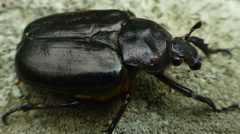
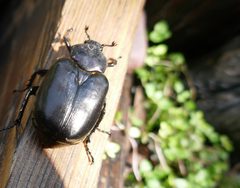
Osmoderma are robust, oval-shaped beetles typically 25–40 mm in length. have a dark brown to black coloration with a characteristic strong, fruity odor often described as peach-like or plum-like. The pronotum is broad and the may show fine punctation. Species-level identification requires examination of genitalia and other subtle morphological features; O. eremita and O. barnabita were historically confused and are now recognized as distinct species based on genetic and morphological data.
Images
Habitat
in this are saproxylic, with larvae developing exclusively in tree hollows containing moist, decomposed wood mold (wood mould). Suitable hollows occur primarily in old, broad-leaved deciduous trees, particularly oaks (Quercus spp.), but also lime (Tilia spp.), willow (Salix spp.), beech (Fagus sylvatica), and various fruit trees. include remnants of natural forests, pasture woodlands, hunting parks, avenues, city parks, hedgerow networks, orchards, and trees along agricultural fields and streams. Sun exposure of tree hollows is critical for larval and development.
Distribution
Holarctic distribution. In Europe: recorded from 33 countries with relatively high densities in Central Europe (northern Italy, Austria, Czechia, southern Poland, eastern Germany), parts of Northern Europe (south-eastern Sweden, Latvia), and France. Extinct or rare in north-western Europe (Norway, Danish mainland, The Netherlands, Belgium, north-eastern France). Few data from south-eastern Europe. North American occur in the eastern and central United States and southern Canada.
Diet
Larvae feed on wood mold—the moist, decomposed wood material and associated microorganisms found in tree hollows. Larval development requires 3–4 years. feeding habits are poorly documented; adults may feed on tree sap, ripe fruit, or other sugary substances but specific dietary requirements remain insufficiently studied.
Host Associations
- Quercus spp. - primary larval oaks are the most frequently used tree across the range
- Tilia spp. - larval limes/lindens are secondary but important
- Salix spp. - larval willows used particularly in wetter
- Fagus sylvatica - larval European beech
- Prunus spp., Pyrus spp., Malus domestica - larval fruit trees in traditional agricultural landscapes
Life Cycle
are laid in tree hollows. Larvae develop in wood mold within hollow trees for 3–4 years, passing through three instars. occurs within the hollow. emerge and are active for a relatively short period; they are elusive and difficult to observe. The extended larval period and dependence on specific microhabitat conditions make vulnerable to disruption.
Behavior
are primarily and cryptic, spending much of their time within tree hollows. They exhibit limited as adults; radio-tracking studies of O. eremita have documented individual movements up to approximately 700 m, though most activity occurs within or near the natal tree. Adults produce a distinctive strong odor, likely used for mate attraction and recognition. The serves as a phoretic for various mite species that use the beetles for dispersal between tree hollows.
Ecological Role
Osmoderma function as indicator and umbrella species for the entire associated with hollow trees in Europe. Their presence signals high-quality for numerous other saproxylic species. Through their association with wood mold communities and phoretic mites, they contribute to microhabitat connectivity in fragmented landscapes. Larval activity in decomposing wood contributes to nutrient cycling within tree hollow microecosystems.
Human Relevance
Several (notably O. eremita and O. barnabita) are protected under Annexes II and IV of the EU Directive, requiring member states to monitor and ensure their conservation. The has been the focus of extensive conservation research, including development of standardized monitoring protocols using traps and trained detection dogs. Conservation efforts for Osmoderma benefit broader saproxylic and have driven policy for veteran tree preservation across Europe. Ex situ breeding programs have been developed for reintroduction efforts.
Similar Taxa
- GnorimusAnother of Cetoniinae containing saproxylic associated with tree hollows; differ in coloration and body shape, with Gnorimus species often showing metallic or patterned
- ProtaetiaLarger cetoniine scarabs with similar robust body form; Protaetia often show metallic coloration and are not exclusively dependent on tree hollows for breeding
- Lucanus cervus shares (tree hollows and decaying wood) and conservation status but belongs to Lucanidae; easily distinguished by enlarged in males and different body form
Sources and further reading
- BugGuide
- Wikipedia
- GBIF taxonomy match
- iNaturalist taxon
- NCBI Taxonomy
- Catalogue of Life
- Dogs most efficient in monitoring beetles | Blog
- saproxylic beetles | Blog
- Osmoderma eremita (Coleoptera, Scarabaeidae, Cetoniinae) in Europe
- Phoretic Mites Associated with the Hermit Flower Beetle, Osmoderma eremicola Knoch (Coleoptera: Scarabaeidae)
- Why the Hermit Beetle is so Rare in Central European Managed Forests? Habitat Requirements of the Forest Population of Osmoderma Barnabita
- Hermit Beetle (Osmoderma eremita) in a Fragmented Landscape: Predicting Occupancy Patterns
- The European beetle of conservation concern, Osmoderma barnabita, as a surrogate species for conserving tree-related microhabitat richness in forests
- Ex Situ Breeding and Conservation of Osmoderma Species: A Systematic Review and Evidence-Based Breeding Guidelines for Reintroduction
- Spatial analysis of the habitat and distribution of Osmoderma eremita (Scop.) in trees outside of woodlands
- First results of radio-tracking of Osmoderma eremita (Coleoptera: Cetoniidae) in French chestnut orchards
- Comparing size of Osmoderma eremita populations and habitat quality in different French localities: conservation perspectives
- Habitat of Osmoderma eremita Scop. (Coleoptera: Scarabaeidae), a beetle living in hollow trees
- The Biology and Taxonomy of the Nearctic Species of Osmoderma (Coleoptera, Scarabaeidae)
- Updated distribution of Osmoderma eremita in Abruzzo (Italy) and agro-pastoral practices affecting its conservation (Coleoptera: Scarabaeidae)
- Minimum viable metapopulation size of a beetle, Osmoderma eremita, living in tree hollows