
Osmoderma scabra
(Palisot de Beauvois, 1807)
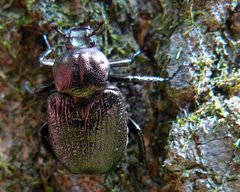
Osmoderma scabra is a saproxylic scarab beetle native to eastern North America. It belongs to the same as the European hermit beetle (Osmoderma eremita), which is protected under the EU Directive and has been extensively studied for conservation monitoring. Unlike its European , O. scabra has received limited research attention and is not listed under major conservation frameworks. The species develops in decaying wood and hollow trees, where larvae feed on wood mould for multiple years before emerging as short-lived .
Pronunciation
How to pronounce Osmoderma scabra: /ɒsmoʊˈdɜrmə ˈskɑːbrə/
These audio files are automatically generated. While they are not always 100% accurate, they are a good starting point.
Images
Habitat
Decaying wood in hollow trees; wood mould in tree cavities. Specific tree associations are not well documented for this species, though are known to use old, open-grown trees with heartwood decay.
Distribution
Eastern North America: Canada (New Brunswick, Nova Scotia, Ontario, Prince Edward Island, Quebec); United States (Connecticut, Georgia, Illinois, Indiana, Iowa, Kansas, Kentucky, Maine, Maryland, Massachusetts, Michigan, Minnesota, New Hampshire, New Jersey, New York, North Carolina, Ohio, Pennsylvania, Rhode Island, South Carolina, Tennessee, Vermont, Virginia, West Virginia, Wisconsin).
Ecological Role
Saproxylic decomposer; contributes to nutrient cycling in forest through processing of decaying wood and wood mould.
Human Relevance
Not a significant agricultural or forestry pest. No documented economic impacts. Not subject to major conservation initiatives, unlike the European O. eremita.
Similar Taxa
- Osmoderma eremitaEuropean with similar and ; protected under EU Directive and subject to extensive conservation monitoring using trained detection dogs and other methods. O. scabra is distinguished by Nearctic distribution.
- Osmoderma barnabitaAnother North American with overlapping distribution; -level identification requires examination of genitalia and other subtle morphological characters.
More Details
Conservation context
While O. scabra is not formally protected, the extensive research on European Osmoderma (particularly O. eremita) provides a methodological framework that could be applied to North American if conservation needs arise. The MIPP project in Europe developed non- monitoring techniques including trained detection dogs that successfully located O. eremita larvae with 73% probability compared to 34-50% for traditional wood mould sampling.
Research gap
Most published literature on the Osmoderma focuses on European . The , status, and specific requirements of O. scabra remain poorly documented relative to its European .