
Osmoderma eremicola
(Knoch, 1801)
Hermit Flower Beetle, Hermit Beetle
Osmoderma eremicola is a large scarab beetle native to eastern North America. are and associated with mature woodland , particularly near tree trunks. The is notable for producing a distinctive leathery odor and serves as a phoretic for multiple mite species. Larvae develop in decaying wood and wood mould within hollow trees over a multi-year period.
Pronunciation
How to pronounce Osmoderma eremicola: /ɒzməˈdɜːrmə ɛrɛˈmɪkələ/
These audio files are automatically generated. While they are not always 100% accurate, they are a good starting point.
Identification
Distinguished from other North American scarabs by combination of large size (21–32 mm), shiny dark brown coloration, and association with mature woodland . The leathery odor is diagnostic when present. Separated from Osmoderma scabra by smoother, less punctate and generally larger size. Distinguished from flower chafer such as Trichiotinus and Gymnetis by darker, less patterned coloration and more robust build.
Images
Appearance
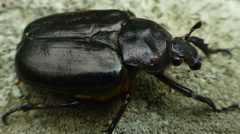
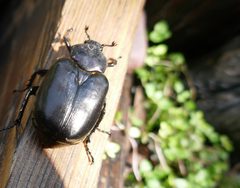
Large, robust scarab beetle measuring 21–32 mm in length. Body is shiny and dark brown in color. Overall build is compact and oval, typical of flower chafers (Cetoniinae). are (clubbed with plate-like segments).
Habitat
Mature deciduous and mixed woodlands. are found in wooded areas around tree trunks, particularly in association with old or trees. Larvae inhabit hollow trees and accumulate in wood mould (decaying wood debris) within cavities.
Distribution
Eastern Nearctic: southern Canada (New Brunswick, Nova Scotia, Ontario, Quebec) through the United States Midwest and east to Georgia. Documented from Illinois, Indiana, Iowa, Maryland, Minnesota, South Carolina, and Virginia in the United States.
Seasonality
are active from June through August, with peak activity in mid-summer. Larval stage persists for up to three years within trees.
Host Associations
- phoretic mites - beetles serve as for multiple mite that inhabit wood mould
- hollow deciduous trees - larval Larvae develop in wood mould accumulated in tree cavities, particularly in old or trees
Life Cycle
Complete with prolonged larval development. Larvae inhabit wood mould in hollow trees for up to three years. occurs within the wood mould or surrounding substrate. is synchronized with summer months; adults are relatively short-lived and primarily focused on .
Behavior
are and cryptic, spending daylight hours concealed near tree trunks or in bark crevices. When disturbed, adults may feign death. The produces a distinctive leathery odor, presumably from defensive secretions. Adults are capable of but are rarely encountered far from woodland .
Ecological Role
Larvae contribute to wood decomposition and nutrient cycling in forest through processing of decaying wood material. serve as for phoretic mites, facilitating mite of new wood mould . The is considered an indicator of old-growth woodland conditions due to its dependence on mature trees with hollows.
Human Relevance
Occasionally encountered by entomologists and naturalists in woodland settings. Not considered an agricultural or forestry pest. The has been used in research on phoretic mite associations and as a subject for conservation monitoring methodology development (though this work primarily concerns the European O. eremita).
Similar Taxa
- Osmoderma scabraOverlapping range and similar ; distinguished by smaller size, more punctate , and less shiny appearance
- Trichiotinus speciesSimilar size and flower chafer ; distinguished by patterned or lighter coloration, absence of leathery odor, and different associations (often flowers rather than tree trunks)
More Details
Olfactory characteristics
The leathery odor produced by has been noted in field observations and may function in chemical defense or intraspecific communication. This odor has been exploited in conservation detection dog training for the European O. eremita.
Conservation context
While not formally listed in North America, the shares ecological requirements with the European O. eremita, which is protected under the EU Directive. Both species depend on old trees with hollows, making them vulnerable to forestry practices that remove trees.