
Protaetia
Burmeister, 1842
flower chafers
Species Guides
1- Protaetia fusca(Mango Flower Beetle)
Protaetia is a large of scarab beetles in the Scarabaeidae, Cetoniinae, containing over 300 distributed primarily across Asia. Commonly known as flower chafers, these beetles are characterized by their often metallic or colorful appearance. Several species have economic and cultural significance: Protaetia orientalis is an pest in Hawaii where it complicates detection of the damaging coconut rhinoceros beetle, while Protaetia brevitarsis is traditionally consumed as food in southern China and Southeast Asia and has been studied for its potential immune-enhancing properties. The genus has been documented as attracted to fermenting baits in field studies.
Pronunciation
How to pronounce Protaetia: /proʊˈteɪtiə/
These audio files are automatically generated. While they are not always 100% accurate, they are a good starting point.
Identification
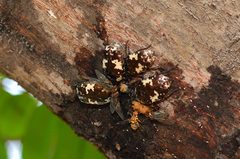
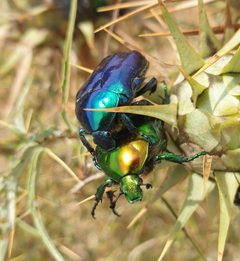
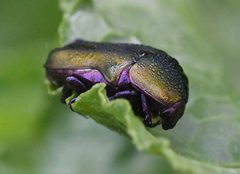
Protaetia are flower chafers (Cetoniinae) with compact, often oval bodies and frequently exhibit metallic coloration in shades of green, blue, , or bronze. As a -level entry, specific diagnostic features for species identification are not provided. The Cetoniinae can be distinguished from other scarab subfamilies by the combination of an exposed and the structure of the mesocoxae. Protaetia orientalis is specifically noted as morphologically indistinguishable from Oryctes rhinoceros in early life stages ( and first-instar larvae), requiring genetic testing for reliable differentiation.
Images
Distribution
Primarily Asia, with additional records in the Palaearctic, Oriental, Australian, and Madagascan regions according to GBIF. Protaetia orientalis has been introduced and is now widespread in Hawaii. Protaetia brevitarsis is documented from China and South Korea.
Behavior
of at least some have been observed to be attracted to fermenting baits. In a field study using molasses/beer and red wine traps, Protaetia (Liocola) lugubris was collected after 6 days. Protaetia marmorata has been documented from traps baited with white wine, sugar, and yeast.
Human Relevance
Protaetia brevitarsis larvae are a traditional food source in southern China and Southeast Asia, with high protein content (42-66% depending on preparation). Laboratory studies in mice suggest potential functional food applications for immune enhancement. Protaetia orientalis is an in Hawaii where it creates identification challenges for pest management: its early life stages are morphologically indistinguishable from the destructive coconut rhinoceros beetle (Oryctes rhinoceros), potentially leading to misallocation of resources or missed detection of pest .
Similar Taxa
- Oryctes rhinoceros, first-instar larvae, and excrement are morphologically indistinguishable from Protaetia orientalis, requiring genetic testing (multiplex assay) for differentiation. are more readily distinguished.
- LiocolaProtaetia (Liocola) lugubris indicates this group has been treated as a subgenus within Protaetia, suggesting close taxonomic relationship and similar .
More Details
Invasive Detection Challenges
In Hawaii, the presence of widespread Protaetia orientalis complicates early detection of Oryctes rhinoceros because their stages cannot be distinguished morphologically. A multiplex assay developed by University of Hawaii researchers can differentiate the two from , larvae, or excrement in hours, compared to weeks required to rear larvae to identifiable third instar.
Nutritional Research
Protaetia brevitarsis has been subject to laboratory nutritional analysis showing 42.83% protein in larva powder and 66.22% in whole larvae, with low fat content (5.47% and 15.42% respectively). Feeding studies in ICR mice demonstrated enhanced cellular , humoral immunity, and beneficial changes to gut composition.
Sources and further reading
- BugGuide
- Wikipedia
- GBIF taxonomy match
- iNaturalist taxon
- NCBI Taxonomy
- Catalogue of Life
- Beetle Collecting 101: Fermenting bait traps for collecting longhorned beetles | Beetles In The Bush
- Coconut Rhinoceros Beetle or Oriental Flower Beetle? New Genetic Test Gives Faster Answer
- The potential of Protaetia brevitarsis as a functional food that enhances immune function and gut microbiota in mice.
- Quality characteristics of chicken nuggets containing Protaetia brevitarsis seulensis larvae during refrigeratedstorage.