
Mydidae
Mydas flies, Mydaid flies
Subfamily Guides
4- Ectyphinae
- Leptomydinae(Mydas flies)
- Mydinae(mydas flies)
- Rhaphiomidinae
Mydidae, or mydas flies, are a small of large to very large flies within the superfamily Asiloidea. With approximately 471 described , they represent one of the most distinctive dipteran groups due to their exceptional size—Gauromydas heros is the largest known fly species—and their frequent mimicry of stinging hymenopterans, particularly spider wasps. Most species inhabit arid and semiarid regions globally. The family is poorly studied, with larval documented for only a handful of species.
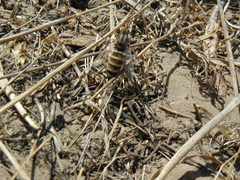
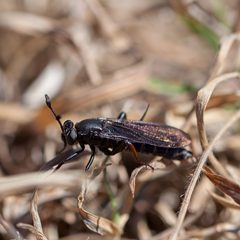
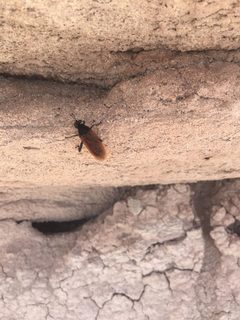
Pronunciation
How to pronounce Mydidae: /ˈmɪdɪˌdiː/
These audio files are automatically generated. While they are not always 100% accurate, they are a good starting point.
Identification
Mydidae can be distinguished from the superficially similar robber flies (Asilidae) by their elongate, clubbed —robber flies possess short, simple antennae. The is further characterized by extremely large body size relative to other flies, with some exceeding 60 mm in length. Many species exhibit aposematic coloration, typically black bodies with red or orange abdominal markings, mimicking pompilid wasps. have a robust, somewhat -like build with large .
Images
Habitat
Most mydid are found in arid and semiarid regions, including deserts, savannas, and dry grasslands. They also occur in other such as open woodlands and forest edges. Larval habitats include decaying wood, particularly stumps and logs infested with wood-boring beetles, and some species have been recorded from nests (Atta and Acromyrmex spp.).
Distribution
distribution with highest diversity in tropical and subtropical regions. Documented from North America (including the eastern United States, western states, and Mexico), South America (Amazonia, Brazilian savanna, Atlantic Forest remnants), southern Africa (Namibia, South Africa), and Australia (Western Australia, South Australia, Queensland). The Neorhaphiomidas is to Australia.
Diet
males have been observed visiting flowers, presumably for nectar. Adult females are unlikely to feed. Larvae are , feeding on Coleoptera—specifically wood-boring larvae—and have been documented in nests.
Host Associations
- Atta spp. - larval in nestsLarvae found in nests of leaf-cutter ants
- Acromyrmex spp. - larval in nestsLarvae found in nests of leaf-cutter ants
- Texania campestris - preyLarvae reared from sycamore stump infested with this buprestid
- Platanus occidentalis - Dead sycamore stumps serve as larval development sites
Life Cycle
Complete with poorly documented stages. Larvae develop in decaying wood or nests, feeding on larvae or other prey. occurs within the substrate. are short-lived and emerge to mate. Only three worldwide have published larval and pupal descriptions: Mydas clavatus (North America), Diochlistus gracilis (Australia), and Miltinus viduatus (Australia).
Behavior
are generally slow-moving and conspicuous, flying boldly in open areas due to their protective mimicry. Males have been observed taking nectar from flowers. Mating has been observed in Diochlistus gracilis, though details are not fully documented. Adults are not aggressive and do not sting despite their appearance.
Ecological Role
Larvae function as of wood-boring larvae, potentially regulating of these beetles in dead wood . Their association with nests suggests additional ecological interactions that remain poorly understood. may contribute to pollination through nectar feeding.
Human Relevance
Mydas flies pose no threat to humans despite their intimidating size and -like appearance. They do not bite or sting. Some are rare and of conservation interest, such as Rhaphiomidas moapa from sand dune . The is of scientific interest due to its phylogenetic position within Asiloidea and the extreme body size of Gauromydas heros.
Similar Taxa
- AsilidaeRobber flies share large size, predatory habits, and -mimicking coloration with Mydidae. Distinguished by short, simple versus the elongate clubbed antennae of Mydidae, and by generally more agile .
- ApioceridaeRelated within Asiloidea that also includes large flies. Distinguished by different wing venation and male genitalia structure.
- PompilidaeSpider wasps are the hymenopteran models for mydas fly . Distinguished by two pairs of wings (four total), narrow waist, and actual stinging capability.
Sources and further reading
- BugGuide
- GBIF taxonomy match
- iNaturalist taxon
- NCBI Taxonomy
- Catalogue of Life
- Bug Eric: Robber Flies
- flies | Beetles In The Bush | Page 8
- Magnificently Monstrous Muscomorphs | Beetles In The Bush
- cybertaxonomy | Blog
- Ospriocerus abdominalis | Beetles In The Bush
- Two new species of Rhaphiomidas (Diptera: Mydidae)
- New Records of Distribution for Protomydas coerulescens (Olivier) (Diptera: Mydidae)
- A new species of Neorhaphiomidas Norris (Diptera: Mydidae) from Queensland, Australia
- Investigation of the families Asteiidae, Lauxaniidae, Mydidae, and Neriidae (Insecta: Diptera)
- Investigation of the families Asteiidae, Lauxaniidae, Mydidae, and Neriidae (Insecta: Diptera)
- Review of the genus Namadytes Hesse, 1969 (Insecta: Diptera: Mydidae: Syllegomydinae)
- A new Mapinguari Papavero & Wilcox (Diptera, Mydidae, Mydinae) from Minas Gerais State, Brazil
- Immature stages of two Australian mydas flies (Diptera: Mydidae) of the genera Diochlistus and Miltinus
- Behavior of the Delhi Sands Flower-Loving Fly (Diptera: Mydidae), a Little-Known Endangered Species