
Apioceridae
Flower-loving Flies
Genus Guides
1- Apiocera(Flower-loving Flies)
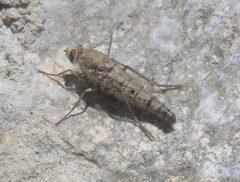
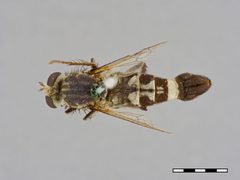
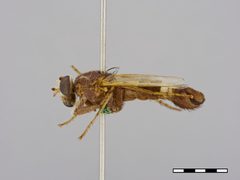
, commonly known as flower-loving flies, is a of true flies (Diptera) comprising approximately 150 . The family was historically considered to contain multiple , but taxonomic revision has restricted it to the single genus Apiocera. Members are notable for their strong, fast and association with flowers. The family exhibits a disjunct distribution across arid regions of North America, South America, and Australia, with the Australian fauna being the most diverse globally. are active primarily in spring and summer, with midday activity in hot, sunny conditions. Larvae develop in sandy soils.
Pronunciation
How to pronounce Apioceridae: /ˌæpiːoʊˈsɛrɪdaɪ/
These audio files are automatically generated. While they are not always 100% accurate, they are a good starting point.
Identification
Images
Habitat
frequent flowers in terrestrial environments. Larvae inhabit sandy soils in dry, arid including deserts and coastal areas. Australian occur from sea-shores to mountain summits, with Western Australia showing particularly high diversity.
Distribution
Disjunct distribution across three continents: North America (desert regions), South America (southern regions), and Australia (widespread including Western Australia, South Australia, Victoria, New South Wales, and Queensland). The Australian fauna is the richest in the world with 64 Apiocera and 6 Neorhaphiomydas .
Seasonality
active in spring and summer; midday activity in hot, sunny conditions.
Diet
feed on nectar from flowers. Larval diet presumed to be or parasitic, though this remains unconfirmed.
Life Cycle
Larvae develop in sandy soils. emerge in spring and summer. Specific developmental stages and duration not documented.
Behavior
Males patrol sandy areas and pounce on females for mating, followed by a struggle between sexes. are strong, fast fliers. Activity concentrated during midday in hot, sunny conditions.
Ecological Role
may function as due to frequent flower visitation. Soil-dwelling larvae may contribute to soil processes, though specific roles undocumented.
Human Relevance
Subject of taxonomic research, particularly in Australia where comprehensive reviews have been conducted. The has been used as a model group for demonstrating cybercatalog approaches to , linking specimen data, images, and literature through persistent identifiers.
Similar Taxa
More Details
Taxonomic History
The has undergone significant taxonomic revision. Cazier (1941) recognized as occupying only southern Australia, but subsequent work expanded this to include arid regions of the Americas. Multiple formerly placed in Apioceridae have been transferred to Mydidae, leaving only Apiocera in the family.
Research Significance
The Australian fauna has been extensively reviewed, with a 1953 review adding 49 new Apiocera and 4 new Neorhaphiomydas species. The was featured in a 2015 cybercatalog demonstrating how taxonomic knowledge can be networked through persistent identifiers linking to online data repositories.
Sources and further reading
- BugGuide
- GBIF taxonomy match
- iNaturalist taxon
- NCBI Taxonomy
- Catalogue of Life
- Diptera | Blog - Part 3
- cybercatalog | Blog
- ZooBank | Blog
- DOI | Blog
- data | Blog - Part 2
- Plazi | Blog
- A review of Australian Apioceridae (Diptera)
- Redescription of Apiocera clavator with Notes on Its Behavior (Diptera: Apioceridae)1,2
- Review of the Australian <i>Apiocera minor</i> Norris species-group (Diptera: Apioceridae) with a revised key to species