
Stizoides renicinctus
(Say, 1823)
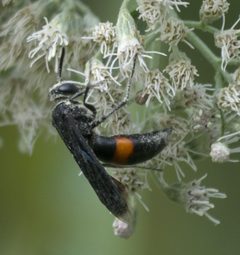
Stizoides renicinctus is a kleptoparasitic sand wasp in the Crabronidae, one of only two in its occurring in North America. The species has no common English name. It is known for its distinctive black body with a red or orange band on the second abdominal tergite, dark wings with translucent tips, and elongate build. Males are frequently observed visiting flowers for nectar, while females actively seek out the burrows of to exploit their food stores. The species exhibits unusual social including nighttime sleeping clusters and weather-related .
Pronunciation
How to pronounce Stizoides renicinctus: /ˌstiːzoʊˈaɪdiːz ˌrɛnɪˈsɪŋktəs/
These audio files are automatically generated. While they are not always 100% accurate, they are a good starting point.
Identification
Field marks include all black body with red or orange band on second abdominal segment, dark wings with translucent wingtips, and elongate build. Both sexes similar in size (16-18 mm). Distinguished from similar-looking Scolia dubia (Blue-winged Wasp), spider wasps (Anoplius spp.), and the large fly Mydas clavatus by combination of abdominal band position, wing coloration, and overall proportions. Reliable identification requires examination by an entomologist.
Images
Habitat
Associated with supporting ; observed in Colorado Springs neighborhoods on saltcedar trees, in southern Arizona along dry arroyos and rivers, and in shortgrass prairie environments. Presence indicates healthy habitat with abundant or prey supporting host wasp populations.
Distribution
North America: from Michigan and Wisconsin south to North Carolina and west to Alberta, British Columbia, California, Arizona, and Mexico. Also recorded in Central America. Primarily western in distribution, found almost exclusively west of the Mississippi River in the United States.
Seasonality
active from latter half of June through summer months in Colorado; males observed on flowers during this period. One record of loose forming on June 16 as storm clouds gathered, suggesting weather-related behavioral responses.
Host Associations
- Prionyx - -hunting sphecid ; female Stizoides destroys and replaces with her own in burrow stocked with paralyzed Acrididae
- Palmodes - -hunting sphecid ; documented parasitizing Palmodes laeviventris in Nevada with estimated 7.5% rate
- Acrididae - indirect prey provided by Prionyx
- Tettigoniidae - indirect prey including provided by Palmodes
Life Cycle
Behavior
Kleptoparasitic: raids food caches of rather than hunting own prey. Males visit flowers for nectar, establishing territories around flowering shrubs. Females actively search for host burrows. Exhibits : forms 'sleeping' clusters on vegetation at night, and gathers in loose aggregations in response to impending inclement weather. Sometimes found amid sleeping clusters of other solitary wasp . Documented making low 'orientation ' before departing nest area.
Ecological Role
Kleptoparasite of beneficial predatory ; may reduce of - and -hunting wasps that provide agricultural pest control. Estimated 7.5% rate in one Nevada study, extrapolated to roughly 10,000 destroyed Palmodes nests in 350 square yards. Presence may indicate healthy with abundant wasp populations and their prey.
Human Relevance
No direct agricultural or medical significance. Potential indirect negative impact through of beneficial predatory that control and pests. Subject of citizen science interest due to unusual appearance and ; frequently misidentified by observers due to resemblance to more common wasp .
Similar Taxa
- Scolia dubiaBlue-winged Wasp; similar black body with colored abdominal markings, but has blue wings and different banding pattern; much more common and widespread
- Anoplius atroxSpider wasp; similar black body with red/orange markings, but more slender with longer legs; active hunter of spiders rather than kleptoparasite
- Mydas clavatusLarge fly mimic; equal or larger size, similar coloration, but single pair of wings and different body proportions; harmless
Misconceptions
Frequently misidentified by non-entomologists due to resemblance to more common . Author explicitly notes that most reported sightings from Florida, eastern states, and even Guam and Malaysia are erroneous, representing Scolia dubia, spider wasps, or other look-alikes. Species is not aggressive toward humans; being solitary, it does not defend nests aggressively.
More Details
Taxonomic Note
One of only two Stizoides in North America; the other, S. foxi, is restricted to Arizona and Mexico. Globally, contains approximately 30 species found primarily in Africa, Mediterranean Europe, Middle East, and India.
Historical Documentation
I. LaRivers documented of Palmodes laeviventris in Elko County, Nevada in 1945 (American Midland Naturalist), providing quantitative estimate of parasitism impact.
Observation Challenge
Finding a female in act of locating or exploiting a burrow could reveal previously unknown host relationships; author encourages observers to document such .