
Anoplius atrox
(Dahlbom, 1843)
Spider wasp
Anoplius atrox is a of spider wasp in the Pompilidae. It is a large, robust with distinctive coloration that has been frequently mistaken for other wasp species by observers. The species is known to prey on spiders, particularly wolf spiders (Lycosidae), which it paralyzes and provisions in underground burrows for its larvae. It has been documented in North America, with records from various regions including the western United States.
Pronunciation
How to pronounce Anoplius atrox: /əˈnɒplɪəs ˈeɪtrɒks/
These audio files are automatically generated. While they are not always 100% accurate, they are a good starting point.
Identification
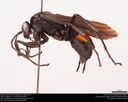
Anoplius atrox is a large spider wasp, typically with an all-black body and distinctive orange or red markings on the —often appearing as spots or a band on the second abdominal segment (tergite). It has been specifically noted as resembling Stizoides renicinctus in general appearance, though the latter is a kleptoparasitic with different . The wings are dark with translucent tips. Body length appears substantial, with individuals described as 'very large' relative to common wasps. Microscopic examination is typically required for definitive -level identification within the Anoplius, as many species are superficially similar.
Images
Distribution
North America; specifically documented from Colorado and other western states, with range extending to regions where it overlaps with similar-looking .
Diet
Spiders, particularly wolf spiders ( Lycosidae). The paralyzes prey with venom delivered via sting to nerve centers, then transports the immobilized spider to an underground burrow where an is laid on the victim.
Life Cycle
Solitary nesting . Females excavate burrows, often originating inside existing burrows or crevices, or dig new tunnels in soil. Each burrow is provisioned with one or more paralyzed spiders, with a single laid per spider. The larva consumes the living but paralyzed . Multiple burrows may be excavated simultaneously before one is selected for completion.
Behavior
Females hunt spiders actively, backwards while carrying prey using their . They have been observed to abandon prey if disturbed during transport. Both sexes visit flowers for nectar. The is not social and does not defend communal nests.
Ecological Role
of spiders; contributes to regulation of wolf spider . As a solitary , it does not provide significant pollination services despite nectar-feeding.
Human Relevance
Can sting if handled or threatened, but being solitary is not defensive of nests and generally not aggressive toward humans. Frequently mistaken by non-entomologists for other including Stizoides renicinctus, Scolia dubia (Blue-winged Wasp), and the mydas fly Mydas clavatus.
Similar Taxa
- Stizoides renicinctusNearly identical color pattern with black body and orange/red abdominal band; distinguished by as kleptoparasite of other rather than active spider hunter, and by geographic restriction primarily west of the Mississippi River
- Scolia dubia (Blue-winged Wasp)Similar size and dark coloration with abdominal markings; distinguished by blue-black wings and different body proportions
- Mydas clavatusLarge fly mimic with similar size and coloration; distinguished by single pair of wings ( Diptera) and fly-like structure
- Anoplius aethiopsSimilar large black spider wasp with blue-violet wing reflections; requires microscopic examination to separate, with A. aethiops more common in late summer to fall and visiting flowers more regularly
- Anoplius semicinctusSimilar black body with red spots on ; distinguished by specific pattern details requiring close examination
Misconceptions
Widely reported from eastern and southeastern United States (Florida, Georgia, North Carolina, Virginia, New York, New England) by observers, but these records almost certainly represent misidentifications of Scolia dubia, Mydas clavatus, or other Anoplius . The actual range of A. atrox appears to be more western, and the species has been explicitly noted as not occurring in many eastern states where it has been claimed.
Sources and further reading
- BugGuide
- Wikipedia
- GBIF taxonomy match
- Catalogue of Life
- Bug Eric: Wasp Wednesday: Stizoides renicinctus
- Bug Eric: Wasp Wednesday: Anoplius aethiops
- Bug Eric: Wasp Wednesday: Anoplius
- Western Diamondback Rattlesnake | Beetles In The Bush
- Rattlesnakes may be present! | Beetles In The Bush
- Bug Eric: Spider Sunday: Beach Wolf Spider