
Anoplius aethiops
(Cresson, 1865)
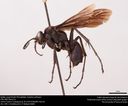
Anoplius aethiops is a large spider wasp in the Pompilidae. Females hunt and paralyze wolf spiders (family Lycosidae), particularly in the Hogna, to provision underground burrows for their offspring. The species is widely distributed across North America and is most active in late summer and early fall. It is morphologically similar to Anoplius cleora, requiring microscopic examination for definitive identification.
Pronunciation
How to pronounce Anoplius aethiops: //əˈnoʊpliəs ˈiːθiˌɒps//
These audio files are automatically generated. While they are not always 100% accurate, they are a good starting point.
Identification
Distinguished from the similar Anoplius cleora by preference and : A. aethiops occurs in fields, meadows, and forest edges, while A. cleora replaces it in open sand dune habitats. A. aethiops frequently visits flowers for nectar; A. cleora rarely does. Definitive identification requires microscopic examination. Distinguished from Sphex and other sphecid by the broad connection between and (no thin petiole).
Images
Appearance
Large, robust spider wasp with a jet black body that reflects bluish or purplish iridescence in certain light. Females measure 13–23 mm in body length; males are smaller at 9–18 mm. Wings are black with blue or violet reflections. The is broadly joined to the without a thin petiole or stalk, distinguishing it from sphecid like Sphex. Body is stout rather than slender, with relatively shorter legs compared to some other spider wasp .
Habitat
Open areas including overgrown fields with fine-grained soil, meadows, prairies, and forest edges. Replaced by A. cleora in open sand dune . Requires suitable soil conditions for burrow excavation.
Distribution
Coast to coast in the United States except North Dakota; southern British Columbia and southeastern Canada to the north; Mexico and Guatemala to the south. Less common in the southeastern United States compared to other parts of its range.
Seasonality
Late July through mid-September, persisting into late fall in some regions. Most common in late summer.
Host Associations
- Lycosidae - preyWolf spiders, especially Hogna: H. helluo, H. carolinensis, H. aspersa, H. baltimoriana, H. frondicola, Rabidosa santrita, Gladicosa gulosa, Schizocosa ocreata
Life Cycle
Females dig individual burrows, often originating inside existing burrows or crevices. They hunt, sting to paralyze, and transport wolf spiders to the burrow. A single is laid on the paralyzed spider, the burrow is closed, and the process repeats. The larva feeds on the living but paralyzed spider. Multiple per year not documented; may show wing wear indicating extended activity periods.
Behavior
Females walk backward rapidly while transporting prey, using to lift the spider completely off the ground. Both sexes visit flowers including wild carrot, goldenrod, sweet clover, milkweed, and thoroughwort for nectar. If disturbed during prey transport, females may abandon the paralyzed spider. Paralyzed spiders may eventually recover if not retrieved by the .
Ecological Role
of wolf spiders, regulating spider in open . Provides food source for kleptoparasitic and other organisms that may exploit its nests. contribute to pollination through nectar feeding.
Human Relevance
Not aggressive toward humans; stings possible if handled but not considered dangerous. Ecologically beneficial as of wolf spiders and as . May be encountered in gardens, parks, and natural areas with suitable .
Similar Taxa
- Anoplius cleoraMorphologically nearly identical; distinguished by (sand dunes vs. fields/edges), flower-visiting (rare vs. frequent), and geographic distribution
- Sphex spp.Similar large black with blue-black wings, but have thin petiole separating and ; different (Sphecidae)
- Great Black Wasp (Sphex pensylvanicus)Large size and coloration cause initial confusion, but petiole structure and -level differences separate them
More Details
Prey Transport
The 's method of backward while lifting heavy prey with has been described as equivalent to a human lifting a recliner with their teeth and backing across a street.
Identification Challenges
The is part of a complex of similar black spider wasps in Anoplius that are difficult to separate without microscopic examination and expert knowledge.
Wing Wear
Specimens observed in late season often show tattered wings, indicating extended activity periods and multiple nesting cycles.
Sources and further reading
- BugGuide
- Wikipedia
- GBIF taxonomy match
- NCBI Taxonomy
- Catalogue of Life
- Bug Eric: Wasp Wednesday: Anoplius aethiops
- Bug Eric: Moving, Again
- Bug Eric: Spider Sunday: Dotted Wolf Spider
- Bug Eric: Wasp Wednesday: Anoplius
- Rosie defoliators: Roseslug sawfly, Endelomyia aethiops, Curled rose sawfly, Allantus cinctus, and Bristley rose sawfly, Cladius pectinicornis — Bug of the Week
- Bug Eric: Wasp Wednesday: Stizoides renicinctus