
Schizocosa ocreata
(Hentz, 1844)
Brush-legged Wolf Spider, Brush-legged Split Wolf Spider
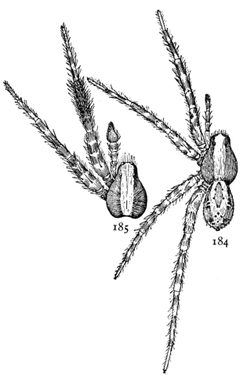
A medium-sized wolf spider native to eastern and central North America, distinguished by prominent . Males possess conspicuous dark bristle tufts on their forelegs used in , while females lack these ornamentations. The has become a model organism for studies of multimodal sexual communication, , and -prey interactions involving visual signaling.

Pronunciation
How to pronounce Schizocosa ocreata: //ˌskɪtsəˈkoʊsə oʊˈkrɛətə//
These audio files are automatically generated. While they are not always 100% accurate, they are a good starting point.
Identification
Distinguished from congeneric by male foreleg bristle tufts—specifically, the presence and size of these tufts separate it from Schizocosa bilineata. Females difficult to identify to species without examination of epigynal structures or association with males. Dark stripe and 'cardiac' mark on provide -level characters but not species-level in females.
Images
Appearance
Medium-sized wolf spider with distinct . Males display prominent dark, fur-like bristle tufts on the forelegs—the namesake 'brush-legged' trait. Both sexes have a dark stripe on the and , with darker lateral coloration providing crypticity. Body length approximately 9–18 mm in males, 13–23 mm in females. The bristle tufts on male forelegs are the only morphological feature distinguishing this from its Schizocosa bilineata.
Habitat
Eastern deciduous forest leaf litter; open areas including fields, forest edges, meadows, and prairies. Ground-dwelling, utilizing debris and grass tussocks for shelter. Microhabitat selection influenced by humidity requirements and risk.
Distribution
Eastern and central United States; recorded from Nebraska eastward through the Midwest and South to the Atlantic coast. Absent from Pacific coast states, Idaho, and Nevada. Distribution overlaps with that of spider wasp Anoplius aethiops, which preys upon this .
Seasonality
active from spring through fall; as adults or immatures in leaf litter or protected ground-level microsites. Peak activity in late summer. Females with sacs observed in early spring. Males may persist later in season despite higher dehydration risk.
Diet
Active feeding on crickets (Acheta domesticus), various insect , and Collembola. Prey captured without web use, relying on vision and vibration detection. Diet quality influences female receptivity to mating and reproductive output.
Host Associations
- Climaciella brunnea - mantisfly larvae board spiders and enter sacs to consume spider eggs; S. ocreata recorded as in Illinois
- Anoplius aethiops - preySpider wasp paralyzes and provisions burrows with this wolf spider
Life Cycle
Hemimetabolous development with multiple instars. Molting required for sexual maturation; well-fed females require more but achieve maturity faster with greater body mass. Self-amputation and limb adds approximately 3.7 days to molting time. Females produce sacs carried attached to ; egg number and size positively correlated with maternal diet history. Lifespan approximately 1–2 years.
Behavior
Non-web-building utilizing exploitative competition for prey acquisition. Males perform elaborate multimodal courtship combining visual leg-tuft displays with vibratory seismic signals. Males exhibit eavesdropping , increasing courtship effort when detecting rival male signals. Trail-following of virgin female chemical cues; males cannot determine directionality from trails. 'Freezing' behavior used as anti-predator defense. Self-amputation of damaged limbs with subsequent .
Ecological Role
regulating of ground-dwelling insects and other arthropods. Serves as significant prey item for visually acute predators including birds, American toad (Anaxyrus americanus), and spider wasps. Subject to by mantisfly larvae. Sexual signals create trade-off between mating success and risk, potentially influencing .
Human Relevance
Not medically significant; bites may cause local pain but not classified as dangerous. Venom used defensively against conspecifics rather than humans. Important model organism for behavioral research, particularly studies of , multimodal communication, and honest signaling. Research subjects for studies of , dehydration physiology, and transcriptomics.
Similar Taxa
- Schizocosa bilineata; distinguished only by male foreleg tuft ; formerly considered
- Rabidosa rabidaSympatric large wolf spider; lacks foreleg tufts; different preferences and geographic range
- Hogna spp.Large sympatric wolf spiders; lack in foreleg ornamentation; different body proportions
More Details
Multimodal Sexual Communication
Males combine visual signals (foreleg tuft displays) with vibratory seismic signals during courtship. Females show increased receptivity to multimodal versus unimodal signals, though signal modes appear redundant in qualitative effect. Female preference influenced by prior exposure—familiarity with particular tuft-size phenotypes increases receptivity to those phenotypes.
Sexual Conflict and Cannibalism
Females frequently attack males post-copulation; males use venom defensively to reduce risk. Copulatory wounding occurs when males use fangs to scar females during mating. Sexual cannibalism represents significant mortality source for males, particularly smaller individuals with smaller tufts.
Immune Function and Development
exposure to bacterial (e.g., Pseudomonas aeruginosa) enhances response and melanization . Cuticular hydrocarbons convey information about female mating status and diet history; male chemical cues indicate status to discriminating females.
Predation-Communication Trade-off
Courting males more conspicuous to avian than non-courting individuals due to movement patterns and coloration. Stationary 'freezing' reduces detection risk. Behavioral plasticity mediates conflict between sexual advertisement and survival.
Sources and further reading
- BugGuide
- Wikipedia
- GBIF taxonomy match
- iNaturalist taxon
- NCBI Taxonomy
- Catalogue of Life
- Bug Eric: Wasp Wednesday: Anoplius aethiops
- Bug Eric: Spider Sunday: Spring Spiders
- Bug Eric: Wasp Mantisfly
- The brain transcriptome of the wolf spider, Schizocosa ocreata
- Trail-following behavior by males of the wolf spider, Schizocosa ocreata (Hentz)
- Courtship behavior and coloration influence conspicuousness of wolf spiders (Schizocosa ocreata (Hentz)) to avian predators
- Male chemical cues as reliable indicators of infection in the wolf spider Schizocosa ocreata
- Male courtship signal modality and female mate preference in the wolf spider Schizocosa ocreata: results of digital multimodal playback studies
- Dehydration resistance and tolerance in the brush-legged wolf spider (Schizocosa ocreata): a comparison of survivorship, critical body water content, and water-loss rates between sexes