
Schizocosa
Chamberlin, 1904
Brush-legged Spiders
Species Guides
15- Schizocosa aulonia
- Schizocosa avida(lance wolf spider)
- Schizocosa bilineata
- Schizocosa ceratiola
- Schizocosa crassipalpata
- Schizocosa crassipes
- Schizocosa maxima
- Schizocosa mccooki(McCook's Split Wolf Spider)
- Schizocosa mimula
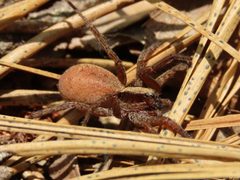
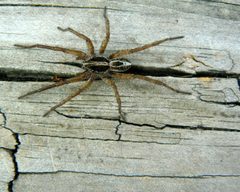
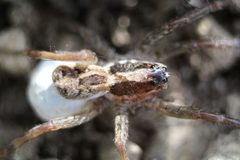
Schizocosa is a of wolf spiders (Lycosidae) comprising 56 distributed across North and South America, Africa, and East and Southeast Asia. Members are medium to large spiders (5–15 mm, occasionally to 28 mm) with strong legs, keen eyesight, and distinctive . The genus is notable for elaborate male courtship involving vibratory and acoustic signals, with some species exhibiting prominent leg ornamentation. Several species have been extensively studied for , reproductive isolation, and behavioral .
Pronunciation
How to pronounce Schizocosa: /ˌskɪzoʊˈkoʊsə/
These audio files are automatically generated. While they are not always 100% accurate, they are a good starting point.
Identification
Distinguished from other Lycosidae by shape: or concave margin, narrowed and steeply sloped at first leg . The combination of distinct mark, procurved first row, and specific male leg ornamentation (where present) aids -level identification. Schizocosa ocreata males have prominent black bristle tufts on forelegs; S. rovneri lacks these. S. mccooki is notably large within the . Some species pairs require microscopic examination for definitive separation.
Images
Appearance
Medium to large wolf spiders with robust, elevated bodies and strong legs. or concave posteriorly, narrowed and steeply sloped at first leg ; uniform in height from groove to third row when viewed laterally. Dorsal fovea long, distinct, and shallow. Lateral carapace areas dark red-brown to nearly black with black streaking; pale submarginal bands narrow but distinct, sometimes broken into spots. Eye area and highest carapace region black. First eye row procurved, narrow; eyes uniform with or slightly larger than anterior lateral eyes. ovoid with distinct dark mark extending over half its length. Legs moderately long, stout, with strong macrosetae.
Habitat
Primarily grassland and meadow , including fields, prairies, and deciduous forest leaf litter. S. heasmani occurs in meadows; S. aulonia inhabits beaches and sand dunes. Ground-dwelling among grasses and low vegetation; may use leaf litter or grass tussock bases for shelter.
Distribution
North America, South America, Africa, and East and Southeast Asia. In North America, common throughout most of the continent; S. ocreata occurs in eastern United States deciduous forests. Specific collection records include Lancaster County, Nebraska; eastern Ontario; northeastern Illinois; Colorado Springs, Colorado.
Seasonality
Active during spring through fall; and immatures may overwinter. Peak activity varies by and latitude. S. ocreata and S. rovneri show identical laboratory maturation patterns across temperature and light regimes. Adults observed active in early March in temperate regions when temperatures exceed 10°C.
Host Associations
- Climaciella brunnea - Mantispid larvae board Schizocosa spiders, transfer to females during mating if initial is male, and enter sacs to feed on spider eggs
- Anoplius aethiops - Spider wasp paralyzes Schizocosa ocreata and other wolf spiders to provision nests
Life Cycle
Development includes /subadult and mature stages. may occur as adults or immatures outside sacs. Females carry egg sacs attached to . Copulation consists of two successive patterns: Pattern I with multiple consecutive insertions per palp, and Pattern II with alternating palp use after each insertion.
Behavior
Fast, darting movement when pursuing prey or seeking cover. Males perform elaborate courtship with vibratory signals including thumps and raps; substratum-coupled acoustic signals critical for female receptivity. Courtship vigor and signal characteristics predict mating success. Male-male agonistic displays and dominance-subordinance relations occur in some . Females may exhibit aggression and sexual . Males adjust copulatory under competition risk; females frequently become refractory to remating after partial copulations.
Ecological Role
Ground-dwelling in grassland and forest floor . Serve as prey for spider wasps (Pompilidae) and for mantispid .
Human Relevance
Subject of extensive behavioral and evolutionary research, particularly regarding , speciation, and vibratory communication. No documented medical or economic significance.
Similar Taxa
- RabidosaSimilar large wolf spider ; both include for Climaciella brunnea mantispids and prey for spider wasps
- HognaOverlapping size range and use; both preyed upon by Anoplius aethiops
- GladicosaSimilar ground-dwelling wolf spider ; shared
More Details
Research significance
Schizocosa is among the most intensively studied spider for behavioral and . Research on S. ocreata and S. rovneri has demonstrated how similar achieve reproductive isolation through courtship signal divergence despite overlapping ranges, , and morphological similarity. The genus exemplifies how vibratory and evolves under sexual selection.
Male ornamentation variation
in leg ornamentation varies substantially among . S. ocreata males possess prominent black bristle tufts on forelegs used in visual and tactile displays; S. rovneri lacks these structures. This variation has been used to study ornament evolution and female choice mechanisms.
Temperature effects on behavior
Laboratory studies demonstrate that temperature variation affects courtship signal form and female preference expression. Higher temperatures increase courtship rates, and female preferences for specific signal traits (e.g., 'chirp' duration) may only manifest at warmer temperatures, with implications for mating success in variable environments.
Sources and further reading
- BugGuide
- Wikipedia
- GBIF taxonomy match
- iNaturalist taxon
- NCBI Taxonomy
- Catalogue of Life
- Bug Eric: Wasp Wednesday: Anoplius aethiops
- Bug Eric: Spider Sunday: Spring Spiders
- Bug Eric: Wasp Mantisfly
- The brain transcriptome of the wolf spider, Schizocosa ocreata
- Wolf Spider Sociobiology: Ii. Density Parameters Influencing Agonistic Behavior in Schizocosa Crassipes
- The Inheritance of Courtship Behavior in Schizocosa Wolf Spiders (Araneae; Lycosidae)
- Digest: temperature variation effects on wolf spider (Schizocosa floridana) courtship behaviors
- The effects of conspecific male density on the reproductive behavior of male Schizocosa retrorsa (Banks, 1911) wolf spiders (Araneae: Lycosidae)
- The Effect of Temperature on the Courtship Behavior of the Wolf Spider Schizocosa rovneri (Araneae: Lycosidae)
- Wolf Spider Sociobiology: I. Agonistic Display and Dominance-Subordinance Relations in Adult Male Schizocosa Crassipes
- The Inheritance of Courtship Behavior and Its Role as a Reproductive Isolating Mechanism in Two Species of Schizocosa Wolf Spiders (Araneae; Lycosidae
- Two new species of the spider genus Schizocosa (Araneida: Lycosidae) from the Great Lakes region
- Timing of female sexual unreceptivity and male adjustment of copulatory behaviour under competition risk in the wolf spider Schizocosa malitiosa
- No evidence for a relationship between hemolymph ecdysteroid levels and female reproductive behavior inSchizocosawolf spiders
- Behavioral Ecology of the “Edge Effect”in Schizocosa Crassipes (Araneae: Lycosidae)
- EVOLUTION OF ORNAMENTATION AND COURTSHIP BEHAVIOR IN SCHIZOCOSA: INSIGHTS FROM A PHYLOGENY BASED ON MORPHOLOGY (ARANEAE, LYCOSIDAE)
- Female sexual receptivity after partial copulations in the wolf spider (Schizocosa malitiosa)
- Unraveling female mate choice in Schizocosa mccooki: The interplay of male mass and vibratory courtship