
Rabidosa
Roewer, 1960
Rabid Wolf Spiders, Dotted Wolf Spiders
Species Guides
5- Rabidosa carrana
- Rabidosa hentzi
- Rabidosa punctulata(Dotted Wolf Spider)
- Rabidosa rabida(Rabid Wolf Spider)
- Rabidosa santrita(Santa Rita Wolf Spider)
Rabidosa is a of wolf spiders ( Lycosidae) established by Roewer in 1960. The genus contains five recognized distributed in North America, with most species restricted to the United States. These are medium to large-sized, ground-dwelling spiders with characteristic patterning on the . Members of this genus have been subjects of behavioral research, particularly regarding mating systems and thermal . Several species are known for parasitic mantisfly larvae.
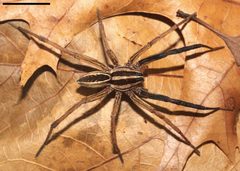
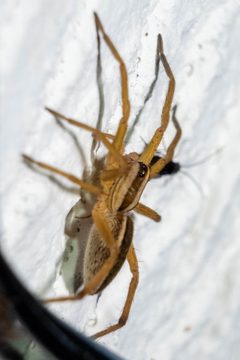
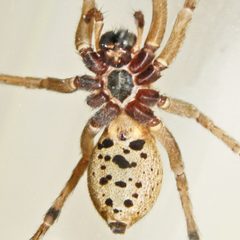
Pronunciation
How to pronounce Rabidosa: /ræbɪˈdoʊsə/
These audio files are automatically generated. While they are not always 100% accurate, they are a good starting point.
Images
Habitat
Ground-dwelling in open areas including fields, meadows, forest edges, and prairies. Some have been observed climbing vegetation to heights of approximately one meter, though this appears to be atypical possibly associated with avoidance.
Distribution
North America. Five occur in the United States: Rabidosa carrana, R. hentzi, R. punctulata, R. rabida, and R. santrita. Rabidosa rabida has the broadest distribution, occurring throughout North America.
Seasonality
activity varies by . For Rabidosa punctulata, mature females occur from June through October, with males appearing in early September. Activity patterns may include both and periods.
Diet
Preys on insects including small grasshoppers. May scavenge dead insects. Prey is seized with legs assisted by sticky brushes of hairs, and may be loosely wrapped in silk to secure it.
Host Associations
- Climaciella brunnea - Mantisfly larvae board spiders, transfer to females during mating, and enter sacs to feed on spider eggs. Rabidosa rabida is a documented .
- Anoplius aethiops - Spider wasp that paralyzes wolf spiders and provisions underground nests. Rabidosa santrita is among documented .
Life Cycle
Females attach sacs to using silk, carrying them for approximately one month while maintaining nomadic movement. Spiderlings emerge and climb onto the female's , attaching to specialized knob-tipped setae. They remain for roughly three weeks until their next . occurs in protected places, likely as spiderlings.
Behavior
Males follow -impregnated draglines of females. Two alternative mating strategies have been documented in R. punctulata: large males in good condition may overpower females through grappling, while smaller or poorer-condition males perform involving leg-waving and stridulation producing rhythmic vibrations. Primarily hunters that wait in ambush or actively run down prey. Shows chemically-mediated defensive in response to cues.
Ecological Role
of insects in ground-dwelling . Serves as for parasitic mantisfly larvae and prey for spider wasps.
Similar Taxa
- LycosaFormerly included some Rabidosa ; distinguished by geographic distribution (Lycosa is Old World with no North American species) and morphological characters established in taxonomic revision.
- HognaSimilar large wolf spiders that share and are also preyed upon by spider wasps; distinguished by abdominal patterning and genitalic characters.
More Details
Thermal Biology
Field observations of Rabidosa rabida suggest thermoconforming —body temperatures correspond closely to ambient temperatures rather than showing active . Maximum observed temperatures approach published critical thermal maxima. Spiders have been observed hunting and feeding at temperatures well above laboratory-measured thermal preferences.
Diel Activity
Rabidosa rabida exhibits cathemeral activity, with documented during both day and night periods. This pattern was previously undescribed for the .
Research Significance
Multiple in this have been used as model organisms for studies on mating , , thermal , and -prey interactions. Research has demonstrated that exposure disrupts mating behavior in R. rabida, and that seasonal temperature variability affects mating behaviors in R. punctulata.
Sources and further reading
- BugGuide
- Wikipedia
- GBIF taxonomy match
- iNaturalist taxon
- NCBI Taxonomy
- Catalogue of Life
- Bug Eric: Spider Sunday: Dotted Wolf Spider
- Bug Eric: Wasp Wednesday: Anoplius aethiops
- Bug Eric: Wasp Mantisfly
- PESTICIDES AFFECT THE MATING BEHAVIOR OF RABIDOSA RABIDA (ARANEAE, LYCOSIDAE)
- Observations of undescribed diel activity in the wolf spider Rabidosa rabida show cathemeral behavior
- Mating in the Cold: Seasonal Temperature Variability Affects Mating Behaviors of the Wolf Spider (Rabidosa punctulata)
- The effect of prior exposure to predator cues on chemically-mediated defensive behavior and survival in the wolf spider Rabidosa rabida (Araneae: Lycosidae)
- Field Observations of Body Temperature for the Wolf Spider,Rabidosa rabida(Araneae: Lycosidae), Differ From Reported Laboratory Temperature Preference Suggesting Thermoconforming Behavior
- Intraspecific Variation in the Thermal Biology of <I>Rabidosa rabida</I> (Araneae: Lycosidae) (Walckenaer) From the Mountains of Arkansas
- Female mating status affects male mating tactic expression in the wolf spider Rabidosa punctulata.