
Rabidosa punctulata
(Hentz, 1844)
Dotted Wolf Spider
Rabidosa punctulata is a ground-dwelling wolf spider distributed across the eastern and central United States. Mature females average 15.2 mm in body length, males 12.8 mm. The exhibits distinctive alternative male mating tactics: complex multimodal with substrate-borne vibrations and visual leg waves toward unmated females, versus direct coercive mounting with grappling toward already-mated females. Females carry sacs attached to their and provide extended maternal care, with spiderlings riding on the mother's for approximately three weeks after .
Pronunciation
How to pronounce Rabidosa punctulata: /ræbɪˈdoʊsə pʌŋkˈtjuːləˌtæ/
These audio files are automatically generated. While they are not always 100% accurate, they are a good starting point.
Identification
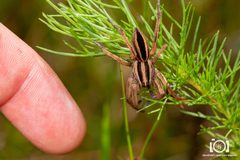
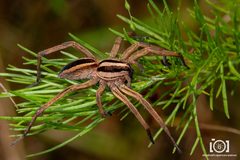
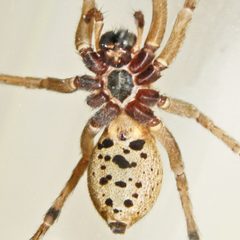
Light brown large wolf spider with stripes on the and bearing light spots with a dark middle stripe. Underside of abdomen has diagnostic pattern of black spots or blotches. Mature females lack the pale spots inside the margin of the dark chocolate stripe down the abdomen that characterize Rabidosa rabida. Males mature earlier than females, with males appearing in early September and females between June and October.
Images
Habitat
Areas of weeds and tall grasses. Found in open agricultural fields, wooded edges, and grassland . In eastern coastal areas, observed at edges of open fields in otherwise wooded regions.
Distribution
Eastern and central United States: Massachusetts west to Kansas, south to Texas and northern Florida. Range includes southern Michigan, eastern Oklahoma, and extends to southeast Kansas.
Seasonality
active primarily June through October. Mature females occur between June and October; mature males appear in early September with evidence of earlier maturation. Spiderlings overwinter in protected places after emerging in late autumn.
Diet
Preys on variety of insects including small grasshoppers. Has been observed to scavenge dead insects. hunter that employs ambush and pursuit strategies.
Life Cycle
Females mature 13-15 days post-maturation. Mated females require three or more hours to create sac attached to , permitting continued nomadic movement. Females carry egg sacs for approximately one month. Spiderlings emerge and pile atop female's , latching onto knob-tipped hairs where they ride until next roughly three weeks later. Spiderlings then disperse and overwinter in protected places.
Behavior
hunter that waits in ambush or runs down prey. Prey seized with legs aided by sticky brushes of hairs; may loosely wrap prey in silk to secure from falling when resting on vegetation. Males follow -impregnated draglines of females. Males express two alternative mating strategies: (1) complex multimodal courtship with leg-waving and stridulation producing rhythmic vibrations, mounting only after female receptivity; (2) direct mount tactic involving grappling and flipping unreceptive female onto back to limit resistance. Tactic expression depends on female mating status and male condition, with larger males in better condition more likely to adopt direct mount tactics. Females assess male condition and may cannibalize poor condition males. Once mated, females reduce receptivity and increase aggression toward courting males. Has been observed climbing vegetation to heights of three feet, possibly as avoidance in response to searching spider wasps.
Ecological Role
in grassland and edge . Serves as for parasitic mantidfly Climaciella brunnea, whose larvae board female spiders and enter sacs to feed on spider eggs. Prey for spider wasps in Pompilidae, including Anoplius aethiops and A. cleora.
Similar Taxa
- Rabidosa rabidaLarger size; has pale spots inside margin of dark chocolate stripe down , which R. punctulata lacks; more common and widespread
- Rabidosa santritaOverlapping range; of Anoplius aethiops; requires close examination for separation
- Hogna speciesSimilar large wolf spider habitus; some overlap in range and serve as for same spider wasp
More Details
Taxonomic History
Formerly placed in Lycosa as Lycosa punctulata; transferred to Rabidosa following determination that Lycosa is an Old World genus with no North American representatives.
Mating System Complexity
Female multiple mating introduces potential for sperm competition. Already-mated females remated only 34% of time versus 92% for unmated females. Males paired with mated females showed longer courtship latencies, more time courting, and more courtship bouts.
Research Significance
has become model organism for studying alternative mating tactics, multimodal communication, and conditional strategy expression in arthropods.
Sources and further reading
- BugGuide
- Wikipedia
- GBIF taxonomy match
- iNaturalist taxon
- NCBI Taxonomy
- Catalogue of Life
- Bug Eric: Spider Sunday: Dotted Wolf Spider
- The ubiquitous tiger beetle | Beetles In The Bush
- Bug Eric: Wasp Wednesday: Anoplius aethiops
- Bug Eric: Wasp Mantisfly
- Mating in the Cold: Seasonal Temperature Variability Affects Mating Behaviors of the Wolf Spider (Rabidosa punctulata)
- Female mating status affects male mating tactic expression in the wolf spider Rabidosa punctulata.