
Rabidosa rabida
(Walckenaer, 1837)
Rabid Wolf Spider
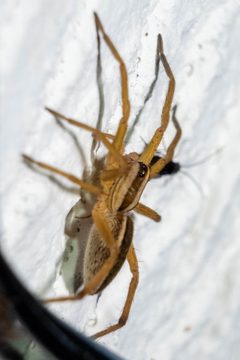
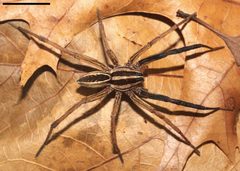
Rabidosa rabida is a large wolf spider (Lycosidae) native to eastern North America. Females reach approximately 25 mm in body length, males about half that size. The exhibits distinctive dark stripes on the and against a yellow background. It is an active hunter that does not build capture webs, instead pursuing or ambushing prey. The species has been observed to display cathemeral activity patterns and thermoconforming in field conditions.
Pronunciation
How to pronounce Rabidosa rabida: /ræˈbɪdəzə ˈræbɪdə/
These audio files are automatically generated. While they are not always 100% accurate, they are a good starting point.
Identification
Distinguished from Rabidosa punctulata by the absence of pale spots inside the margin of the abdominal stripe, and by male leg coloration: R. rabida males have mostly black front legs, while R. punctulata males have uniformly colored legs. The single dark abdominal stripe (vs. spots in R. punctulata) is visible on the upperside. Larger size than most sympatric wolf spiders. Erratic, rapid movement when disturbed.
Images
Appearance
Large, robust wolf spider with yellow base coloration. bears two dark longitudinal stripes. has a single central dark stripe of the same color. Eight arranged in three rows: four small eyes below, two large eyes, and two eyes above. Females average approximately 25 mm body length; males average approximately 12 mm. Males have front legs that are mostly black, a trait distinguishing them from the similar Rabidosa punctulata.
Habitat
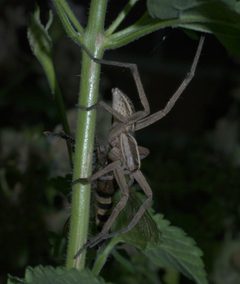
Occurs in cotton fields, wooded areas, and open with ground cover. Often found in holes, under debris, or in deep burrows covered by organic matter. Sometimes observed near ponds. In agricultural settings, has been documented climbing vegetation to heights of approximately one meter, possibly as avoidance .
Distribution
Native to North America. In the United States, occurs from Maine south to Florida and west to Texas and Oklahoma.
Seasonality
active during warmer months. Mating documented in studies during active season. Spiderlings carried on mother's back until .
Diet
Active of insects and other small arthropods. Prey seized with legs aided by sticky brushes of hairs. Prey items include various insects and small grasshoppers. May scavenge dead insects.
Life Cycle
Females construct sacs from silk attached to , carried for approximately one month. Spiderlings emerge and ride on mother's back until their next , approximately three weeks later, after which they disperse. Development from egg to maturity spans at least one year.
Behavior
hunter that ambushes or chases prey; sometimes camouflages itself as bark or leaves. Does not build capture webs but uses silk to wrap prey and protect sacs. Male performs courtship 'dance' with leg movements and produces sound through leg stridulation. Exhibits cathemeral activity pattern (both day and night activity) in some . Thermoconforming observed in field conditions rather than active . Rapid, erratic movement when disturbed. Bites if provoked but not medically significant.
Ecological Role
controlling insect . Serves as for parasitic mantidfly Climaciella brunnea, whose larvae board the spider and consume its . Prey for spider wasps (Pompilidae) including Anoplius .
Human Relevance
'rabid wolf spider' derives from rapid, erratic movement, not from any association with rabies. Bites are not dangerous to humans. Occasionally encountered in agricultural settings and around human structures. May be mistaken for more dangerous spiders due to large size.
Similar Taxa
- Rabidosa punctulataSimilar size and preference; distinguished by pale spots inside abdominal stripe margin and uniformly colored male legs
- Hogna speciesLarge sympatric wolf spiders; lack distinct striped pattern of R. rabida
Misconceptions
The 'rabid wolf spider' mistakenly suggests association with rabies; this is false—spiders cannot carry or transmit rabies. The name refers solely to the ' rapid, erratic movement pattern.
More Details
Thermal biology
Field observations indicate thermoconforming rather than active , with body temperatures closely tracking ambient conditions. Maximum observed temperatures approach published critical thermal maximum.
Predator avoidance
Documented climbing vegetation to escape spider wasp , a departure from typical ground-dwelling .
Sources and further reading
- BugGuide
- Wikipedia
- GBIF taxonomy match
- iNaturalist taxon
- NCBI Taxonomy
- Catalogue of Life
- Bug Eric: Spider Sunday: Dotted Wolf Spider
- Bug Eric: Wasp Mantisfly
- Bug Eric: Wasp Wednesday: Anoplius aethiops
- PESTICIDES AFFECT THE MATING BEHAVIOR OF RABIDOSA RABIDA (ARANEAE, LYCOSIDAE)
- Observations of undescribed diel activity in the wolf spider Rabidosa rabida show cathemeral behavior
- The effect of prior exposure to predator cues on chemically-mediated defensive behavior and survival in the wolf spider Rabidosa rabida (Araneae: Lycosidae)
- Field Observations of Body Temperature for the Wolf Spider,Rabidosa rabida(Araneae: Lycosidae), Differ From Reported Laboratory Temperature Preference Suggesting Thermoconforming Behavior
- Intraspecific Variation in the Thermal Biology of <I>Rabidosa rabida</I> (Araneae: Lycosidae) (Walckenaer) From the Mountains of Arkansas