
Schizocosa mccooki
(Montgomery, 1904)
McCook's Split Wolf Spider
Schizocosa mccooki is a large wolf spider in the Lycosidae, distributed across western North America from the Pacific coast to western Lake Erie. This inhabits diverse open including grasslands, chaparral, desert, and pinyon pine forests. Males produce complex vibratory courtship signals consisting of thumps and raps, with female mate choice influenced by male body mass and signal characteristics. Some have been observed digging burrows.
Pronunciation
How to pronounce Schizocosa mccooki: /ˌskɪzoʊˈkoʊsə məˈkʊki/
These audio files are automatically generated. While they are not always 100% accurate, they are a good starting point.
Identification
Distinguished from similar Schizocosa by size and geographic range. S. maxima is virtually indistinguishable morphologically but larger (males 16.1–20.3 mm, females 21–28.4 mm); recent phylogenomic work suggests S. maxima may be a junior synonym of S. mccooki, though formal taxonomic changes are pending. Pattern of pale band on and demarcated mark on aid identification within .
Images
Appearance
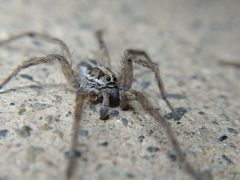
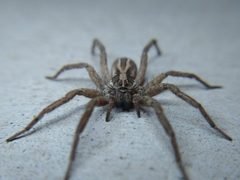
Large wolf spider with body length 9.1–15.5 mm in males and 9.6–22.7 mm in females. gray to light brown with pale band, black lateral bands, and pale submarginal bands sometimes extending to margins. dorsum with demarcated mark, dark transverse bars, and paired white spots; lateral areas mottled yellow, brown, and black with oblique black lines. Venter reddish-brown to dark orange, sometimes with extensive black areas under abdomen. Females have darker tipped forelegs.
Habitat
Open including grasslands, chaparral, desert, and pinyon pine forests. Some dig burrows.
Distribution
Western North America from Pacific coast to western Lake Erie; recorded from Canada, United States, and Mexico.
Seasonality
active in early spring; observed as adults or immatures.
Host Associations
- Climaciella brunnea - Mantispid larva boards spider, transfers to female during mating if spider is male, enters sac to feed on spider eggs
Life Cycle
Overwinters as or . Female carries sac attached to .
Behavior
Males perform vibratory courtship with two major signal components: thumps and raps. Heavier males tend to produce thumps with lower frequencies. Female mate choice based on male mass, overall courtship vigor, and thump duration. Some dig burrows.
Ecological Role
Prey for spider wasps including Anoplius aethiops. for mantispid Climaciella brunnea.
Similar Taxa
- Schizocosa maximaVirtually indistinguishable morphologically; differs primarily in larger size. Recent phylogenomic work suggests possible synonymy with S. mccooki.