
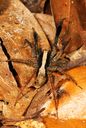
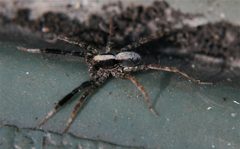
Schizocosa crassipes
(Walckenaer, 1837)
A wolf spider in the Lycosidae, found in the United States. Males perform complex involving visual signals and substrate vibration. The species exhibits an "edge effect" tendency to aggregate at forest-field interfaces. It has been documented as a for mantisfly larvae (Climaciella brunnea), which parasitize spider sacs.
Pronunciation
How to pronounce Schizocosa crassipes: /ˌskɪzoʊˈkoʊsə ˈkræsɪpɛz/
These audio files are automatically generated. While they are not always 100% accurate, they are a good starting point.
Images
Habitat
Edge at the interface between forest and field; occupies the between wooded areas and open fields
Distribution
United States; North America
Host Associations
- Climaciella brunnea - for mantisfly larvaelarvae enter female spider's sac and feed on eggs; recorded in Illinois
Behavior
Males engage in visual and vibratory to attract females, including leg waving and substrate drumming. Exhibits at edges (edge effect). Males display agonistic and dominance-subordinance relationships.
Sources and further reading
- BugGuide
- Wikipedia
- GBIF taxonomy match
- iNaturalist taxon
- NCBI Taxonomy
- Catalogue of Life
- Emily Bick: Salinity, the Water Hyacinth and a Weevil | Bug Squad
- Bee Assassin on Coneflower | Beetles In The Bush
- Bug Eric: Wasp Wednesday: Anoplius aethiops
- Bug Eric: Spider Sunday: Spring Spiders
- Bug Eric: Wasp Mantisfly
- Wolf Spider Sociobiology: Ii. Density Parameters Influencing Agonistic Behavior in Schizocosa Crassipes
- Behavioral Ecology of the “Edge Effect”in Schizocosa Crassipes (Araneae: Lycosidae)
- Wolf Spider Sociobiology: I. Agonistic Display and Dominance-Subordinance Relations in Adult Male Schizocosa Crassipes