
Schizocosa avida
(Walckenaer, 1837)
lance wolf spider
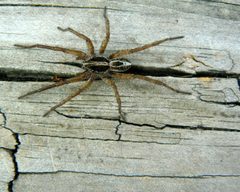
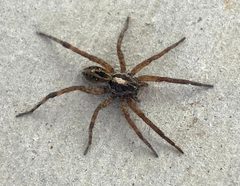
Schizocosa avida is a of wolf spider ( Lycosidae) native to North America. It is one of the most frequently observed Schizocosa species, with substantial iNaturalist documentation. The species is known to serve as a for the parasitic mantidfly Climaciella brunnea, whose larvae board female spiders and consume their sac contents. Like other wolf spiders, it is a ground-dwelling active hunter.
Pronunciation
How to pronounce Schizocosa avida: //ˌskɪtsəˈkoʊsə əˈvɪdə//
These audio files are automatically generated. While they are not always 100% accurate, they are a good starting point.
Identification
Schizocosa are characterized by distinctive striped patterns on the and a dark cardiac mark on the . S. avida specifically can be difficult to distinguish from congeneric species without close examination. Immatures bear color patterns that provide camouflage among grasses and seeds. The is distinguished from other Lycosidae by particular features of the male and female , requiring microscopic examination for definitive species-level identification.
Images
Habitat
Ground-dwelling in open areas including fields, meadows, prairies, and forest edges. Found on concrete paths, trails, and grassy substrates where its striped camouflage pattern is effective.
Distribution
North America. Documented from Canada (Manitoba, Ontario) throughout the United States. GBIF and iNaturalist records confirm presence across broad North American range.
Seasonality
active in early spring; observed on warm days in March even in temperate regions. Activity extends through warmer months. Overwinters as adults or immatures, with spring-emerging adults being among the most abundant early-season spiders in some .
Host Associations
- Climaciella brunnea - Mantidfly larvae board spiders, transfer to females during mating if initial is male, then enter sacs to feed on spider eggs. Documented as host in Illinois study (Redborg and Redborg, 2000).
Life Cycle
Females produce sacs carried attached to . Egg sacs are enclosed in silk; parasitic mantidfly larvae must enter before closure is complete. occurs as or immatures rather than within egg sacs.
Behavior
Active ground-dwelling hunter, not web-building. Uses speed and camouflage rather than ambush or trap . Basks on warm surfaces in early spring. When disturbed, seeks cover at trail edges or in vegetation.
Ecological Role
Predatory controlling insect . Serves as prey for spider wasps including Anoplius , and as obligate for parasitic mantidflies.
Human Relevance
Subject of citizen science documentation with nearly 5,000 iNaturalist observations. Serves as research organism for studies of - relationships and mimicry systems.
Similar Taxa
- Schizocosa ocreataCongeneric wolf spider with overlapping range; both documented as for parasitic insects and both exhibit striped patterns. Microscopic examination required for separation.
- Alopecosa speciesAnother early-spring active wolf spider with similar ground-dwelling habits and female sac carrying ; differs in color pattern and genital .
- Thanatus speciesRunning crab spider (Philodromidae) with superficially similar striped and dark cardiac mark; differs in leg proportions (extra-long first two pairs) and -level characters.