
Alopecosa
Simon, 1885
Fox Spiders
Species Guides
5- Alopecosa aculeata(Spinyrib Wolf Spider)
- Alopecosa exasperans
- Alopecosa hirtipes
- Alopecosa kochi(Koch's Wolf Spider)
- Alopecosa pictilis(Painted Wolf Spider)
Alopecosa is a of wolf spiders (Lycosidae) comprising approximately 160 . These ground-dwelling spiders are predominantly Eurasian in distribution, with some species extending into North Africa and North America. Most species reach up to 2 cm in body length. Females construct burrows for deposition and guard their egg sacs until hatching. The genus has been subject to taxonomic revision, with species historically grouped into complexes based on , though courtship and molecular techniques have proven more reliable for species delimitation.
Pronunciation
How to pronounce Alopecosa: /ˌæloʊpəˈkoʊsə/
These audio files are automatically generated. While they are not always 100% accurate, they are a good starting point.
Identification
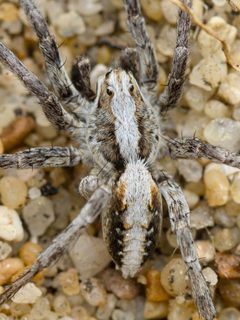
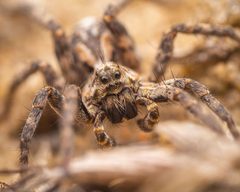
Alopecosa are small to medium-sized wolf spiders, most growing up to 2 cm. They possess the characteristic Lycosidae features: robust body, prominent in three rows, and spiny legs adapted for running. Many species exhibit longitudinal stripes on the and a dark cardiac mark on the . Species identification relies heavily on genitalic —epigyne structure in females and palpal in males—due to cryptic external similarity among closely related species. Courtship differences have proven diagnostic for distinguishing morphologically similar species.
Images
Habitat
occupy diverse terrestrial across their range. Alopecosa sulzeri is restricted to xerothermic grasslands. The generally favors dry climates. Specific habitat associations vary by species: some occur in arctic tundra (A. hirtipes), others in steppe zones, sand habitats (A. psammophila), or temperate grasslands. Many are ground-dwelling, seeking shelter in leaf litter, grass tussocks, or debris.
Distribution
Predominantly Eurasian, with the majority of native to Europe and Asia. Some species occur in North Africa. Disjunct in North America represent the northern Nearctic distribution of the albostriata species group (A. albostriata, A. mutabilis, A. exasperans). Alopecosa fabrilis is a critically endangered British rediscovered in southern England in 2020. A. sulzeri reaches its northern European limit in Poland.
Life Cycle
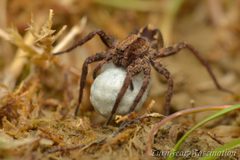
Females construct burrows in which they deposit sacs. The female remains in the burrow guarding the sac until the eggs hatch. In arctic , female mass and clutch size correlate with female body size. occurs as or immatures in leaf litter, grass tussocks, or other ground debris. Some temperate species are active in early spring, with adults emerging on warm days even in late winter.
Behavior
Females exhibit maternal care by guarding sacs in burrows. Courtship is -specific and has been used as a taxonomic character to distinguish cryptic species. Males may engage in mate guarding. Some species are winter-active, while others overwinter passively. When disturbed, individuals seek cover at vegetation edges or in debris.
Ecological Role
Ground-dwelling in terrestrial . As wolf spiders, they function as predators of small . Prey composition undocumented at level. One (A. aculeata) has been recorded as to insects (Acroceridae: Ogcodes; Ichneumonidae: Gelis).
Human Relevance
Alopecosa nagpag venom contains a bioactive (An1a/Av-LCTX-An1a) with demonstrated antiviral activity against virus serotype 2 and Zika virus by inhibiting viral NS2B-NS3 . This peptide represents a potential candidate for antiviral drug development. No other significant direct human interactions documented.
Similar Taxa
- PardosaBoth are ground-dwelling Lycosidae with similar body plans and preferences; Pardosa tend to be more cold-hardy and winter-active, with different arrangement proportions and epigyne structure
- SchizocosaSympatric wolf spider with superficially similar color pattern (striped , dark cardiac mark); distinguished by genitalic and body proportions
- MustelicosaMale palp in the A. albostriata group closely resembles Mustelicosa, to which this group may eventually be transferred; currently distinguished by geographic distribution and subtle genitalic differences
Sources and further reading
- BugGuide
- Wikipedia
- GBIF taxonomy match
- iNaturalist taxon
- NCBI Taxonomy
- Catalogue of Life
- Bug Eric: Spider Sunday: Spring Spiders
- Bug Eric: "Arach" is Back!
- Bug Eric: 2017
- Redescription of holotypes of four Alopecosa species (Araneae, Lycosidae) from China
- Redescription of Alopecosa albostriata (Araneae: Lycosidae) based on specimens from Siberia
- An Antiviral Peptide from Alopecosa nagpag Spider Targets NS2B–NS3 Protease of Flaviviruses
- DATA ON THE BIOLOGY OF ALOPECOSA PSAMMOPHILA BUCHAR 2001 (ARANEAE, LYCOSIDAE)
- Xerophilic Alopecosa sulzeri (Pavesi, 1873) (Araneae: Lycosidae)—a new wolf spider species in Poland
- On the synonymy of two wolf spider species of the genus Alopecosa (Araneae, Lycosidae) from the steppe zone of Russia
- Reproduction in two species of arctic arachnids, Pardosa glacialis and Alopecosa hirtipes
- Separation of two species standing as Alopecosa aculeata (Clerck) by morphological, behavioural and ecological characters, with remarks on related species in the pulverulenta group (Araneae, Lycosidae)