
Gladicosa gulosa
(Walckenaer, 1837)
Drumming Sword Wolf Spider
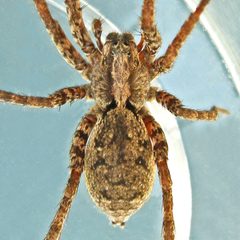
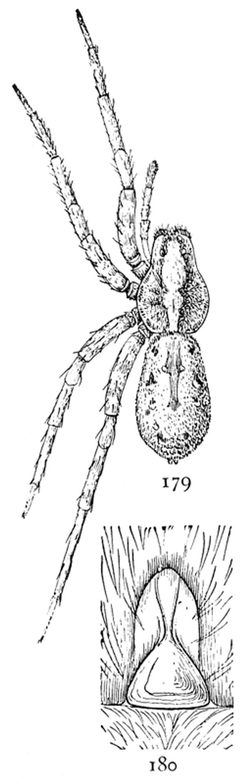
Gladicosa gulosa, commonly known as the Drumming Sword Wolf Spider, is a medium-sized wolf spider found in deciduous forests of eastern North America. Males of this produce distinctive substrate-borne vibratory signals described as "purring" or "drumming" during courtship. The species is , does not construct webs for prey capture, and has been documented as prey for multiple spider wasp species.
Pronunciation
How to pronounce Gladicosa gulosa: /ˌɡlædɪˈkoʊsə ɡjʊˈloʊsə/
These audio files are automatically generated. While they are not always 100% accurate, they are a good starting point.
Identification
Males can be distinguished from similar wolf spiders by their specialized courtship involving substrate-borne vibration production. The lacks web-building structures typical of orb-weaving spiders. Specific morphological characters distinguishing G. gulosa from and other lycosids require expert examination and are not documented in available sources.
Images
Habitat
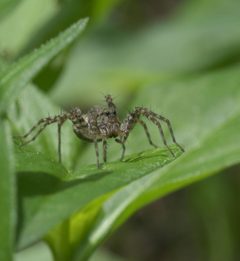
Found in Beech-Maple forests and other deciduous forest types. Occurs in multiple vertical strata including ground layer, herbaceous vegetation, and shrub layer. Has been observed active on snow-covered ground in winter conditions.
Distribution
North America: United States and Canada. Eastern North American distribution with records from Vermont and other eastern states.
Seasonality
Active year-round; observed on snow in mid-winter (mid-20s°F) and presumably active during warmer months. Specific seasonal activity patterns not well documented.
Life Cycle
Females carry in a spherical egg sac attached to the until hatching. Spiderlings may ride on the female's back after hatching until able to forage independently.
Behavior
; hides under leaves during daylight hours. Does not construct webs or permanent shelters. Males produce substrate-borne vibratory signals ("purring" or "drumming") as a primary component of courtship . Has been observed on snow surface in winter.
Similar Taxa
- Hogna spp.Large wolf spiders that overlap in and are also preyed upon by the same spider wasp (Anoplius aethiops); distinguished by lack of specialized vibratory courtship signals
- Schizocosa ocreataAnother wolf spider that shares and spider wasp ; S. ocreata males produce different types of seismic signals during courtship
- Rabidosa santritaOverlaps in and range; distinguished by behavioral and morphological differences not detailed in available sources
More Details
Predation by Spider Wasps
Documented as prey for at least two spider wasp : Anoplius aethiops (Pompilidae) and Priocnemis minorata (Pompilidae). paralyze the spider with venom and cache it in underground burrows as food for their larvae.
Research Significance
The has become a subject of and animal communication research due to its specialized male vibratory signaling. However, quantitative behavioral data remain limited and the species is considered understudied.
Sources and further reading
- BugGuide
- Wikipedia
- GBIF taxonomy match
- iNaturalist taxon
- NCBI Taxonomy
- Catalogue of Life
- Bug Eric: Priocnemis minorata
- Bug Eric: Wasp Wednesday: Anoplius aethiops
- Rockwoods Reservation, Lime Kiln Loop Trail | Beetles In The Bush
- Behaviors associated with mating success in the “purring” wolf spider Gladicosa gulosa