
Priocnemis minorata
Banks, 1912
spider wasp
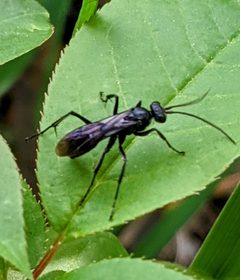
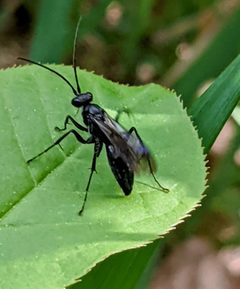
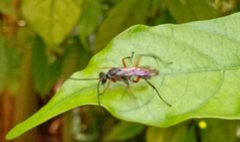
Priocnemis minorata is a medium-sized spider wasp in the Pompilidae. It is among the first pompilid to appear in spring, with peak activity in April and May. The species is known for hunting spiders in deciduous forest leaf litter, paralyzing them to provision underground nests for its larvae.
Pronunciation
How to pronounce Priocnemis minorata: //ˌpraɪ.əʊˈsnɛmɪs mɪˈnɔːrətə//
These audio files are automatically generated. While they are not always 100% accurate, they are a good starting point.
Identification
The serrated upper surface of the hind tibia distinguishes Priocnemis minorata from other black spider wasps. Look for medium-sized, shiny black with smoky or iridescent wings hunting in forest leaf litter during spring.
Images
Habitat
Deciduous forests with dappled sunlight through the tree ; hunts among leaf litter on the forest floor. Nests are constructed in soil with entrances hidden under dead, dry leaves.
Distribution
Most abundant in the eastern United States east of the 100th meridian. Additional records from the Pacific Northwest (southeast British Columbia, western Oregon) and eastern Canada (Nova Scotia, Quebec, Ontario, Vermont).
Seasonality
Active from late March to mid-June, with peak activity in April and May. emerge the following spring after as pupae.
Diet
of spiders. Known include in Amaurobiidae (Coras juvenilis, Wadotes calcaratus, Wadotes hybridus), Anyphaenidae (Hibana gracilis), Clubionidae (Clubiona obesa), Pisauridae (Dolomedes tenebrosus, Pisaurina mira), and Lycosidae (Trochosa terricola, Gladicosa gulosa, Arctosa rubicunda, Varacosa avara).
Host Associations
- Coras juvenilis - prey/paralyzed hacklemesh weaver, Amaurobiidae
- Wadotes calcaratus - prey/paralyzed hacklemesh weaver, Amaurobiidae
- Wadotes hybridus - prey/paralyzed hacklemesh weaver, Amaurobiidae
- Hibana gracilis - prey/paralyzed ghost spider, Anyphaenidae
- Clubiona obesa - prey/paralyzed sac spider, Clubionidae
- Dolomedes tenebrosus - prey/paralyzed fishing spider, Pisauridae
- Trochosa terricola - prey/paralyzed wolf spider, Lycosidae
- Gladicosa gulosa - prey/paralyzed wolf spider, Lycosidae
- Arctosa rubicunda - prey/paralyzed wolf spider, Lycosidae
- Varacosa avara - prey/paralyzed wolf spider, Lycosidae
- Pisaurina mira - prey/paralyzed nursery web spider, Pisauridae; individuals recorded as prey
- Thanatus sp. - prey/paralyzed running crab spider, Philodromidae; potential new record from video documentation
Life Cycle
The female digs a vertical or slightly angled burrow up to 27.5 cm deep, with the entrance hidden under dead leaves. One is constructed at the bottom, with up to six additional cells branching off progressively from the bottom up. Each cell contains one paralyzed spider stored on its side, with an laid on the spider's . The egg hatches in two days; the larva matures in about one week. The remainder of the year is spent as a pupa, with emerging the following spring.
Behavior
Females hunt actively among leaf litter, paralyzing spiders with a sting and transporting them to pre-constructed burrows. One specimen was observed persistently remaining in one location while transporting an nursery web spider, suggesting deliberate, methodical provisioning . Males have been observed in video documentation dispatching prey.
Ecological Role
of spiders, regulating spider in deciduous forest . Serves as an indicator of spring in temperate forests.
Similar Taxa
- Other black PompilidaePriocnemis minorata is distinguished by the serrated upper surface of the hind tibia, a character not shared with other black spider wasps in its range.
More Details
Spring indicator
In the eastern United States, this is often the first member of Pompilidae observed each year, making it a reliable indicator that spring has arrived in deciduous forests.
Nesting depth
The burrow depth of up to 27.5 cm is notably deep for a of this size, possibly providing protection from temperature fluctuations and .