
Trochosa terricola
Thorell, 1856
ground wolf spider
A medium-sized wolf spider (Lycosidae) widespread across Europe and extending into Asia and North America. range from 7–14 mm, with females larger than males. The occupies diverse terrestrial including grassland, heathland, and woodland, showing particular affinity for drier conditions. It is primarily and has been documented as prey for pompilid spider wasps.

Pronunciation
How to pronounce Trochosa terricola: /troʊˈkoʊsə ˌtɛrɪˈkoʊlə/
These audio files are automatically generated. While they are not always 100% accurate, they are a good starting point.
Identification
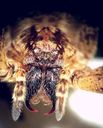
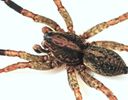
Distinguished from sympatric Pardosa wolf spiders by more sluggish movement. Separated from Trochosa ruricola by dark cardiac mark (light in T. ruricola) and of upland/drier (T. ruricola favors wetter lowland areas). The two short lines on the are characteristic of Trochosa .
Images
Habitat
Found in woodland, grassland, heathland, and industrial sites. Often encountered under stones and logs. Shows preference for drier, heath-like conditions but has been recorded in bog and marsh areas via pitfall trapping. Common in upland areas, unlike T. ruricola.
Distribution
Holarctic. In Europe: widespread throughout continent including Great Britain and Ireland, absent from Iceland. Extends east through Russia to Far East, Kazakhstan, Central Asia, China, Japan. Also present in North America.
Seasonality
recorded March to November, with peak activity spring to mid-summer. In warmer areas may be active year-round.
Host Associations
- Priocnemis perturbator - pompilid , recorded as of T. terricola
- Priocnemis minorata - pompilid , recorded as of T. terricola
- Anoplius viaticus - pompilid , recorded as of T. terricola
Life Cycle
extends over 2–3 years. Eight male and nine female instars determined. Mean 77.3 juveniles emerge from first sac, 38.0 from second sac. maximal in autumn after breeding.
Behavior
Primarily ; more sluggish than sympatric Pardosa wolf spiders. Juveniles . Adult males show diplochrone activity pattern.
Ecological Role
Ground-dwelling in grass heath and woodland . ranges 14.0–76.0 individuals per m². peaks in autumn at approximately 291 mg dry weight per m².
Similar Taxa
- Trochosa ruricolaSimilar appearance but has light cardiac mark versus dark in T. terricola; prefers wetter lowland and is less common in uplands
- Pardosa speciesSympatric and active in same but more agile and active hunters; T. terricola notably more sluggish